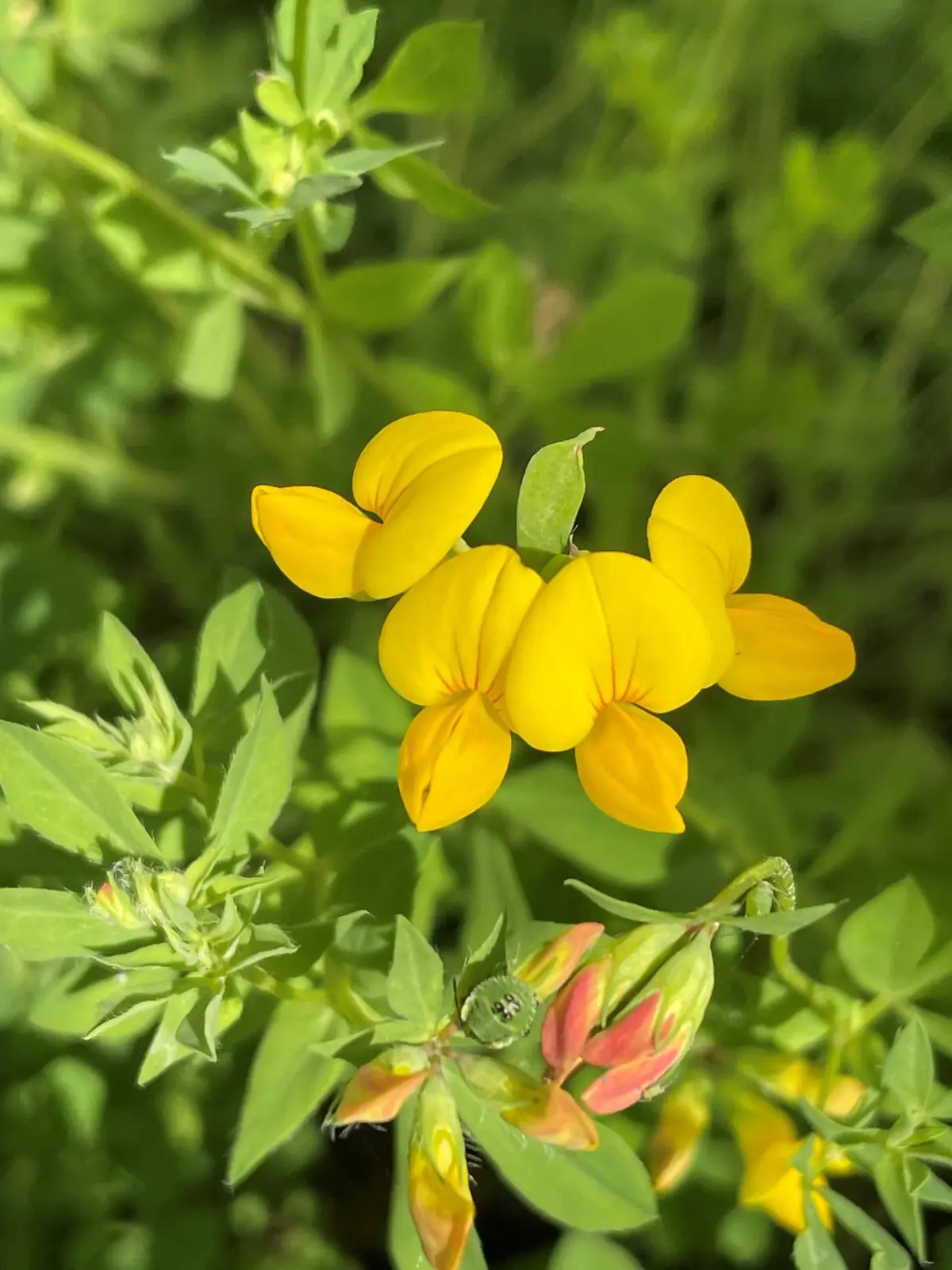
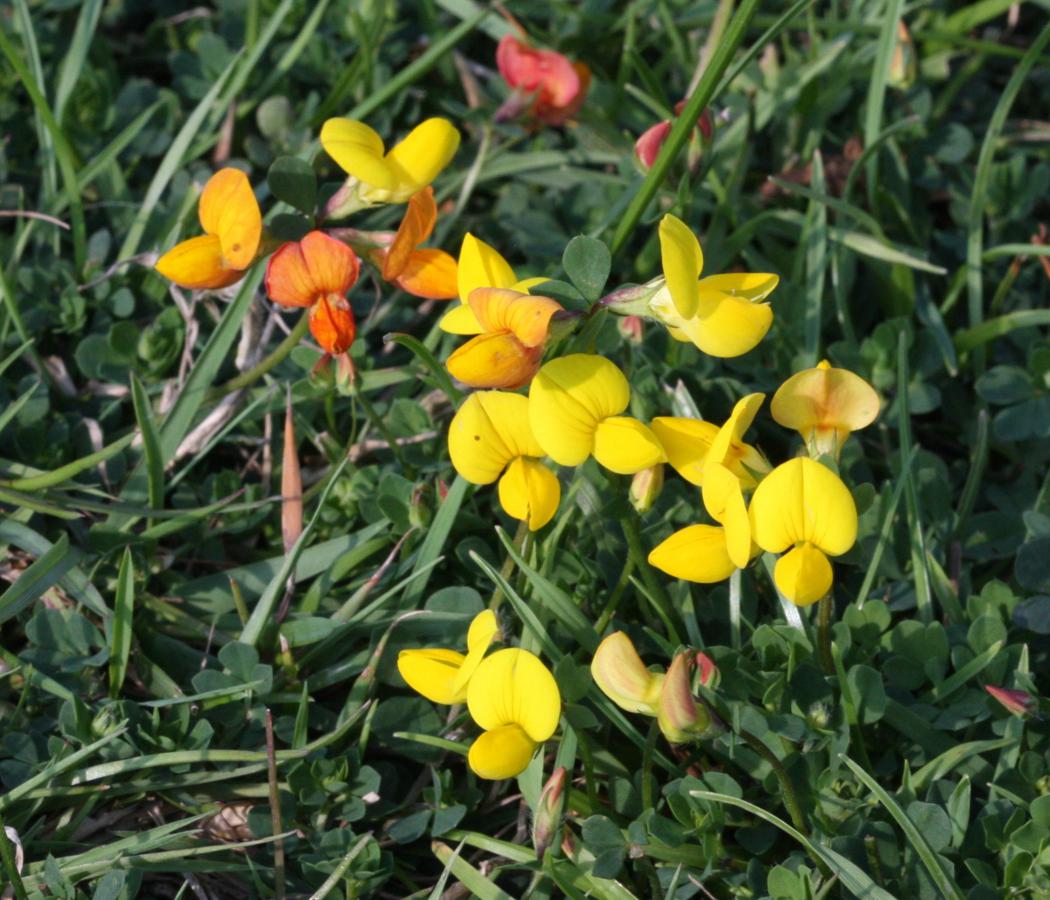
Common Bird’s-foot-trefoil is a low-growing perennial of meadows, grassland and roadside verges. Its clusters of rich yellow pea-shaped flowers are often touched with orange or red, giving rise to the old country name eggs and bacon.
It belongs to Fabaceae, the pea family, and is a particularly useful species for learning the typical pea-flower shape and the family’s characteristic pod fruit.
Identification
- Usually a low, spreading or ascending perennial, often forming loose patches.
- Bright yellow pea-shaped flowers, commonly tinged orange or red.
- Flowers usually occur in small clusters, often with several opening together.
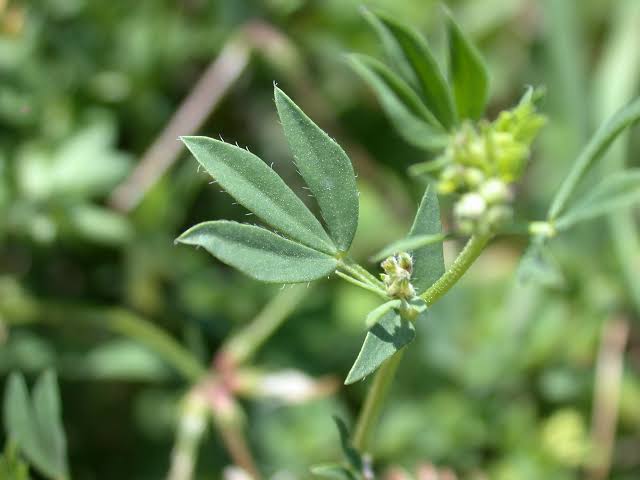
- Each leaf has five narrow oval leaflets.
- The lower pair of leaflets sit very close to the stem and resemble stipules, making the upper three especially conspicuous.
- There are no tendrils.
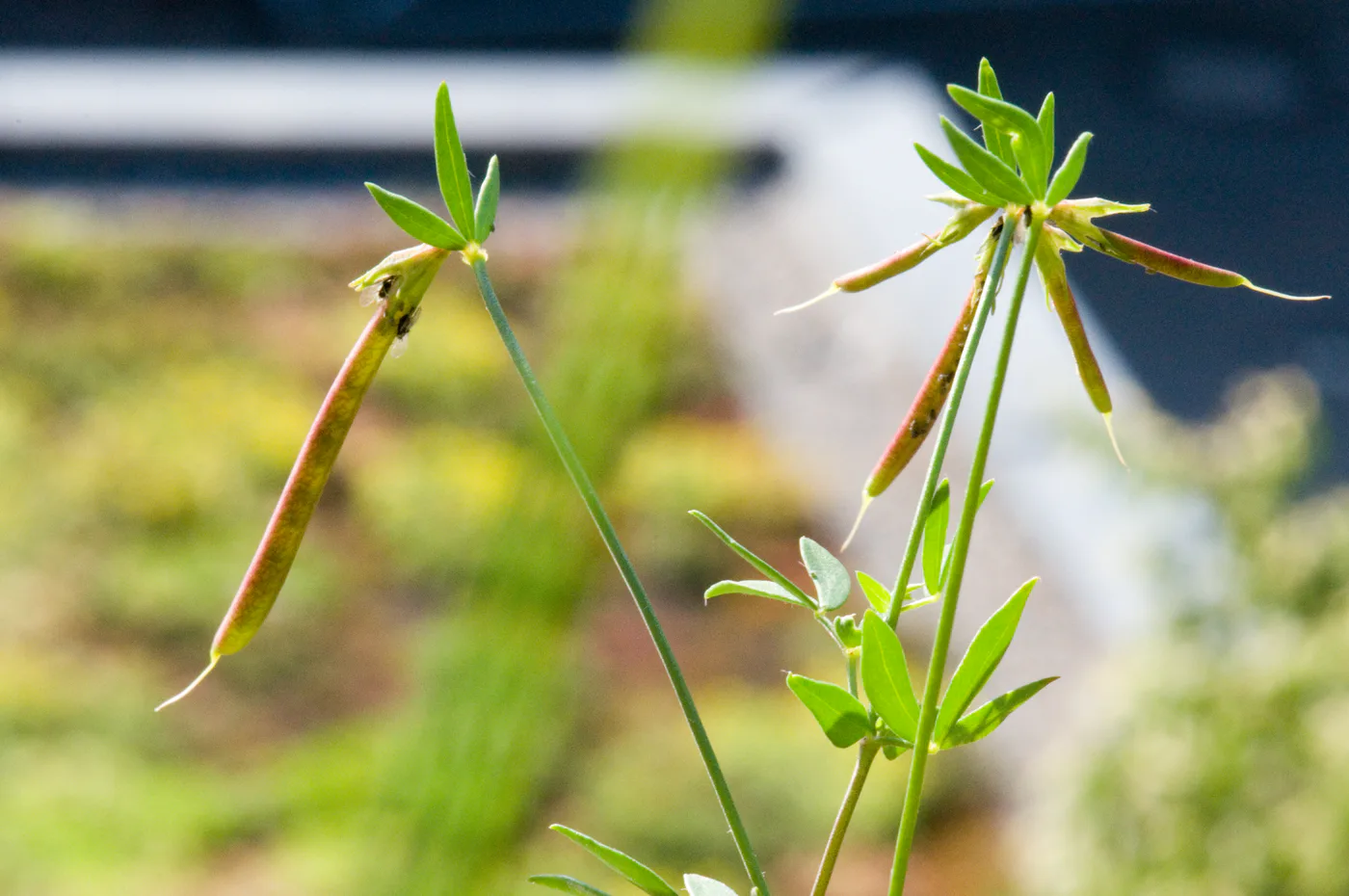
- The mature seed pods are straight and narrow and spread out from one point like the toes of a bird’s foot.
- Stems are usually solid rather than hollow.
A combination of yellow pea-shaped flowers, five leaflets and the distinctive radiating pods makes this one of the easier members of Fabaceae to recognise.
Flower structure
Each flower has the strongly two-sided form typical of many members of the pea family.
The five petals are arranged as:
Inside are ten stamens. In Lotus, nine of the stamen filaments are joined together and one remains free.
The single superior ovary is formed from one carpel and develops into the long pod after fertilisation.
Leaves and stems
The leaves are alternate and compound, with five leaflets.
Three leaflets are grouped at the end of a very short leaf axis, while the other two sit close to the stem. These lower two are true leaflets, although they resemble stipules. Because the terminal three are much more conspicuous, the leaf can look like a three-part or “trefoil” leaf.
The leaf close-up above is useful for seeing all five leaflets clearly: the upper three form the obvious trefoil, while the lower pair sit right beside the stem.
The stems may lie along the ground or rise slightly through surrounding vegetation. Typical plants have solid stems.
Seed pods
The developing fruits are long, narrow pods.
Several pods may radiate from one point, producing a shape reminiscent of a bird’s foot or claw. This is the feature behind both the name Bird’s-foot-trefoil and the old name Granny’s Toenails.
The pods darken as they mature and eventually split to release the seeds.
Habitat
Common Bird’s-foot-trefoil is widespread in open grassy places, particularly:
- meadows
- pastures
- roadside verges
- field margins
- banks
- coastal grassland
- other well-drained grassy habitats
It grows in a range of grassland types and is common throughout much of the UK.
Flowering period
The main flowering period is from May through the summer, often continuing into September.
The vivid yellow and orange-red flowers can make large patches conspicuous from some distance.
Similar species
- Greater Bird’s-foot-trefoil (Lotus pedunculatus) is usually taller and more luxuriant, favours damper ground and typically has hollow stems. It also tends to have broader, floppier-looking leaflets.
- Lesser Trefoil (Trifolium dubium) also has yellow flowers and can grow in similar grassy places, but its tiny flowers are packed into rounded clover-like heads and its leaves have three leaflets rather than five.
- Black Medick (Medicago lupulina) has small yellow flower heads and three-part leaves. Its fruits become dark, coiled pods rather than straight bird’s-foot-like pods.
Where the names come from
The name Bird’s-foot comes from the slender seed pods that spread like a bird’s toes. Trefoil means ‘three-leaved’ and refers to the three conspicuous leaflets at the tip of each leaf. Two more true leaflets grow near the base, giving the leaf five leaflets in total; these lower two can be mistaken for stipules.
Lotus is an ancient plant name that has been applied to more than one kind of plant. Corniculatus is Latin for ‘little-horned’, describing the narrow projecting seed pods.
Folklore & history
The orange-red colouring that often appears among the yellow flowers inspired the old name eggs and bacon. The orange-flowered photograph above shows this particularly well: yellow and orange occur together within the flower cluster, recalling the colours of egg yolk and fried bacon.
Another traditional name, Granny’s Toenails, refers to the claw-like appearance of the mature seed pods.
Plantlife records a rather darker Victorian association: in the language of flowers, Bird’s-foot-trefoil could symbolise revenge.
Wildlife
Bird’s-foot-trefoil is a valuable nectar plant for bees and other pollinating insects.
It is also an important caterpillar food plant. Plantlife records it as a larval food plant for butterflies including the Common Blue, Green Hairstreak and Dingy Skipper.
Its value to both pollinators and butterfly larvae makes it an important component of species-rich grassland.