Look into the flower
Most British bellflowers have a fused corolla opening into five pointed lobes. Look for the central style, which often ends in three spreading stigma lobes.
The bellflower family
Plant family guide
Clustered Bellflower (Campanula glomerata) is a native perennial of chalk and limestone grassland. Its close-packed purple flowers show how a group of individual bells can form a single rounded head.
The Campanulaceae includes bellflowers, harebells, rampions and related plants. Many British members are easy to recognise by their blue or violet flowers, although both flower shape and growth habit vary widely.
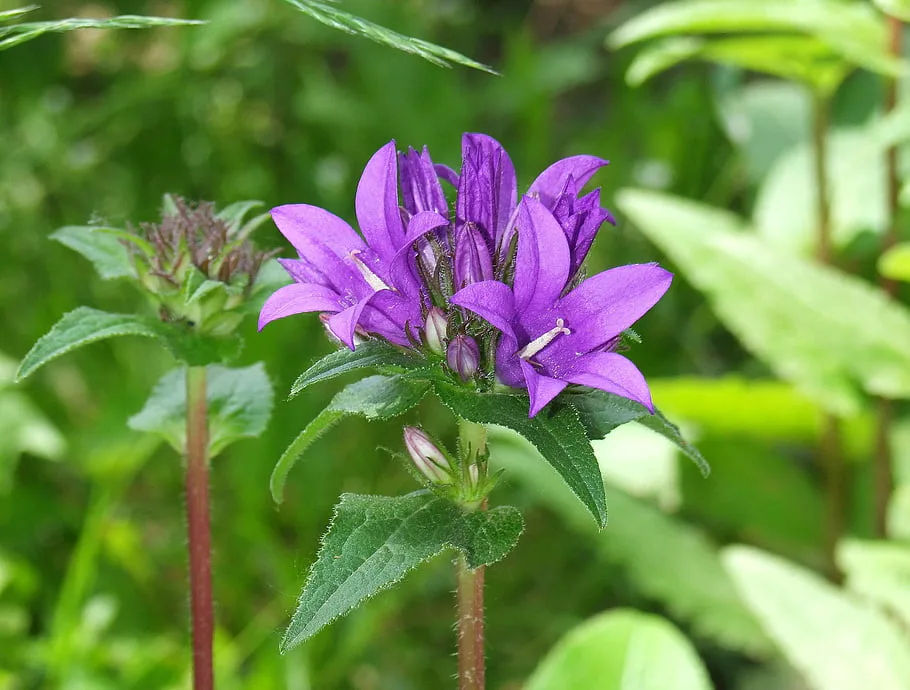
Most British bellflowers have a fused corolla opening into five pointed lobes. Look for the central style, which often ends in three spreading stigma lobes.
Clustered Bellflower crowds its blooms into heads, Harebell holds them on fine stems, and taller woodland bellflowers carry them along leafy shoots.
Alternate leaves are typical. Their shape helps separate species: Clustered Bellflower has broad lower leaves, while Harebell has very slender upper ones.
Despite the family name, not all Campanulaceae have the same open bell-shaped flower. Some forms flare into almost star-shaped lobes; others form tubes or densely packed heads. The plant's stems, leaves and seed capsules are useful for distinguishing them.
Bellflowers also have an intriguing method of presenting pollen. In many species, pollen is brushed onto hairs on the style before the flower becomes receptive. This helps insects collect pollen as they visit, while the stigma lobes open later.
Explore the individual flower pages for more photographs and identification details.