Opposite leaves
Leaves usually grow in opposite pairs. They are simple, with an undivided blade, and the stem joints may be swollen. Red Campion has softly hairy leaves and stems.
The pink family
Plant family guide
The bright flowers of Red Campion make a useful introduction to Caryophyllaceae. Look for pairs of leaves along the stem, five notched petals and a tube of sepals enclosing the flower base.
Known as the pink family, Caryophyllaceae also includes chickweeds, stitchworts and the garden pinks. Most are herbaceous plants. Flower colour alone is not a reliable family clue: many members have white flowers.
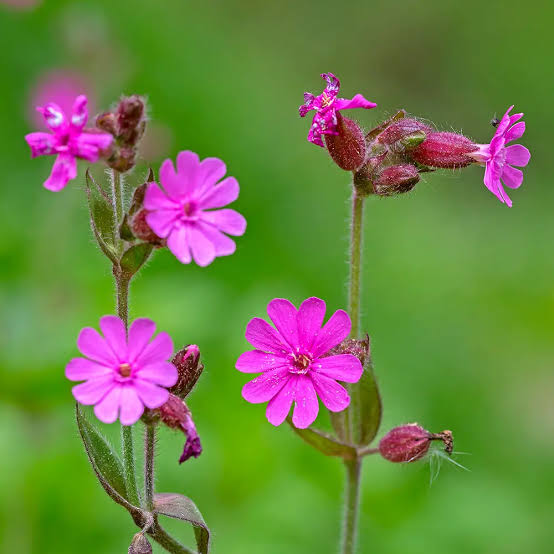
Leaves usually grow in opposite pairs. They are simple, with an undivided blade, and the stem joints may be swollen. Red Campion has softly hairy leaves and stems.
Flowers commonly have five petals, often with notched or divided tips. Red Campion's notches can make five petals look like ten. Not every family member follows this pattern; some have four petals or none.
The calyx is made from the sepals. In campions they join into a tube around the narrow bases of the petals. Elsewhere in the family the sepals can be separate.
Primrose and Red Campion both show five notched parts around the flower edge, but they belong to different families. Primrose's petals join into a corolla tube; Red Campion has separate petals held within its tubular calyx.
Check the whole plant too. Primrose has a basal rosette of wrinkled leaves, while Red Campion carries opposite leaves up its stems. Use several features together when deciding which family a plant belongs to.
Explore the individual flower pages for more photographs and identification details.
The photograph is also used on the Red Campion page.