Two types of leaves
Climbing shoots often bear three- to five-lobed leaves. The older branches that flower usually carry pointed oval or diamond-shaped leaves instead.
The ivy family
Plant family guide
Common Ivy (Hedera helix) is the most familiar British member of Araliaceae. Its evergreen climbing stems and glossy leaves make it easy to recognise, but look closely in autumn and you will find the family's small, five-parted flowers gathered into rounded umbels.
Araliaceae also includes the related Atlantic Ivy (Hedera hibernica) and plants from other parts of the world such as Japanese Aralia (Fatsia japonica) and ginseng (Panax). Across this varied family, members are often woody plants with comparatively small flowers.
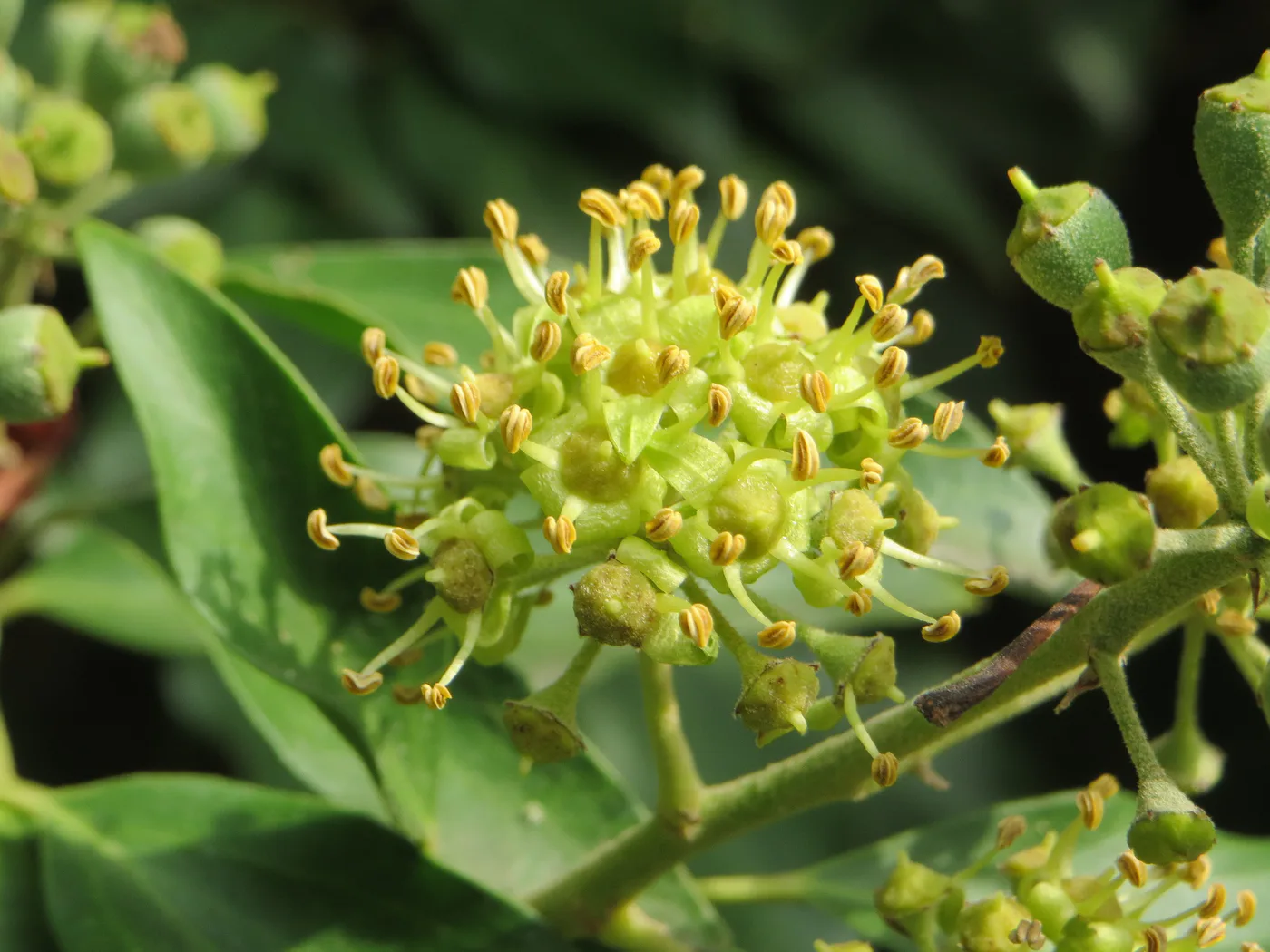
Climbing shoots often bear three- to five-lobed leaves. The older branches that flower usually carry pointed oval or diamond-shaped leaves instead.
Look for rounded clusters of yellow-green flowers on mature shoots in September, October and November, often busy with insects.
Each flower cluster may produce a group of rounded fruits, which change from green to dark blue-black and are eaten by birds.
See the full Common Ivy identification guide for photographs, leaf shapes, berries and folklore.
Araliaceae and Apiaceae, the carrot family, are related and both can have flowers arranged in umbels. But many familiar Apiaceae are soft-stemmed herbs with finely divided leaves, whereas Ivy is a woody, evergreen climber with leathery leaves and fleshy fruits.
Explore the individual flower pages for more photographs and identification details.