Plant family guide

Start with Pyramidal Orchid

Pyramidal Orchid (Anacamptis pyramidalis) is a striking British member of Orchidaceae. Its dense pink flower spike, narrow leaves and individually specialised flowers provide a useful introduction to the family.

British orchids vary greatly in size, colour and habitat, but their flowers share a characteristic plan that becomes much easier to recognise once you know what to look for.
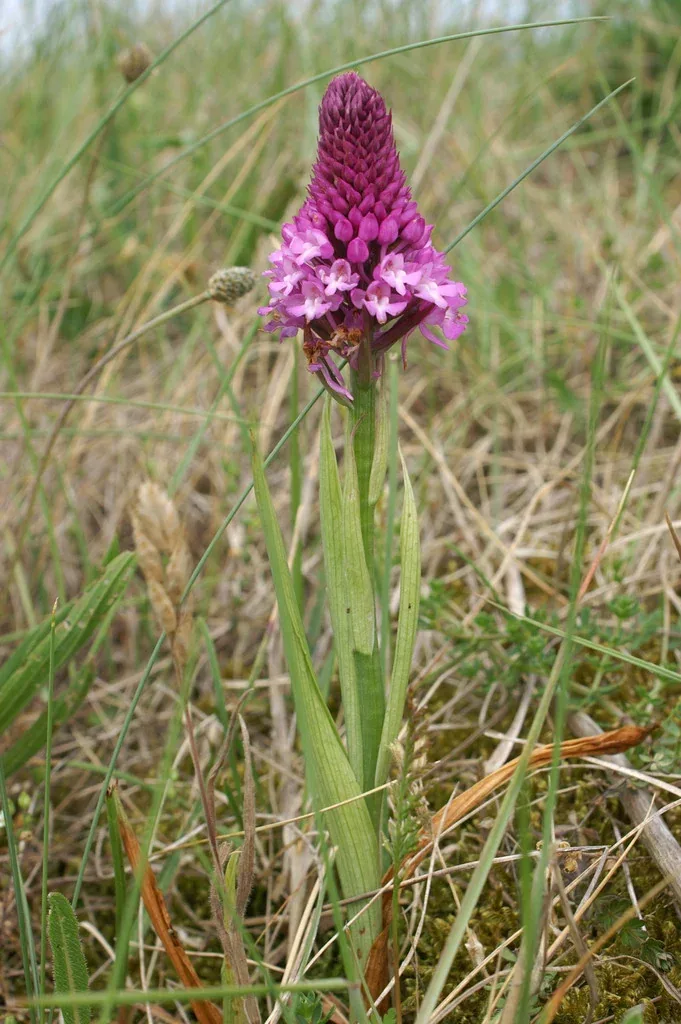
Pyramidal Orchid with a dense pink flower spike and narrow leaves
Pyramidal Orchid (Anacamptis pyramidalis): a British orchid with a dense pink flower spike and long, narrow leaves.

Key family attributes

  • Flower parts: orchid flowers typically have three sepals and three petals, although the parts can be highly modified and may look very different from one another.
  • Labellum: one petal is modified into a prominent lower lip called the labellum. It often acts as a landing platform for pollinating insects.
  • Column: the male and female reproductive structures are fused into a central structure called the column.
  • Pollen: in many orchids the pollen is carried in compact masses called pollinia rather than as loose grains.
  • Ovary: the ovary is inferior, sitting below the other flower parts. In many species it twists as the flower develops, turning the lip into its familiar lower position.
  • Seeds and fungi: orchid seeds are extremely small and contain little food reserve. Germination depends on a relationship with suitable mycorrhizal fungi.

Features to look for in the field

Find the lip

Look for the enlarged or differently shaped lower petal. Its shape, markings and lobes are often among the best clues to the species.

Look into the centre

Instead of separate obvious stamens and styles, orchids have a compact central column carrying their reproductive structures.

Check leaves and habitat

Leaf shape, spotting, stem leaves and habitat are important because several British orchids can have superficially similar flower spikes.

Look closely at Pyramidal Orchid

  • Flower spike: densely packed and distinctly pyramidal when young, becoming more cylindrical as it matures.
  • Lip: broad and clearly divided into three lobes.
  • Spur: each flower has a long, slender spur projecting backwards.
  • Leaves: long, narrow and pointed, with upper leaves clasping or sheathing the stem.

Other British members to compare

Once you recognise the orchid flower plan, compare Pyramidal Orchid with Bee Orchid (Ophrys apifera), Early-purple Orchid (Orchis mascula), Common Spotted-orchid (Dactylorhiza fuchsii) and Fragrant-orchids (Gymnadenia species).

The shape of the labellum, the presence or absence of leaf spots, the form of the spur and the overall flower spike are particularly useful features.

Orchidaceae flowers in this guide

Explore the individual flower pages for more photographs and identification details.
← Back to plant families