Yellow, two-lipped flowers
The upper lip forms a little hood, sometimes tipped with violet teeth. The flower sits within a conspicuous green calyx.
The broomrape family
Plant family guide
Yellow Rattle (Rhinanthus minor) provides a particularly interesting introduction to the broomrape family. It has yellow, two-lipped flowers above toothed, opposite leaves, and its inflated calyces become dry, rattling seed heads.
Many members of Orobanchaceae obtain some or all of their resources from other plants through root connections. Some, such as Yellow Rattle, remain green and photosynthesise; others, including many broomrapes, lack green foliage and depend much more heavily on their hosts.
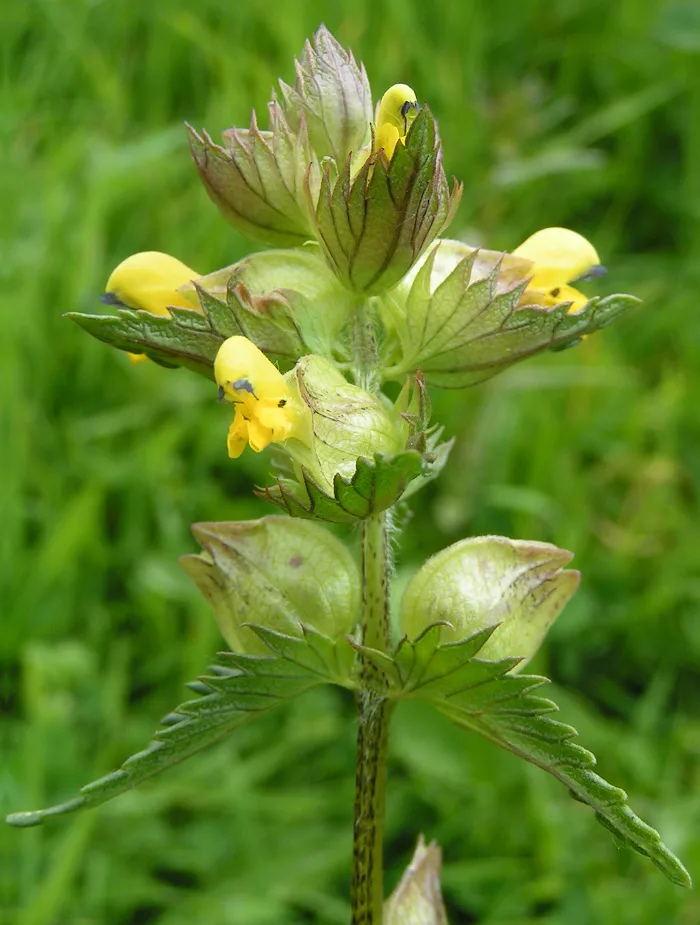
The upper lip forms a little hood, sometimes tipped with violet teeth. The flower sits within a conspicuous green calyx.
Leaves arise in pairs along the upright stem. Around the flowers, the toothed bracts are often especially prominent.
The calyx swells around a seed capsule, then turns brown and papery. Loose seeds rattle when it is shaken.
Eyebrights (Euphrasia species) are small green hemiparasites with white or pale flowers often marked with purple and yellow. Red Bartsia (Odontites vernus) has small pinkish flowers and also draws resources from other plants.
Broomrapes (Orobanche species) look very different: their often brownish or purplish flowering stems have scale-like leaves instead of ordinary green foliage. The family is a good example of why plants can be related even when their outward appearances differ dramatically.
Older floras sometimes place Yellow Rattle in the figwort family, Scrophulariaceae. Modern classifications place it in Orobanchaceae.
Explore the individual flower pages for more photographs and identification details.