Plant family guide

Start with Hedge Bindweed

Hedge Bindweed (Calystegia sepium) is a widespread native climber with large white trumpets, arrow-shaped leaves and stems that wind through hedges and riverside vegetation.

Convolvulaceae includes bindweeds and morning glories. Many species are twining climbers, although some trail across the ground and others are not climbers at all.
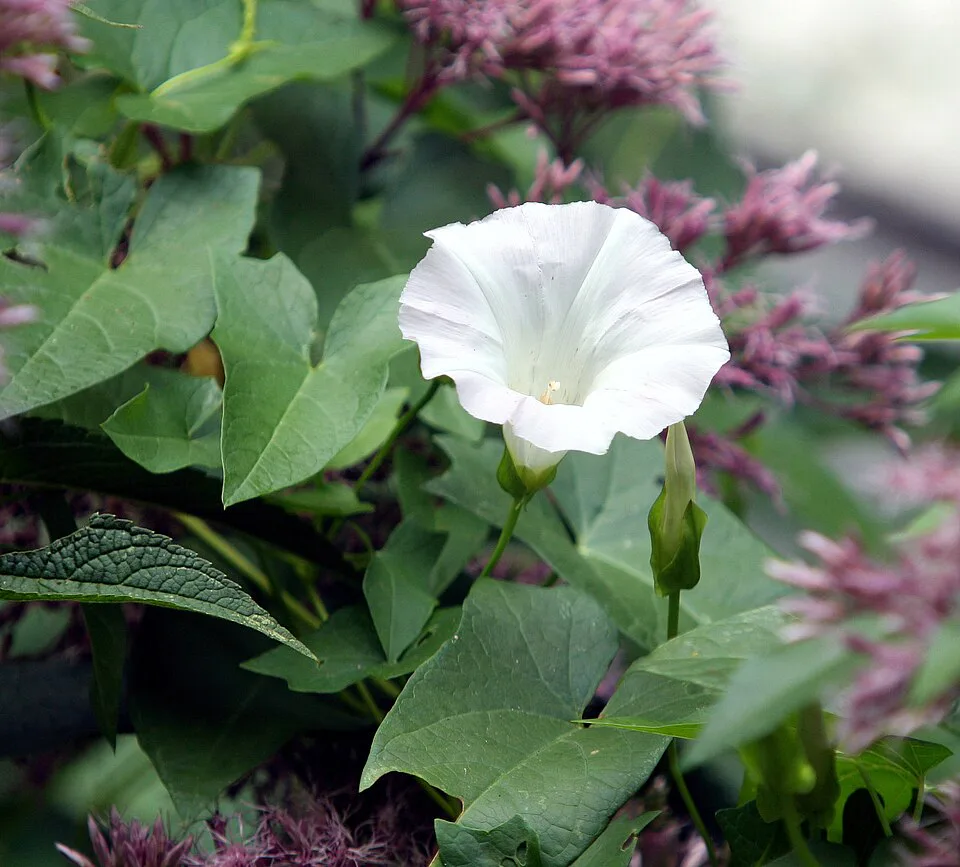
Large white Hedge Bindweed flower among green arrow-shaped leaves
Hedge Bindweed (Calystegia sepium) with its broad white funnel-shaped flower and arrow-shaped leaves.

Key family attributes

  • Flower: commonly a broad, funnel-shaped corolla made from five fused petals.
  • Stamens: usually five, attached inside the corolla tube.
  • Female parts: a single style, often with a divided stigma, above a superior ovary.
  • Leaves: usually simple, often alternate, with arrow-shaped or heart-shaped outlines in familiar bindweeds.
  • Stems: many climb by twining around supporting vegetation.
  • Fruit: commonly a capsule containing a few seeds.

What to look for in Hedge Bindweed

A white trumpet

The five petals are joined into a single broad funnel. Look inside for the stamens and the two-lobed stigma.

Arrow-shaped leaves

Each leaf has a pointed tip and two backward-facing lobes at its base.

Bracteoles below the flower

Two green bracteoles surround the base. In Hedge Bindweed they overlap little, leaving the sepals visible between them.

Comparing familiar bindweeds

  • Hedge Bindweed: white flowers usually 3–7 cm across, broad arrow-shaped leaves and bracteoles that scarcely overlap.
  • Large Bindweed: generally larger white trumpets and broad, overlapping bracteoles that hide the sepals.
  • Field Bindweed: smaller white or pink flowers; two small bracts farther down the flower stalk.
  • Sea Bindweed: a low-growing coastal plant with fleshy, kidney-shaped leaves and pink flowers.

Climbing and spreading

Hedge Bindweed grows upwards by winding its stems around nearby plants, while underground rhizomes allow it to spread sideways and produce fresh shoots. This combination explains why it can form extensive tangles in hedgerows and rough ground.

Convolvulaceae flowers in this guide

Explore the individual flower pages for more photographs and identification details.

← Back to plant families