Five-part flowers
Flowers in this family usually have five sepals and five petals. The petals are commonly joined at their bases; together they form the corolla. In Primrose, the green calyx surrounds the base of the flower tube.
The primrose family: primroses, cowslips and oxlips
Plant family guide
The pale yellow flowers of Primrose are a familiar sign of spring. Look closely at one bloom: its five petals join at the base to form a tube, then spread into five broad, notched lobes.
Primrose, Cowslip and Oxlip are all members of the genus Primula, within Primulaceae. The family also includes loosestrifes in the genus Lysimachia and cyclamens, so its members can look quite different.
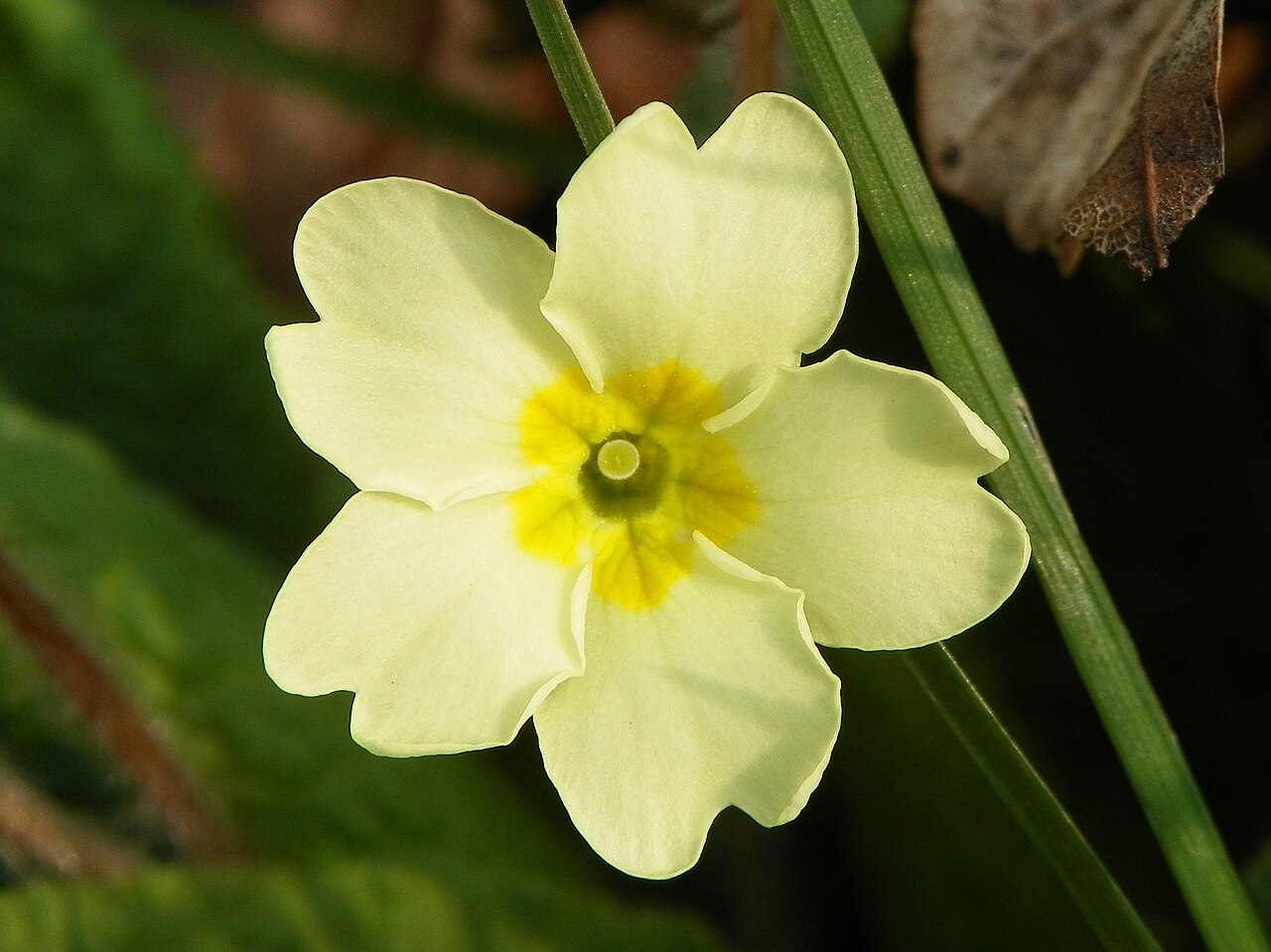
Flowers in this family usually have five sepals and five petals. The petals are commonly joined at their bases; together they form the corolla. In Primrose, the green calyx surrounds the base of the flower tube.
There are usually five stamens, positioned opposite the petal lobes. They attach to the corolla and may be tucked inside its tube, so a hand lens can help.
Primrose has wrinkled leaves in a basal rosette. This helps identify Primula, but is not a rule for the whole family: other members can carry their leaves along upright stems.
These relatives share a similar leaf rosette. The arrangement and shape of their flowers offer useful clues.
Usually pale yellow, open-faced flowers. Each flower rises on its own stalk from the base of the plant.
Smaller, deeper yellow, cup-shaped flowers hang together in a cluster at the top of a shared stalk.
Pale yellow flowers form a cluster on a taller stalk, often facing towards one side.
Garden plants and hybrids can blur these differences. Compare flower arrangement, leaves and habitat as well as colour.
Primrose has two flower forms. A pin flower has a long style, with its rounded stigma near the opening and anthers lower down. A thrum flower has a short style and anthers near the opening. These matching heights help insects transfer pollen between the two forms.
Try comparing flowers on different plants without picking them. Can you spot the rounded stigma or the ring of anthers at the entrance?
Explore the species below for identification details, photographs, habitats and flowering months.