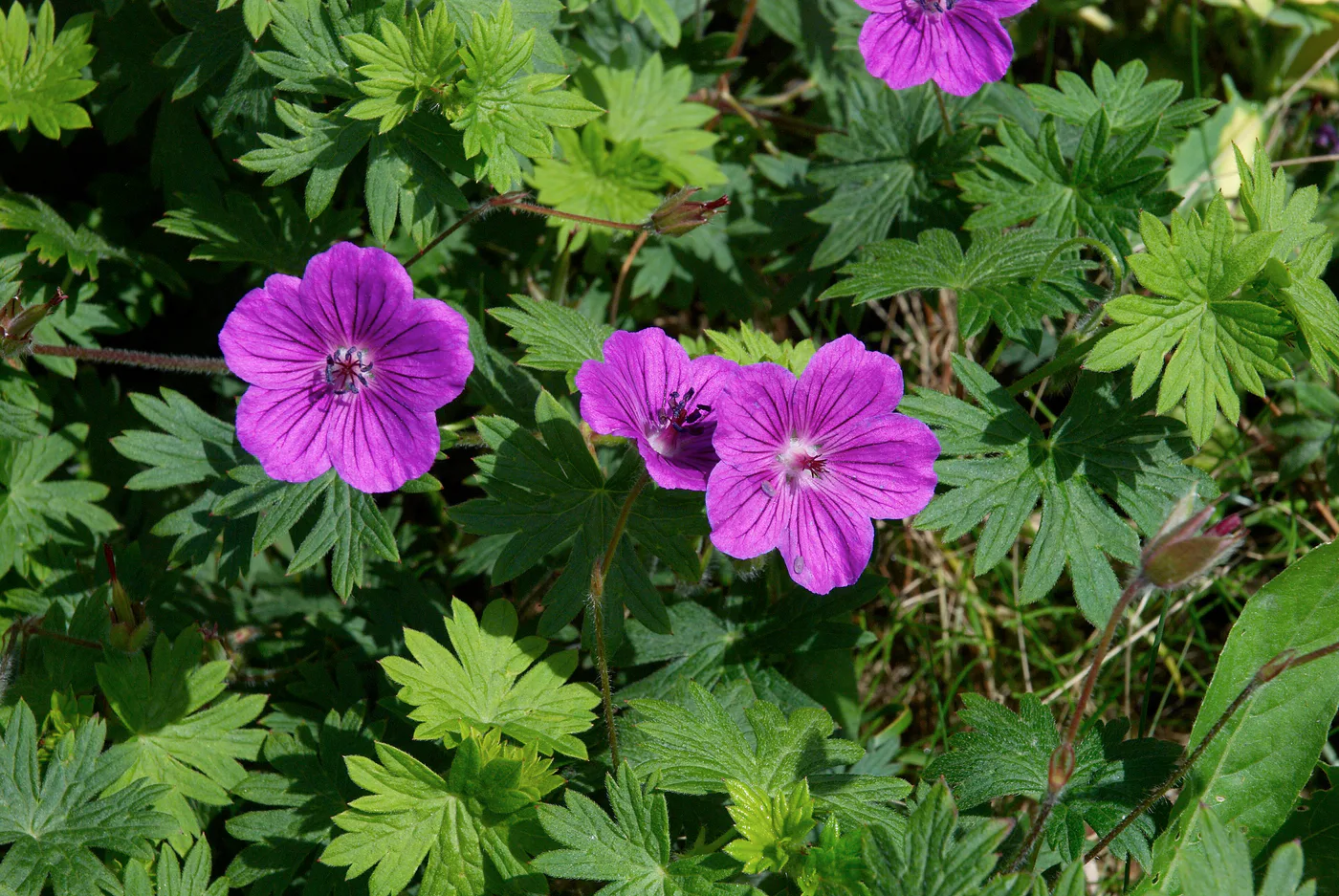
Finely divided leaves
The leaves are deeply cut into several main divisions, each further lobed. They can look rather like miniature fern fronds.
The cranesbill family
Plant family guide
Herb-robert (Geranium robertianum) is a familiar member of the cranesbill family. Look for its finely divided leaves, pink five-petalled flowers and the long, pointed fruits that give cranesbills their name.
Bloody Crane's-bill (Geranium sanguineum) has much larger magenta flowers and finely cut, finger-like leaf divisions. Other British members include Meadow Crane's-bill and Dove's-foot Crane's-bill; their flowers and leaves vary, but they share the characteristic cranesbill fruits.
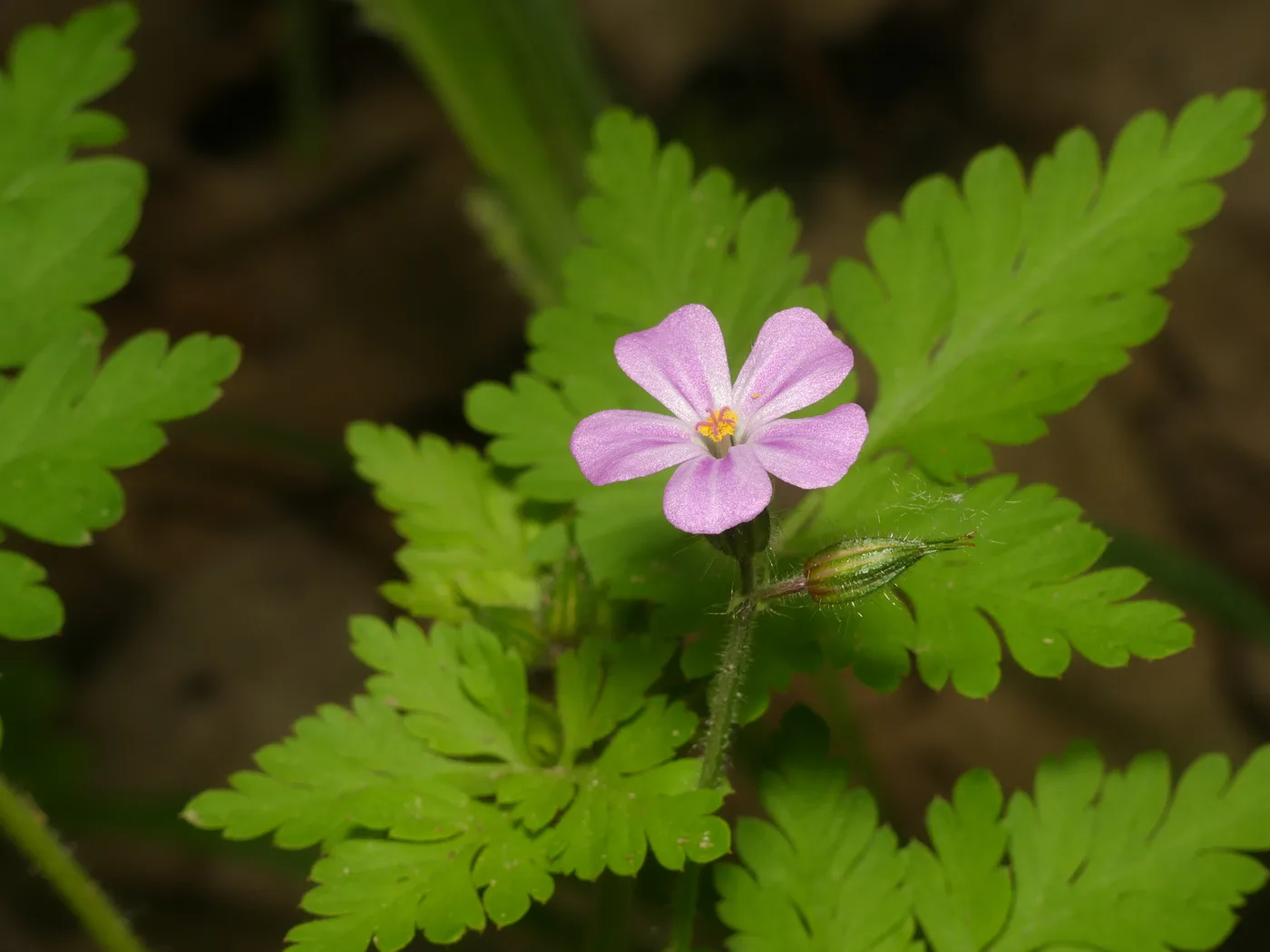
The leaves are deeply cut into several main divisions, each further lobed. They can look rather like miniature fern fronds.
Five pink petals, often with paler veins, surround a cluster of stamens. Flowers are commonly carried singly or in pairs on slender stalks.
After flowering, a narrow beak forms above the developing seeds. At maturity, parts of the fruit spring upwards and scatter the seeds.
Bloody Crane's-bill (Geranium sanguineum) has large magenta flowers and narrow, deeply divided leaves. Meadow Crane's-bill (Geranium pratense) bears blue-violet flowers, while Dove's-foot Crane's-bill (Geranium molle) has small pink flowers above rounded, softly hairy leaves. Storksbills (Erodium) also belong to Geraniaceae, though their fruit-distribution mechanism differs in detail from that of the true cranesbills.
Other wildflowers can also have five pink petals. To recognise Geraniaceae, look at the combination of petal number, leaf shape, stamens and especially the distinctive five-parted, beaked fruit. Fruit structure often provides the most reliable family clue.
Explore the individual flower pages for more photographs and identification details.