Look at the flower head
What appears to be one flower is usually a tightly packed head of separate florets. A hand lens helps you see them.
The daisy family: daisies, dandelions, knapweeds and thistles
Plant family guide
A daisy looks like one flower. Look closely and it becomes a crowd: a single head made up of many tiny flowers called florets. This is the clue that links daisies, dandelions, knapweeds and thistles.
The flower head is called a capitulum. Its florets can take different forms, so members of the family do not all look like a familiar white-and-yellow daisy.
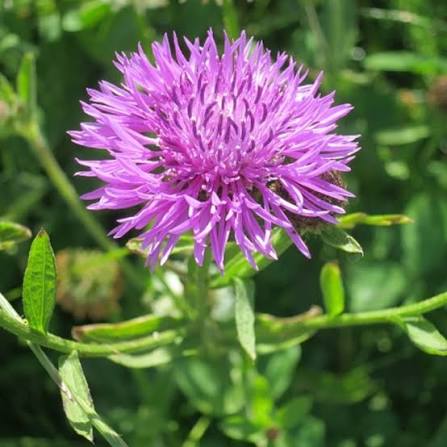
What appears to be one flower is usually a tightly packed head of separate florets. A hand lens helps you see them.
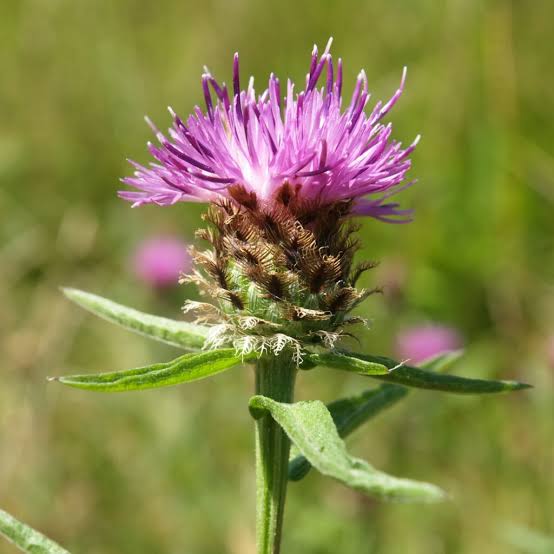
Leaf-like bracts surround the base of the head. Their shape and edges can help distinguish similar species, especially knapweeds and thistles.
Each fertile floret can make a small, dry, one-seeded fruit. Some fruits have a tuft of hairs called a pappus, as in a dandelion clock; others lack a showy tuft.
Leaves vary greatly across this large family. Check them when identifying a species, but start with the flower head when deciding on the family.
Florets can be strap-shaped or tubular. Compare these familiar wildflowers to see how much the pattern can change.
Outer rays + central discs
White ray florets form the outer ring; small yellow disc florets fill the centre.
Strap-shaped throughout
The yellow head consists of strap-shaped florets throughout. There is no central disc.
Mostly tubular
Their heads are built mainly from tubular florets. Some knapweeds have enlarged outer florets, so look closely.
Large white-and-yellow heads on upright stems. Look for it in meadows, other grassland and roadside verges. Turn a head over to see its green bracts.
Yellow heads rise above a rosette of toothed leaves. Later, the fruits form a rounded, feathery clock. Other members of the family also have yellow heads, so use more than the flower colour to identify one.
Pinkish-purple florets emerge from a firm, dark head. The overlapping bracts have dark, fringed tips, a useful field clue.