Plant family guide

Start with Lords-and-ladies

Lords-and-ladies (Arum maculatum) is the familiar native British example of Araceae. Its pale green hood, dark club-shaped centre and later spike of orange-red berries make the family structure particularly easy to study.

The apparent 'flower' is really an inflorescence: many tiny flowers are crowded on a fleshy central spike called a spadix, surrounded by a modified leaf called a spathe.
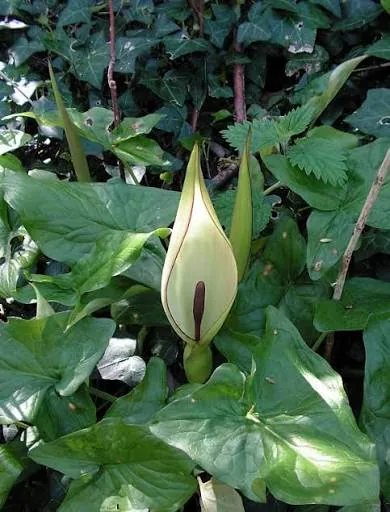
Lords-and-ladies with a pale green spathe surrounding a dark central spadix
Lords-and-ladies (Arum maculatum): the pale green spathe surrounds the projecting upper part of the spadix.

Key family attributes

  • Inflorescence: numerous tiny flowers are crowded onto a fleshy central spadix.
  • Spathe: the spadix is associated with a large modified leaf called a spathe, which may form a hood or sheath around it.
  • True flowers: the individual flowers can be extremely small and may lack the obvious petals and sepals expected in a typical wildflower.
  • Leaves: leaves are often broad and arise from the base or from underground stems. In Lords-and-ladies they are glossy and arrow-shaped.
  • Fruit: after pollination, individual flowers can develop into fleshy berries packed closely along the old spadix.
  • Chemistry: many members contain irritating calcium oxalate crystals, so unfamiliar arum-family plants should not be tasted.

Features to look for in the field

Find the spadix

Look for the fleshy central spike. In Lords-and-ladies its upper portion is conspicuous, while the tiny true flowers are hidden lower down.

Look at the spathe

The pale green hood around the spadix is not a petal. It is a modified leaf and is one of the family's most characteristic structures.

Return later for the berries

After the spring leaves and spathe fade, Lords-and-ladies produces a striking upright column of orange-red berries.

Look closely at Lords-and-ladies

  • Leaves: glossy and arrow-shaped, sometimes with dark spots but often completely unspotted.
  • Spathe: pale green, enclosing the lower part of the flower structure like a hood.
  • Spadix: the exposed upper part is club-shaped and usually purple-brown or yellowish.
  • Berries: later in the year the fruits ripen from green through orange to vivid orange-red.

Other members to compare

Italian Arum (Arum italicum) is commonly grown in gardens and can occur as an escape. Its leaves are often strongly marked with pale veins, giving them a conspicuously marbled appearance.

Both species show the characteristic arum-family combination of a spadix and surrounding spathe.

Araceae flowers in this guide

Explore the individual flower pages for more photographs and identification details.

← Back to plant families