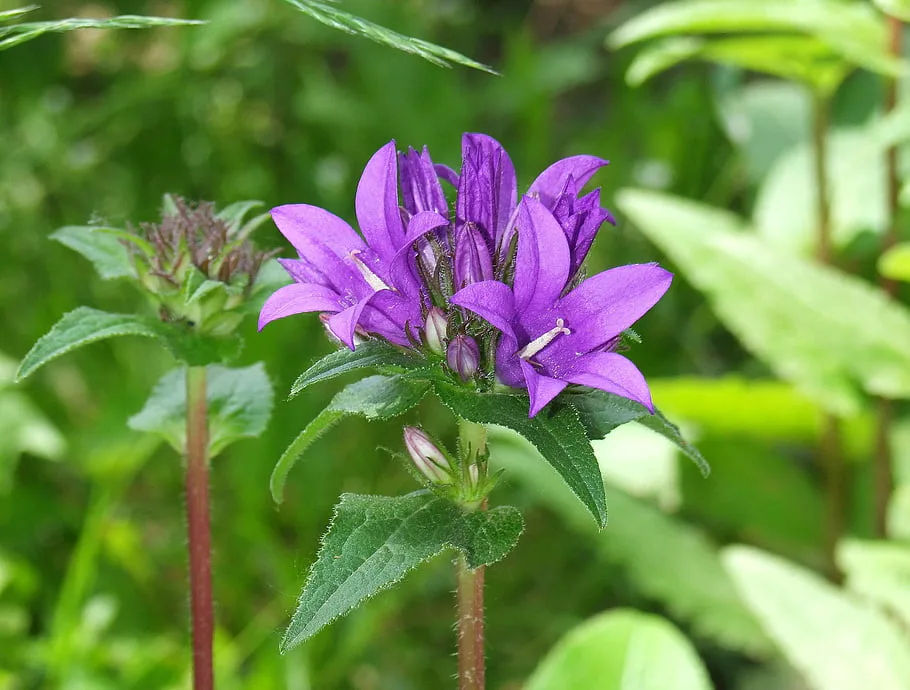
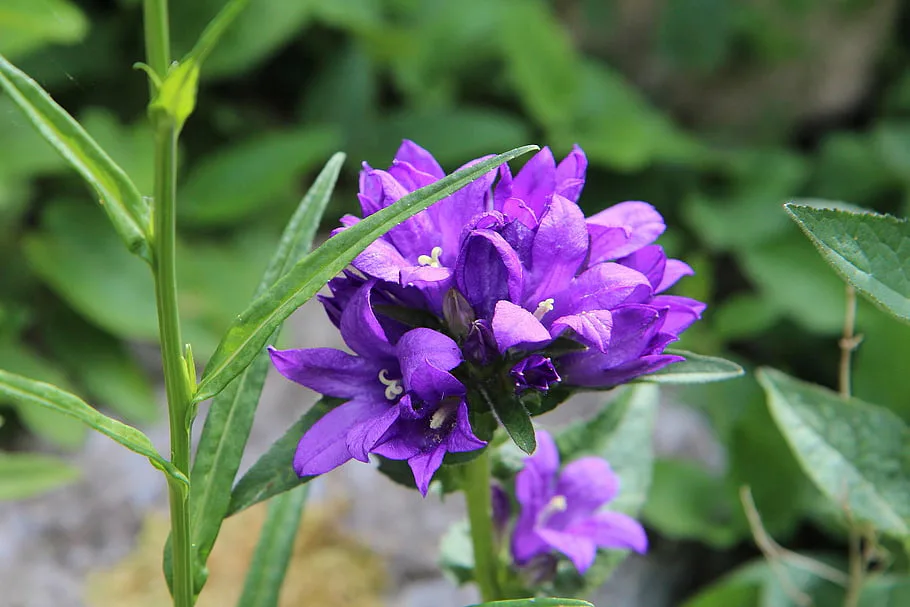
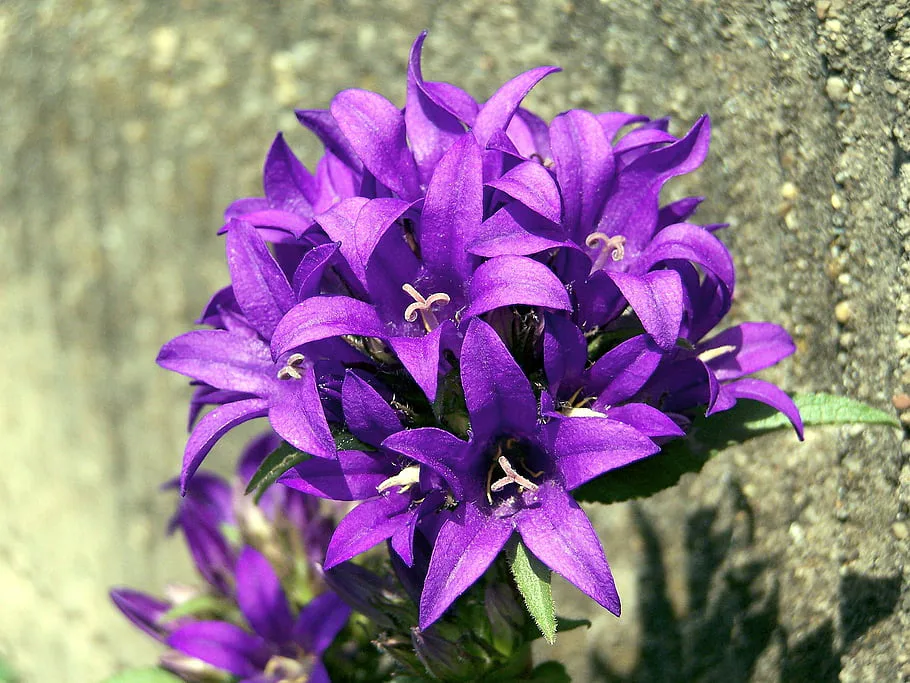
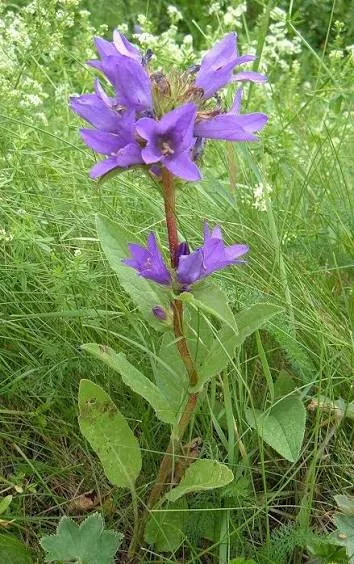
Clustered Bellflower is one of the most striking native flowers of old chalk and limestone grassland. Its rich violet-blue bells are crowded into a rounded cluster at the top of an upright stem, often with smaller groups of flowers tucked into the upper leaf joints. At a glance the head can look like one large flower, but it consists of numerous separate bells pressed closely together.
It belongs to the bellflower family (Campanulaceae). The plant is a perennial, returning from its underground rhizomes each year. Its densely packed flower heads make it quite different from the delicate, dangling bells of Harebell.
Identification
- An upright perennial usually 20–60 cm high, with one or several stems growing from a leafy clump.
- Deep violet-blue to purple flowers, each a short, upright or outward-facing bell with five pointed, spreading lobes; occasional white-flowered plants also occur.
- Several bells packed together at the stem tip into a dense, almost rounded cluster, with smaller groups sometimes arising from the upper leaf axils.
- A lower rosette of relatively broad, stalked leaves, while leaves farther up the stem are smaller and less stalked.
- Stem leaves are generally alternate, oval to lance-shaped, and often have distinctly toothed margins.
- Stems and leaves can feel rough or softly hairy, especially towards the base and along the leaf edges.
- After flowering, the clusters become conspicuous withered heads, eventually producing small seed capsules.
The best feature is the tightly grouped flowers. Unlike Harebell or Giant Bellflower, Clustered Bellflower does not normally have separate bells dangling on long slender stalks.
Flower structure
Each apparent bell is a complete individual flower. Its five petals are fused into a tubular, bell-shaped corolla, opening into five triangular lobes. The green calyx beneath it ends in five narrow sepals. Several flowers may be at different stages of opening in the same cluster, so pointed buds sit alongside fully spread purple bells.
Inside the corolla are five stamens and a central style ending in a usually three-lobed stigma. In bellflowers, the anthers release pollen onto tiny hairs on the growing style. This temporary pollen-covered brush can transfer pollen to visiting insects even before the stigma’s lobes open and become receptive. Look for the pale, curled stigma lobes in a fully open flower.
The ovary lies beneath the flower’s main parts. After pollination, it matures into a dry capsule containing numerous tiny seeds. Despite the head-like appearance of the cluster, these are individual flowers, not the tiny florets that make up a daisy’s flower head.
Leaves and stems
The leaves change noticeably from the base of the plant to the flowering head. Near the ground, they form a loose rosette of broad, oval to heart-shaped leaves, often with a distinctly heart-shaped base. These lower leaves have long stalks and shallowly toothed or scalloped margins, with a pointed tip and a clearly visible network of veins.
Further up the upright stem, the leaves become progressively smaller, narrower and more pointed. The lower stem leaves still have short stalks, but the upper ones are nearly sessile (without a leaf stalk) and may partly clasp the stem. Their edges are finely toothed, and the surface and margins may feel slightly rough from short hairs. The stem leaves are alternate, not in opposite pairs. The uppermost leaves sometimes sit just below, or alongside, the smaller clusters of flowers.
The stem is usually fairly stiff and upright, and may feel a little rough. The plant can spread by short underground rhizomes, forming small patches where the grass is not too vigorous. Although the leaves are useful clues, the distinctive dense cluster of violet-blue bells is the most reliable feature for distinguishing Clustered Bellflower from other bellflowers.
Habitat
Clustered Bellflower favours sunny grassland on lime-rich soils, particularly unimproved chalk and limestone turf, dry grassy slopes, old meadows and well-managed verges. It can also grow on open woodland edges and grassy banks, where competing vegetation is not too dense.
In the UK, its native populations are associated especially with southern and eastern England and patches of suitable calcareous grassland elsewhere. Because it is also a popular garden perennial, plants beside houses or on recently disturbed sites may be cultivated forms or escapes rather than remnants of ancient wildflower grassland.
Its loss from many former sites reflects how old, species-rich grasslands have been ploughed, fertilised, scrubbed over or otherwise altered. A wild patch is worth appreciating as part of a broader grassland community, often alongside plants such as Common Rock-rose and Rough Hawkbit.
Flowering period
Clustered Bellflower flowers mainly from June to August, sometimes continuing into September. Early summer usually brings the fullest display. Individual bells in the head do not all open at once, so one cluster can contain fresh flowers, unopened buds and fading blooms together.
Similar species
- Harebell (Campanula rotundifolia) has slender stems and delicate, usually nodding bells borne separately or in loose groups. Its upper leaves are exceptionally narrow, and it lacks the packed, upright flower heads of Clustered Bellflower.
- Nettle-leaved Bellflower (Campanula trachelium) is often taller, with coarse nettle-like leaves and larger blue-purple bells spaced along an elongated flowering stem rather than collected into a single dense terminal head.
- Giant Bellflower (Campanula latifolia) has larger, often drooping flowers distributed along a tall leafy stem, typically in damper woodland and shady places.
- Peach-leaved Bellflower (Campanula persicifolia) has broad, open bells carried singly or in loose clusters on a slender stem with much narrower, less conspicuously toothed leaves. It is often encountered as a garden escape.
- Round-headed Rampion (Phyteuma orbiculare) can also have a rounded head of violet-blue flowers in chalk grassland, but its tiny individual flowers are narrow and claw-like rather than broad, open bells. It too belongs to Campanulaceae.
Where the names come from
The common name is almost a literal translation of the Latin. Campanula is the diminutive of Latin campana, a bell, and means “little bell”. The name fits the five-lobed flowers, which begin as narrow bells and open into more starry, flared shapes. Glomerata comes from Latin glomeratus, meaning gathered together or clustered, referring to the tight groups of flowers at the stem tips. Linnaeus published the name Campanula glomerata in 1753.
An older English name is Dane’s-blood (sometimes written Danes’-blood), recorded particularly in Cambridgeshire. The name links this plant with stories of battles against the Danes, in which flowers were said to spring from the blood of fallen warriors. The same name, and similar legends, became attached to several unrelated plants in different regions; it was not exclusive to Clustered Bellflower.
In Welsh, one name is clychlys clwstwr, which likewise evokes the clustered bells. The common name neatly separates this species from other bellflowers whose flowers hang more loosely along the stem.
Folklore & history
The Dane’s-blood story belongs to a wider tradition in which unusually coloured plants were believed to mark old battlefields. In Cambridgeshire, Clustered Bellflower became one of the flowers associated with the blood of Danes killed in battle. Similar stories were told of Pasque Flower and Dwarf Elder in other counties. Such tales helped give familiar wild plants a place in local history, even when the battles themselves could no longer be traced.
Clustered Bellflower also appears in the literary world of the nineteenth-century Northamptonshire poet John Clare (1793–1864). His notes about a bellflower growing on hilly ground have been identified by later botanical commentators as this species. The association is fitting: a flower of open, old-fashioned grassland would have been familiar in the landscapes Clare described, but such habitat has since greatly diminished.
More recently, Clustered Bellflower was chosen as Rutland’s county flower in a Plantlife initiative celebrating local wildflowers. It remains a favourite of cottage and wildlife gardens, where both the native species and more vigorous cultivated varieties are grown for their striking summer clusters. In the wild, a stand among the grasses is a reminder of the special plants that survive in old unimproved meadows.
Wildlife
The violet flowers provide pollen and nectar for bees and other flower-visiting insects. Bumblebees and some solitary bees are well suited to visiting bellflowers, brushing against the central style and reproductive parts as they move between the bells. The open flowers can also be visited by hoverflies and other insects.
A patch of Clustered Bellflower can add another nectar source to a species-rich chalk grassland, especially where different wildflowers take turns to bloom across the summer. Maintaining open, lightly managed grassland without excessive fertiliser helps both the plant and the wider community of insects that uses it.