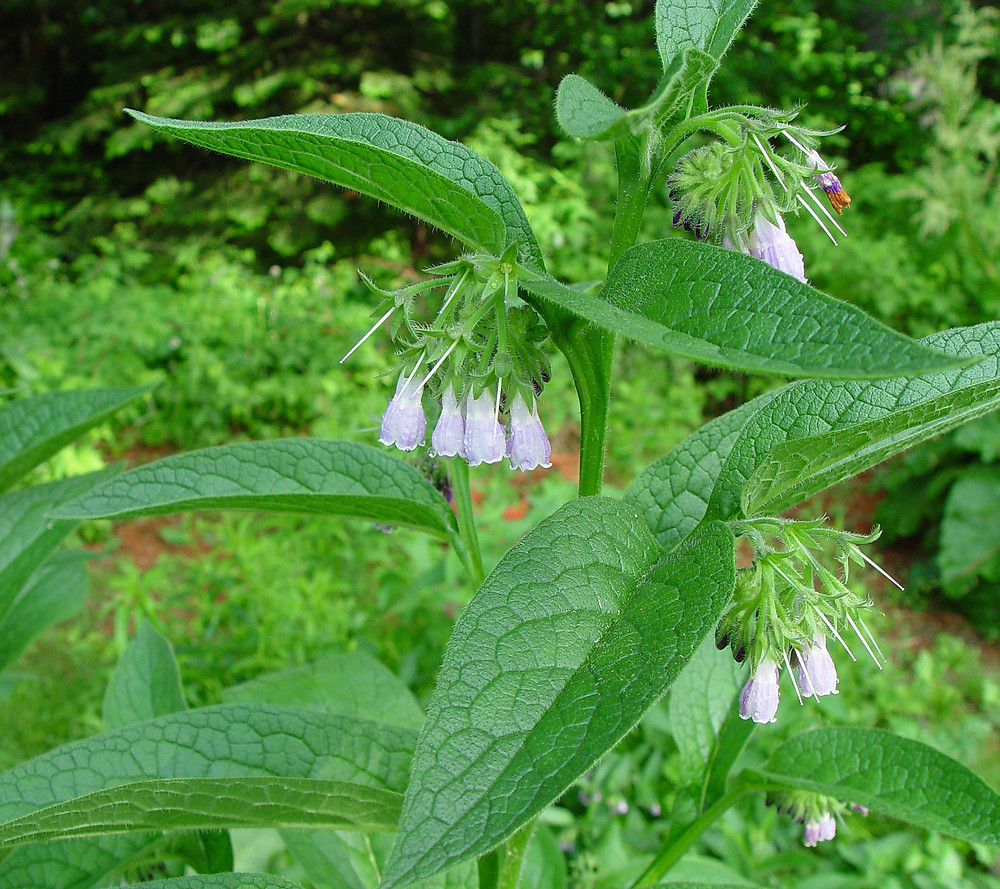
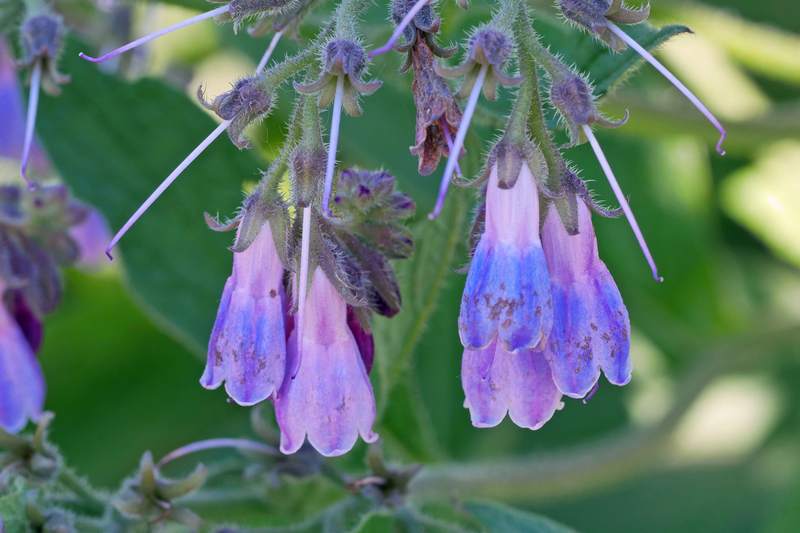
Common Comfrey is a robust perennial of damp ground, often found beside streams, ditches and wet meadows. Its nodding, bell-shaped flowers may be purple, pinkish or creamy white, hanging in curled clusters above large, rough leaves. It belongs to the borage family, Boraginaceae.
Identification
- A tall, sturdy perennial, often 50–120 cm high, with bristly stems and leaves.
- Clusters of tubular, bell-shaped flowers that droop downwards, commonly violet-purple but variable in colour.
- Flower clusters begin tightly coiled and gradually uncurl as the flowers open.
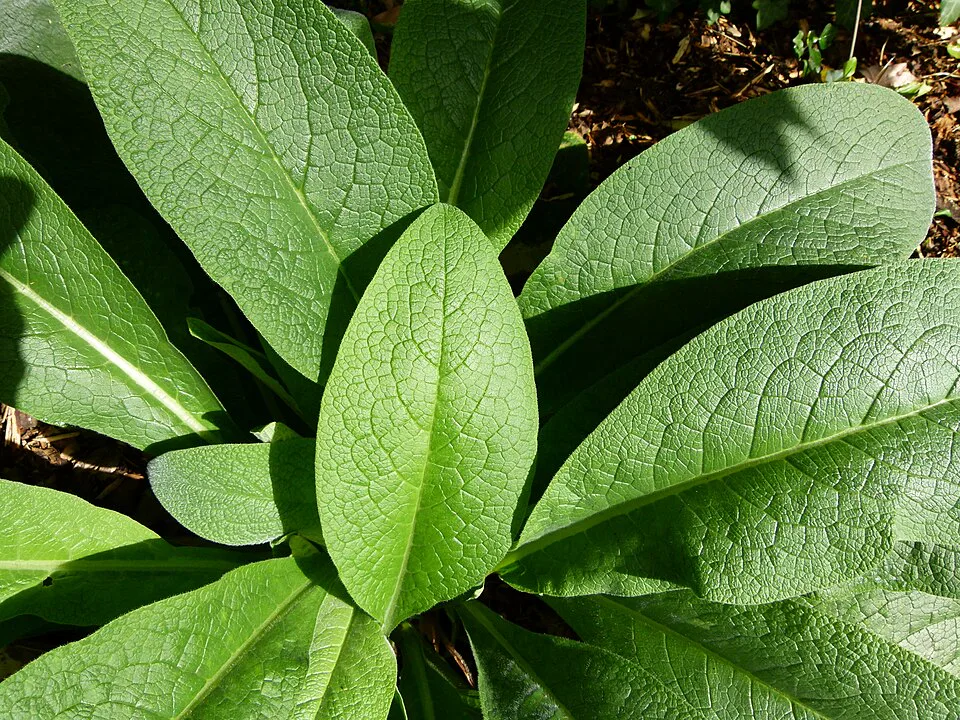
- Large, pointed, lance-shaped leaves with conspicuous veins and a rough, hairy surface.
- The bases of many upper leaves extend down the stem, forming narrow green wings. This is called a decurrent leaf base.
- The plant grows from a substantial perennial rootstock and often forms sizeable clumps.
Flower structure
The flowers have five petals fused into a tubular corolla, with five small lobes at its mouth. The five stamens are enclosed within the flower. Inside the corolla are small scales that help restrict access to the nectar. The green calyx is divided into five narrow lobes.
The flowers are borne in coiled, one-sided cymes, a flowering pattern especially associated with the borage family. As the cluster develops, it straightens and reveals successive flowers. After pollination, each flower can produce up to four small nutlets.
Leaves and stems
Common Comfrey has long, tapering leaves that feel noticeably rough because of their stiff hairs. The lower leaves can be particularly large and are stalked; upper leaves are generally smaller and often clasp the stem, their bases running down it to form wings. The stems are erect, branching and hairy.
These decurrent leaf bases can help distinguish Common Comfrey from some related comfreys, although hybrids and garden escapes can make identification difficult.
Habitat
Look for Common Comfrey on fertile, moist soils along riverbanks, beside ditches, in damp meadows and on the edges of hedgerows. It is native in Britain and is also frequently grown in gardens, from which comfreys can spread.
Flowering period
Common Comfrey usually flowers from May to September, with its main display in summer. The drooping flowers are visited by bees, particularly long-tongued species that can reach nectar inside the tubular corolla.
Similar species
- Russian Comfrey (Symphytum × uplandicum) is a hybrid widely grown in gardens. It can be especially vigorous, with flowers ranging from blue-violet to pink. Separating it from Common Comfrey can require close examination of the plant, particularly the leaf bases and flower details.
- Tuberous Comfrey (Symphytum tuberosum) is generally smaller, with pale yellow flowers, and is often found in woodland or shaded places.
Where the names come from
Comfrey is an old plant name usually linked with Latin words for joining or making firm. That meaning recalls the traditional idea that the herb could ‘knit’ wounds and broken bones together.
Symphytum comes from Greek for ‘growing together’, another reference to that history. Officinale refers to the officina, the traditional apothecary’s storeroom or pharmacy, where this herb was kept.
Folklore & history
Its old names include knitbone and boneset. In European herbal traditions, preparations made from the leaves and roots were applied as poultices, and comfrey was a familiar plant in physic gardens.
Comfrey’s deep roots and generous leafy growth also made it a valued garden plant. In more recent gardening traditions, its leaves have been used to make compost activators and liquid plant feeds.