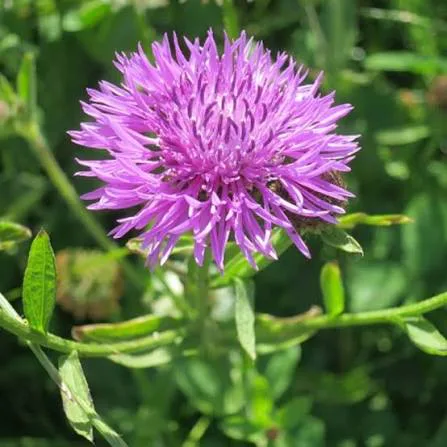
Common Knapweed is a widespread perennial wildflower found in grassland, meadows, roadside verges and field margins across much of the UK.
It belongs to the daisy family, Asteraceae. Like other members of this family, what appears to be a single flower is actually a flower head made up of many individual florets.
Identification
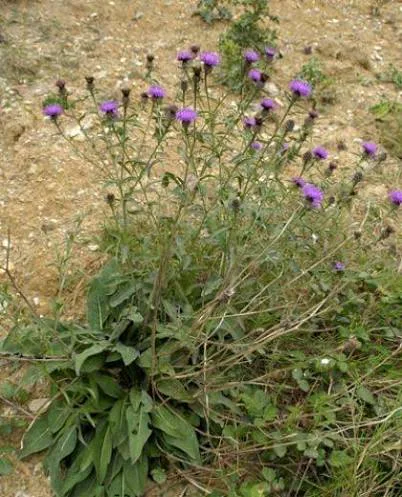
Common Knapweed usually grows between 30 and 100 cm tall.
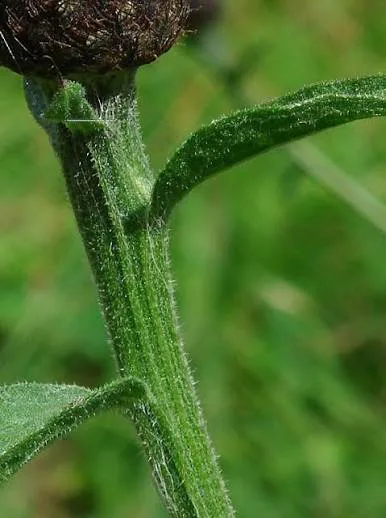
It has upright, branching stems which are often rough or slightly hairy.
The flower heads are purple and rounded, usually appearing singly at the ends of the stems and branches.
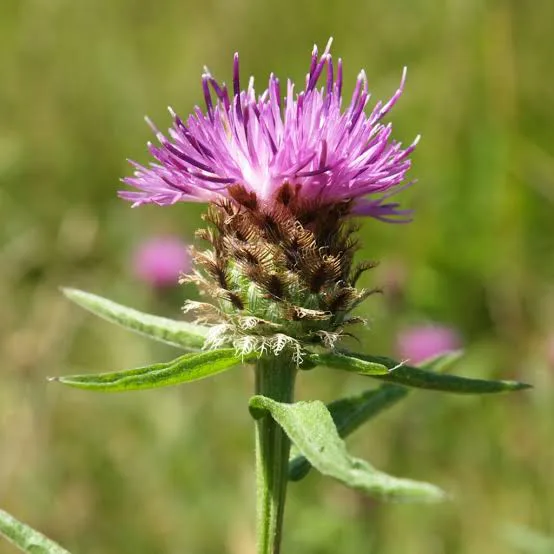
One of the most useful identification features is the group of overlapping bracts immediately beneath the flower head. These have dark brown to almost black fringed tips, giving the unopened flower head a distinctive scaly appearance.
Flower structure
The apparent flower is actually a capitulum — a compact flower head containing many small individual florets.
The florets are tubular and usually purple to reddish-purple.
The flower head is surrounded by an involucre made up of overlapping bracts. In Common Knapweed, the tips of these bracts have dark, comb-like fringes.
These bracts are particularly useful when distinguishing Common Knapweed from related species.
Leaves
The leaves are arranged alternately along the stem.
They are variable in shape.
Lower leaves are generally broader and may be slightly toothed or lobed, while leaves higher up the stem are usually narrower and more lanceolate.
The upper leaves tend to have little or no leaf stalk.
Bracts
The bracts form several overlapping rows beneath the flower head.
Each bract has a dark brown or blackish appendage at its tip with fine fringes around the edge.
From a distance, these dark bract tips can make the unopened flower head look almost black, which is why Common Knapweed is sometimes also known as Black Knapweed.
Habitat
Common Knapweed is often found in:
- meadows
- unimproved grassland
- roadside verges
- field margins
- woodland rides
- banks
It is particularly common in places where the grass is not intensively managed.
Similar species
- Greater Knapweed (Centaurea scabiosa) can be confused with Common Knapweed. It generally has larger flower heads and more deeply divided leaves. Examining the leaves and, especially, the bracts beneath the flower head can help distinguish the two species.
Where the names come from
Knapweed refers to the plant’s hard, knobbly flower head. Another name, Hardheads, describes the same feature, while Black Knapweed points to the dark fringed bracts surrounding the head.
Centaurea has traditionally been associated with Chiron, the healing centaur of Greek legend, although explanations of the ancient name differ. Nigra means ‘black’, referring to the dark appearance of the flower-head bracts.
Folklore & history
Common Knapweed has gathered a number of traditional names, including Black Knapweed, Hardheads, Bachelor’s Buttons and Iron Knobs. Several of these names refer to the dark, tough, knobbly flower heads.
Plantlife records an old love-divination custom in which young women plucked the outer florets and tucked the flower head into their clothing. If unopened florets later began to open, it was taken as a sign that the man they hoped for was near.
Knapweed also appears in traditional herbal history, where it was used for complaints such as wounds, bruises and sore throats.
Flowering period
Common Knapweed usually flowers from June to September.
Its flower heads are an important nectar source for many insects, including bees, butterflies and hoverflies.