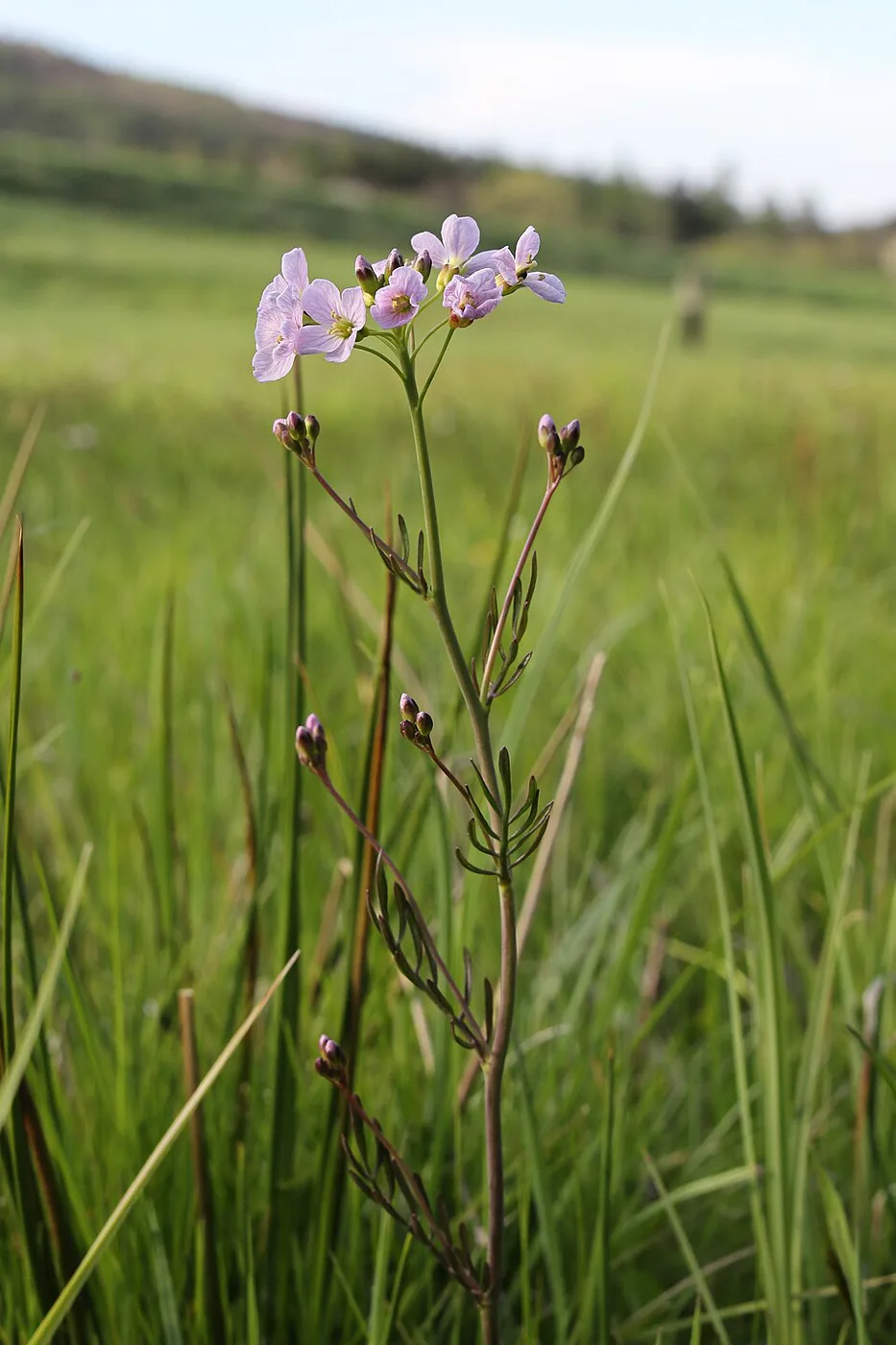
Cuckooflower is a delicate spring wildflower of damp meadows, stream banks and ditches. Its pale lilac, pink or sometimes white flowers rise above the grass on slender stems, often appearing at the same time as the first cuckoos are heard. It is also known as Lady’s-smock and belongs to Brassicaceae, the cabbage family.
Identification
- A usually hairless perennial, often 20–50 cm tall, growing from a low rosette of leaves.
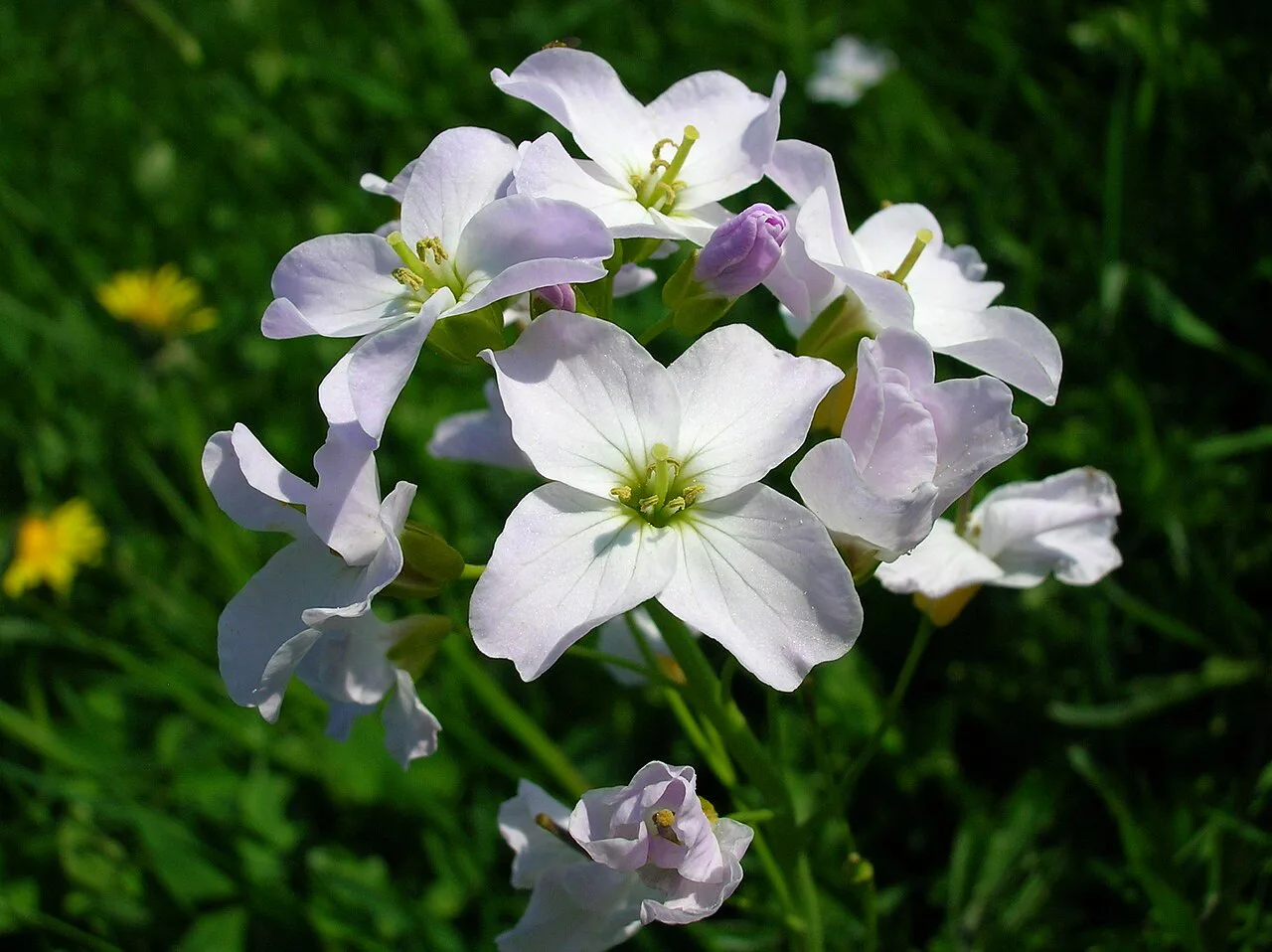
- Loose clusters of small, pale lilac-pink or white flowers, each with four petals arranged in a cross.
- The petals often have darker purple veins; the flower centre has yellowish anthers.
- Lower leaves are pinnate with rounded, sometimes kidney-shaped leaflets, especially the larger terminal leaflet.
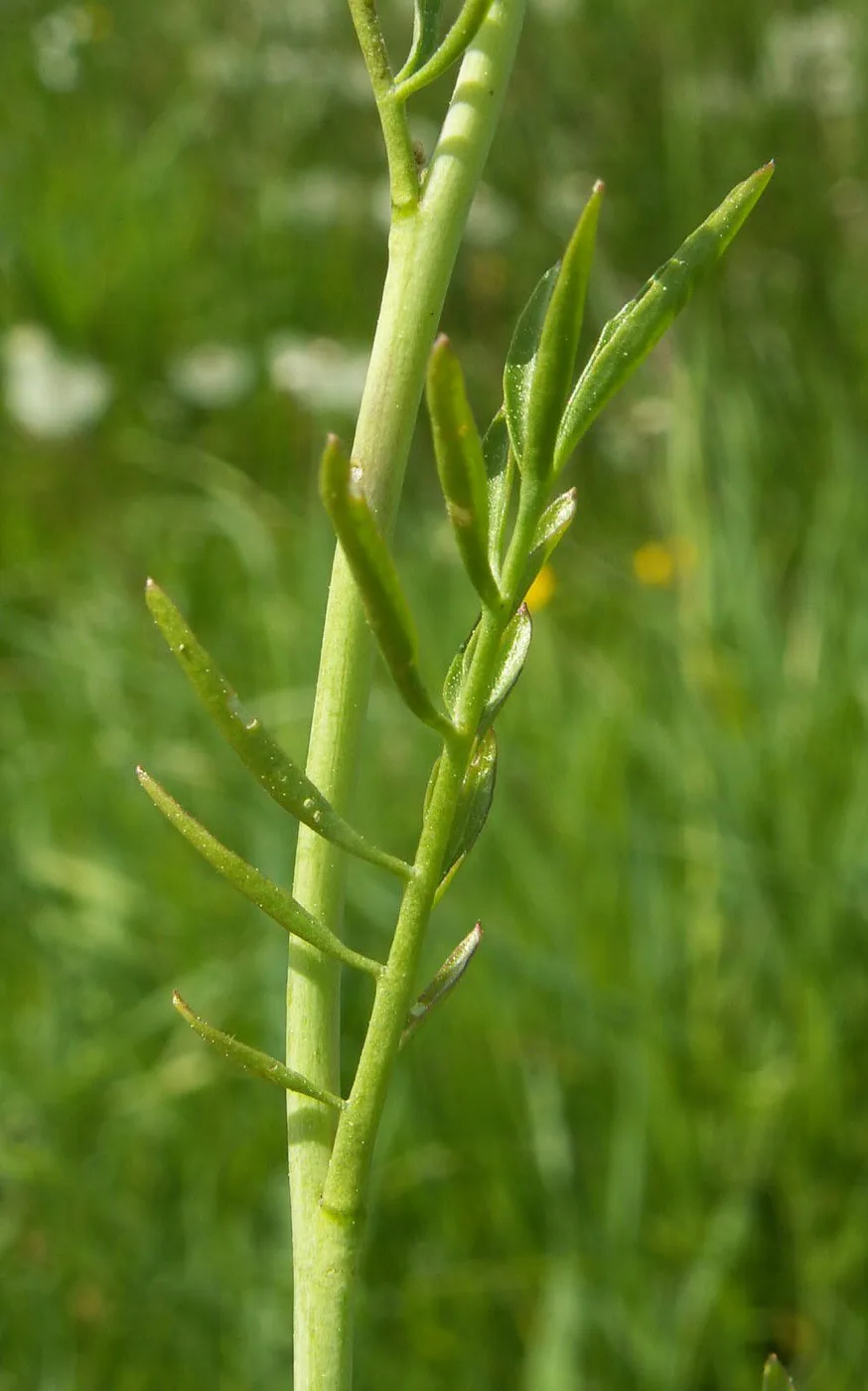
- Upper stem leaves look quite different, with narrow, pointed leaflets.
- After flowering, long, slender upright seed pods develop where the flowers stood.
The combination of four-petalled flowers, rounded basal leaflets, narrow upper leaflets and a preference for damp ground is particularly useful for identification.
Flower structure
Like other members of Brassicaceae, Cuckooflower has four sepals and four separate petals arranged crosswise. The flower is described as cruciform. There are usually six stamens, four longer and two shorter, surrounding the central ovary.
The flowers grow in loose terminal racemes, with individual flower stalks emerging from the flowering axis. As the lower flowers fade, the cluster can extend and develop slender seed pods called siliques. These split when ripe and release the seeds.
Leaves and stems
The leaves are alternate and compound, but their appearance changes markedly up the stem.
At the base is a rosette of pinnate leaves, with rounded leaflets and a larger, often kidney-shaped terminal leaflet. Higher up, the leaflets become much narrower, sometimes almost linear. This difference between lower and upper leaves is one of the plant’s best identification features.
The flowering stems are upright, slender and generally smooth. Cuckooflower has another unusual trick: in moist conditions, a fallen leaf can sometimes produce tiny new plantlets from its margins.
Habitat
Cuckooflower favours soils that remain damp in spring. Look for it in wet meadows, marshy pastures, grassy ditches, riversides, stream banks and around pond margins. It also occurs on damp roadside verges and in gardens with suitable conditions.
It is widespread in Britain, although the drainage and improvement of traditionally wet grassland can reduce suitable habitat.
Flowering period
The main flowering season is April to June, sometimes beginning earlier or continuing later depending on local weather. Its gentle pink-lilac flowers are a familiar sign of late spring in wetter grassland.
Similar species
- Cuckoo Bittercress (Cardamine flexuosa) has much smaller, usually white flowers and often grows on damp disturbed ground rather than forming showy stands in meadow grass.
- Hairy Bittercress (Cardamine hirsuta) is a smaller plant with tiny white flowers, commonly found in gardens and paving cracks.
- Lady’s-smock is not a different species: it is another common name for Cuckooflower itself.
When in doubt, inspect the leaves as well as the flowers. The rounded leaflets at the base and very narrow ones higher on the stem help distinguish Cuckooflower from its smaller bittercress relatives.
Where the names come from
The name Cuckooflower refers to the timing of its blossom: the flowers open in spring at around the time the cuckoo’s call is first heard. Another familiar name, Lady’s-smock, has several suggested explanations, including a comparison between the pale flowers and a woman’s smock; the exact origin is not certain.
Cardamine is an ancient Greek plant name associated with cresses. Its precise derivation is debated; a traditional interpretation links it with Greek words for “heart” and “subdue”, but that explanation is not firmly established. The Latin species name pratensis means “of meadows” or “growing in meadows”, referring to its favoured habitat.
Folklore & history
Cuckooflower has long featured in the folklore of spring meadows. In some parts of Britain, picking it was considered unlucky; other local names include milkmaids, Mayflower and fairy flower. These names reflect the plant’s associations with the countryside at the turn of spring into early summer.
The name Lady’s-smock appears in English literature, notably in Shakespeare’s descriptions of spring flowers. The plant’s young leaves, with their peppery cress-like flavour, were also traditionally gathered for salads and sandwiches.
Wildlife
Cuckooflower is an important foodplant for the caterpillars of the Orange-tip butterfly (Anthocharis cardamines) and the Green-veined White (Pieris napi). Orange-tip butterflies can often be seen visiting the flowers in spring, and females lay eggs on suitable flower stalks.
Bees, hoverflies and other insects also visit the flowers. In damp meadow habitats, Cuckooflower provides a valuable early-season nectar source alongside its role as a butterfly caterpillar foodplant.