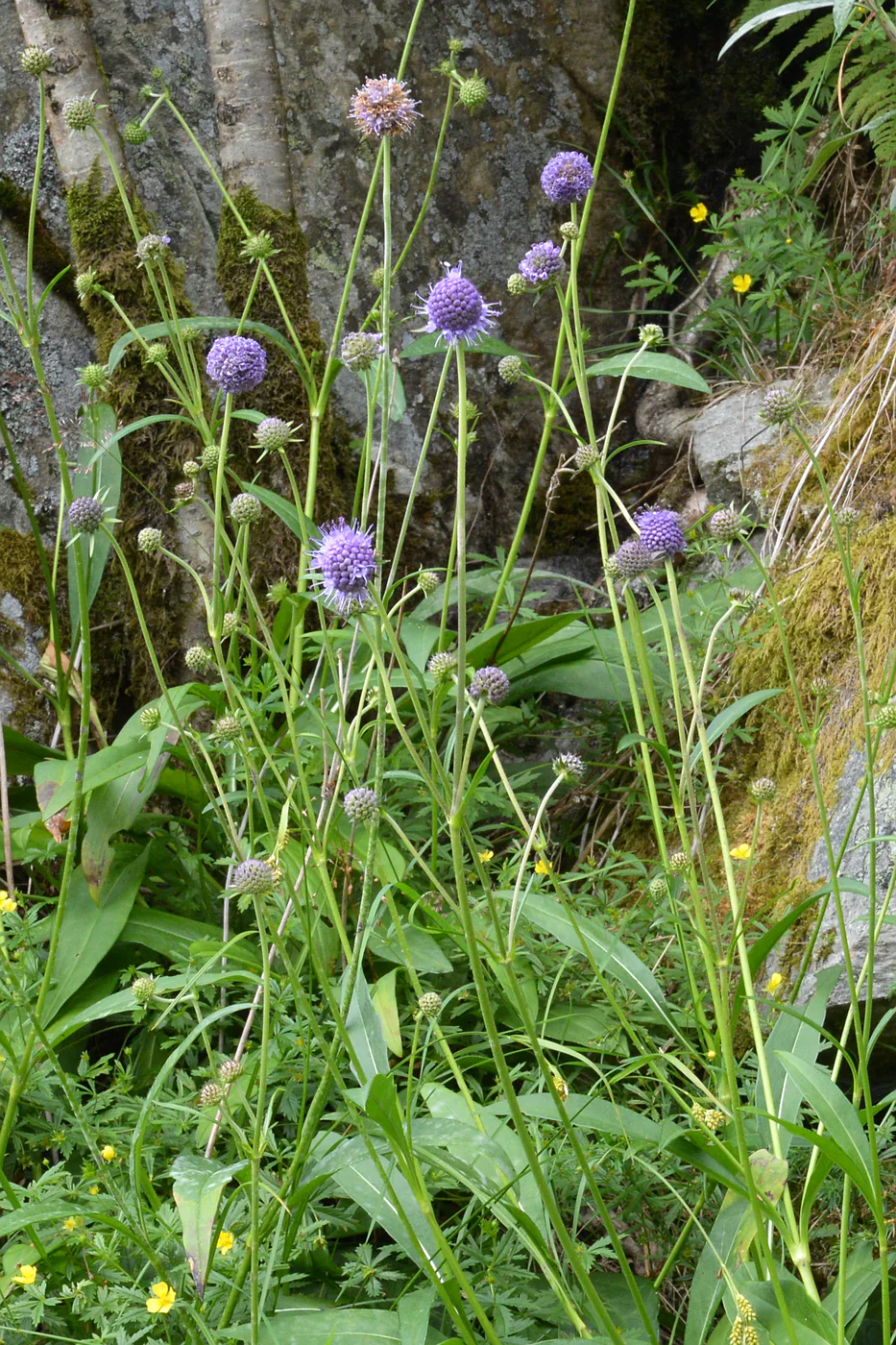
Devil’s-bit Scabious is a distinctive perennial of damp grassland, meadows, wet heath, fens, marshes and open woodland. Its rounded blue-purple flower heads appear on long, slender stems from summer into autumn.
It belongs to the honeysuckle family, Caprifoliaceae. Older books may place scabiouses in the separate family Dipsacaceae, but modern classifications include that group within Caprifoliaceae.
Identification
- Usually around 30–100 cm tall.
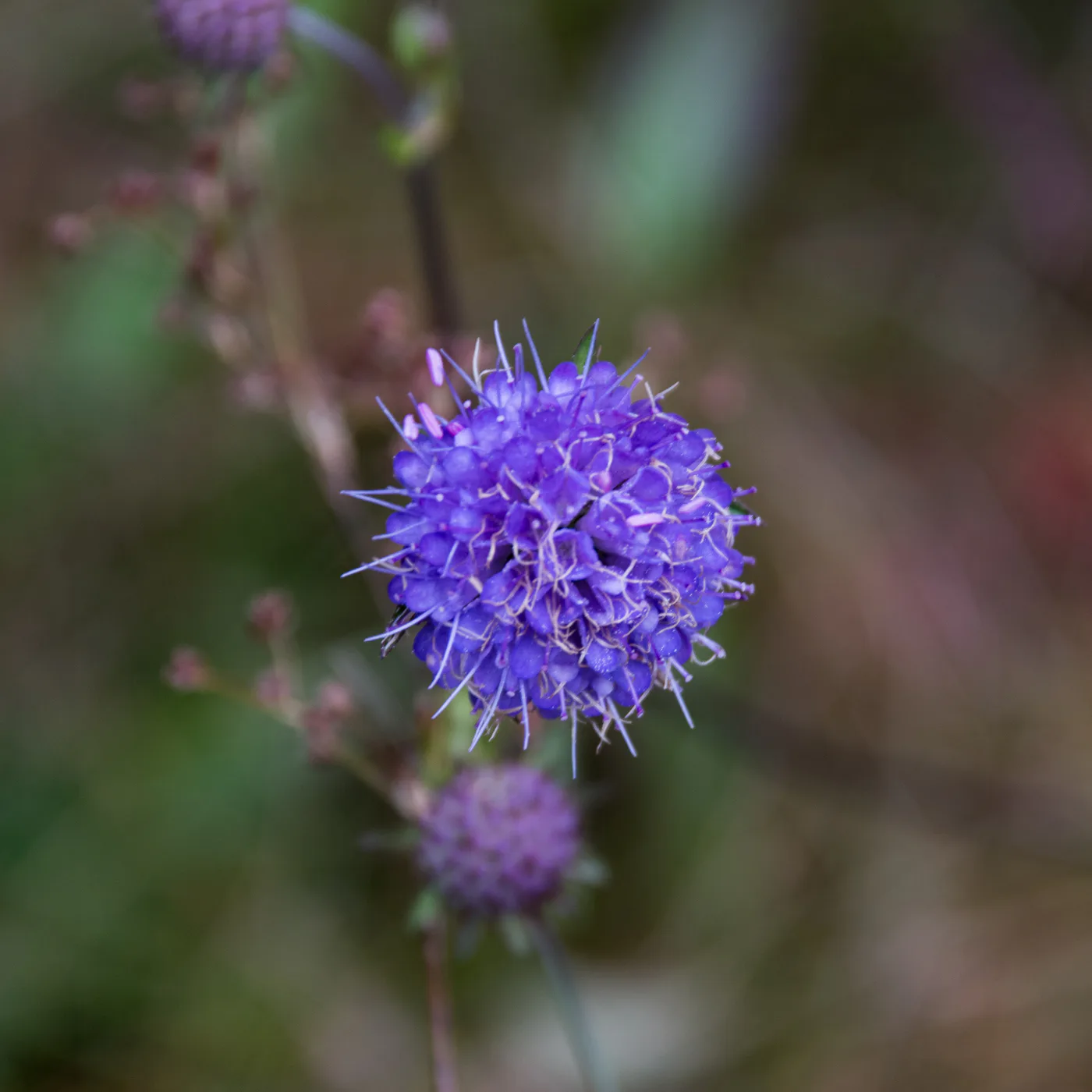
- Flower heads are rounded to slightly domed, commonly around 1.5–2.5 cm across.
- Flowers are usually mauve, violet-blue or deep blue-purple.
- Each head is made up of many small tubular florets.
- Unlike Field Scabious, the outer florets are not dramatically enlarged.
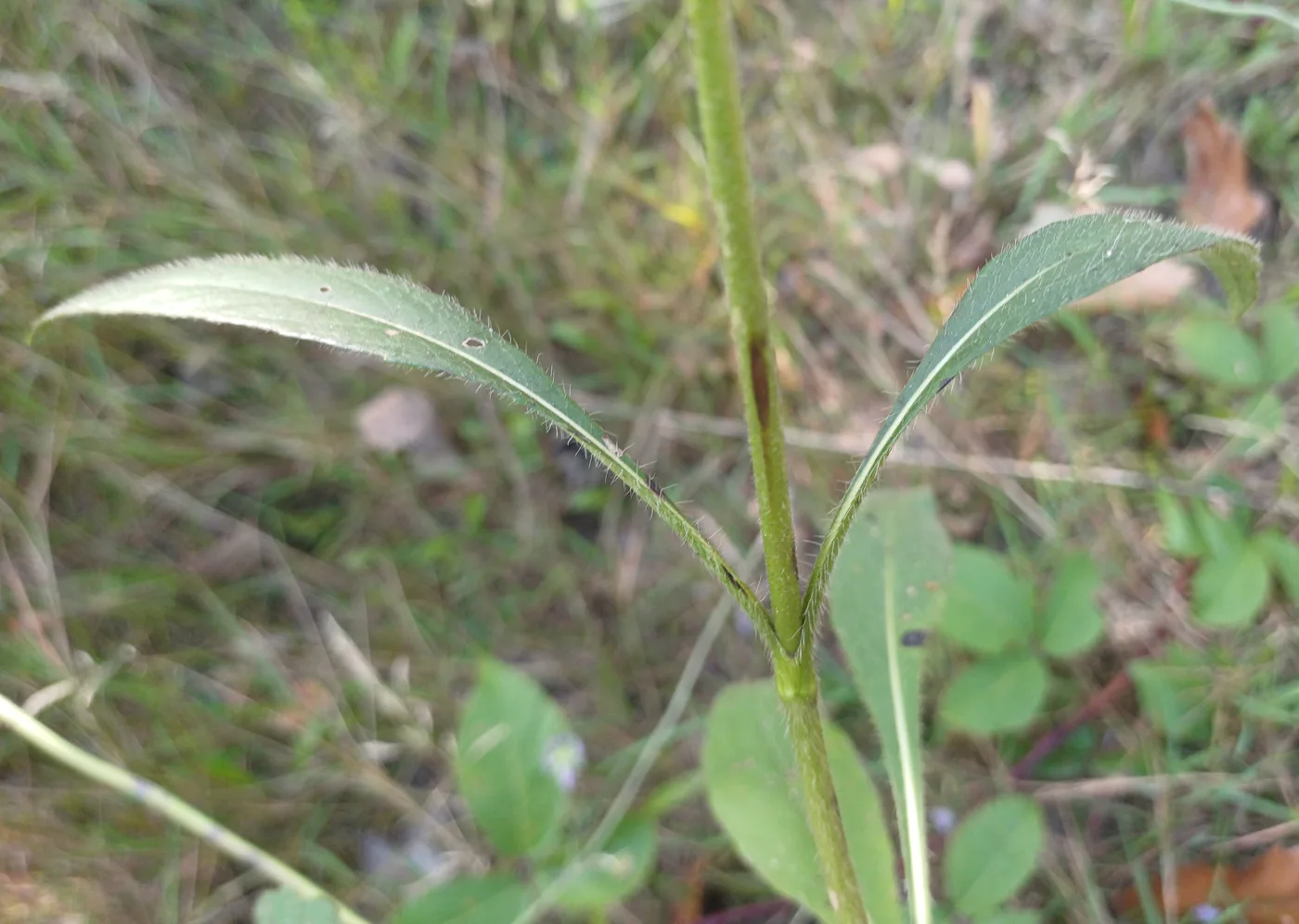
- Leaves are simple, undivided and usually oval to lance-shaped.
- Leaves are arranged mainly in opposite pairs.
- Flower heads are carried on long stalks above the foliage.
- Plants are perennial and can form noticeable patches in suitable damp grassland.
The combination of rounded blue-purple heads, long flower stalks and undivided opposite leaves is particularly useful in the field.
Flower structure
What looks like one flower is actually a compact head containing many individual florets.
Each small floret has a fused corolla ending in four lobes. The florets are packed closely together into a rounded head, with those around the outside remaining broadly similar in size to those in the centre.
A ring of narrow green bracts sits beneath the flower head.
This structure can look rather like members of the daisy family at first glance, but Devil’s-bit Scabious belongs to Caprifoliaceae and its individual florets and fruits are constructed differently.
Leaves and stems
The leaves are one of the best ways to distinguish Devil’s-bit Scabious from several other British scabiouses.
They are generally:
- simple and undivided
- oval to lance-shaped
- pointed or bluntly pointed at the tip
- mostly entire or only weakly toothed
- arranged in opposite pairs
Lower leaves can be broader and stalked, while those higher on the stem are usually narrower.
The flowering stems are upright, slender and branched towards the top, with each branch ending in a flower head.
Habitat
Devil’s-bit Scabious prefers habitats that are often damper and less fertile than those favoured by Field Scabious and Small Scabious.
Typical habitats include:
- damp unimproved grassland
- traditional hay meadows
- marshy grassland
- wet heathland
- fens and mires
- woodland rides and clearings
- upland grassland and mountain slopes
It is particularly characteristic of long-established, species-rich grassland that has escaped agricultural improvement.
Flowering period
Devil’s-bit Scabious can flower from June to October, although it is often most conspicuous from July onwards.
Its late flowering makes it an especially useful nectar source when many earlier grassland flowers have already finished.
Similar species
- Field Scabious (Knautia arvensis) usually grows in drier grassland and verges. Its flower heads are larger and flatter, with the outer florets noticeably enlarged. Its leaves are commonly lobed or deeply divided, unlike the undivided leaves of Devil’s-bit Scabious.
- Small Scabious (Scabiosa columbaria) favours dry, often calcareous grassland. Its leaves become deeply divided into narrow lobes and its pale blue-lilac flower heads usually have enlarged outer florets.
- Sheep’s-bit (Jasione montana) can also produce rounded blue flower heads, particularly on heaths and dry grassland. It belongs to the bellflower family, however, and has much narrower leaves and small five-lobed flowers.
Where the names come from
The blunt, almost bitten-off rootstock inspired Devil’s-bit. A folk tale claimed that the Devil had bitten it away in anger at the plant’s supposed powers. ‘Scabious’ is an old herbal name linked with Latin scabies, a skin complaint.
Succisa is derived from Latin for ‘cut off beneath’, describing the abrupt end of the rootstock. Pratensis means ‘of meadows’, one of its characteristic habitats.
Folklore & history
The rootstock ends abruptly, as though it has been bitten off. According to folklore, the Devil was so angry at the plant’s supposed healing powers that he bit away part of its root, leaving the characteristic blunt end.
Wildlife
Devil’s-bit Scabious is an excellent late-summer and autumn nectar source. Its flower heads attract bees, hoverflies, butterflies and moths.
It is especially important because it is the principal larval food plant of the Marsh Fritillary butterfly in Britain. Females lay batches of eggs on the leaves, and the caterpillars feed communally in silken webs.
The relationship between the butterfly and this plant means that maintaining plentiful Devil’s-bit Scabious in damp, species-rich grassland is an important part of Marsh Fritillary conservation.