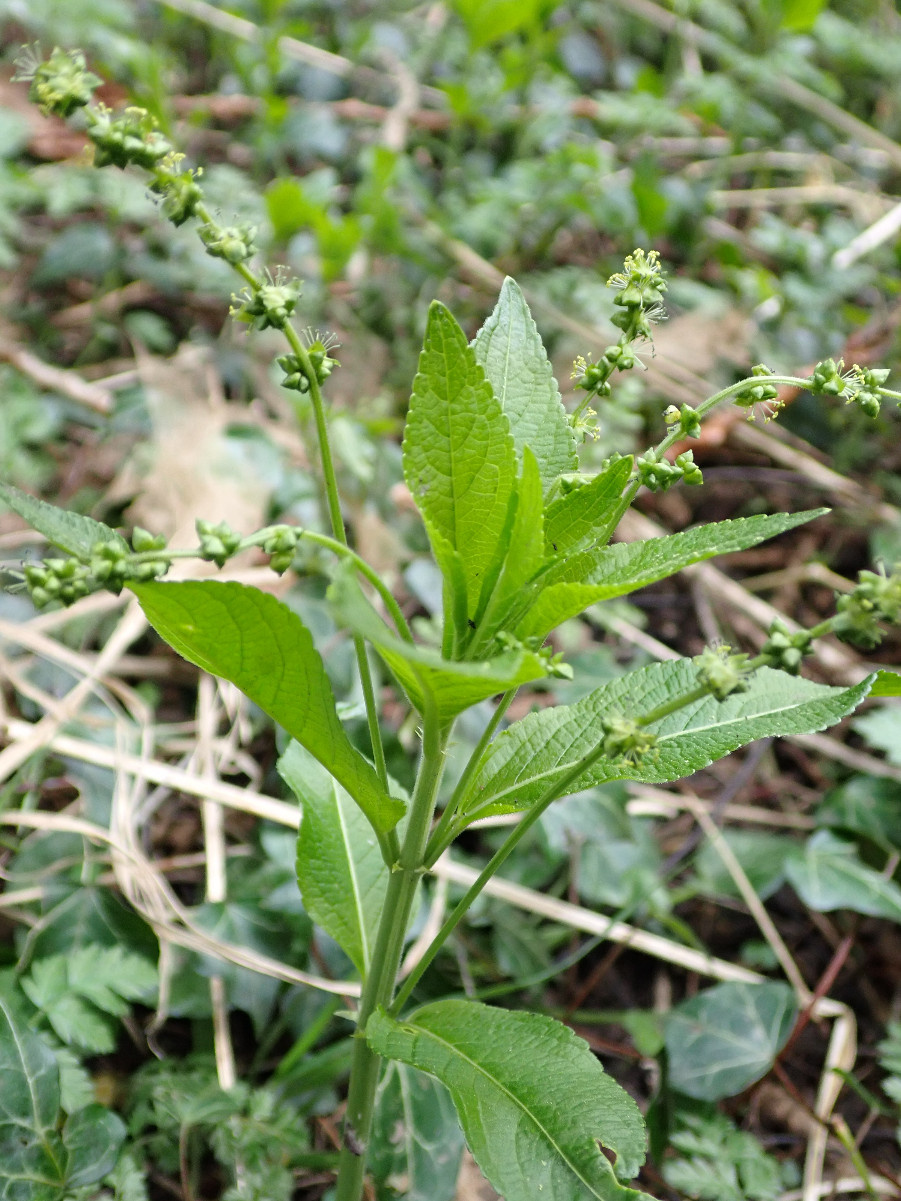
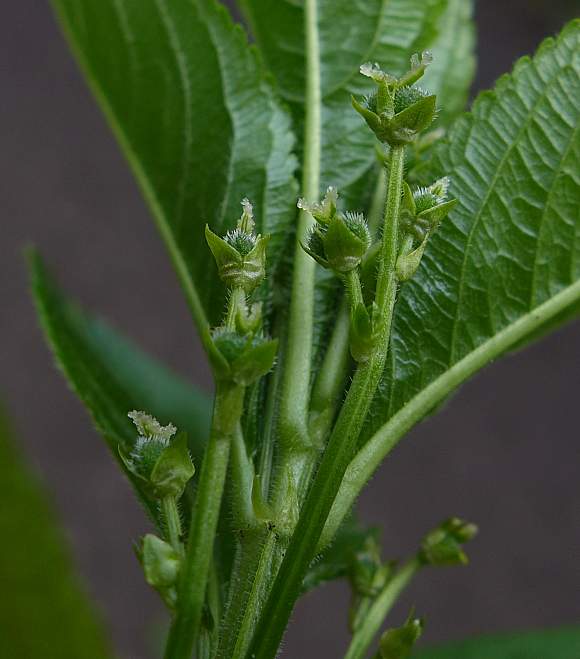
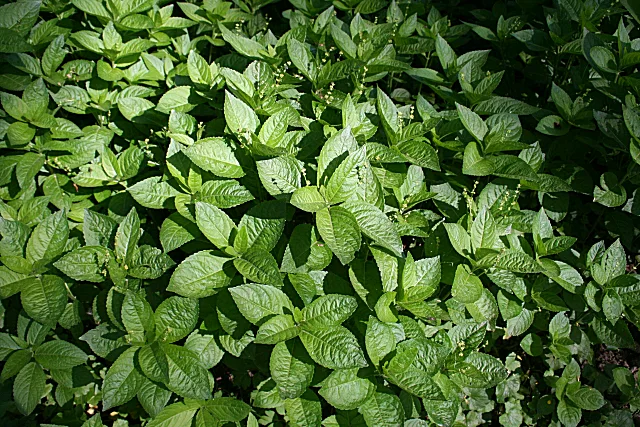
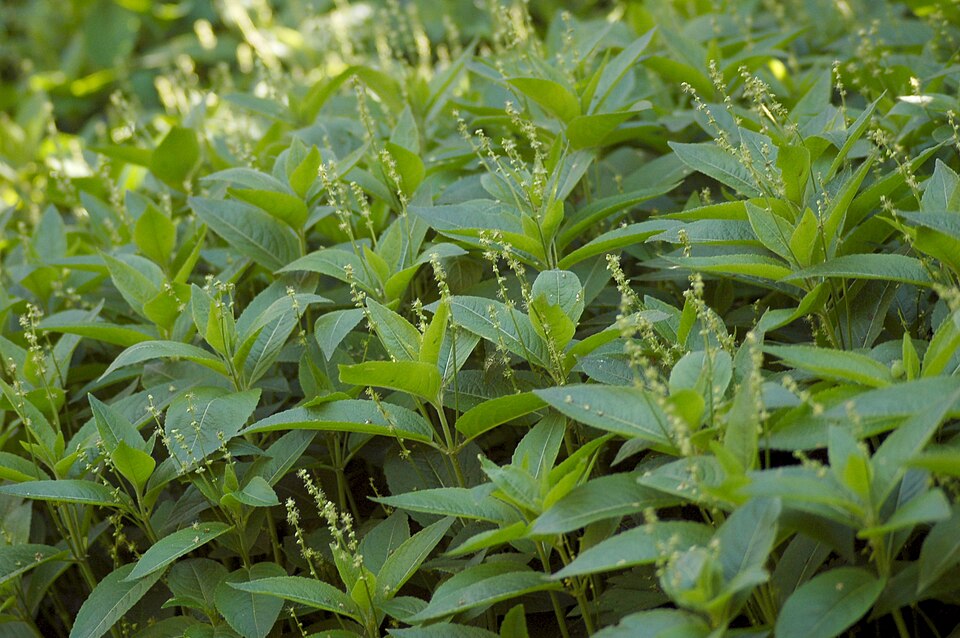
Dog’s Mercury is a native perennial of shady woodland and old hedgerows. In spring it forms broad carpets of fresh green leaves, although its flowers are so small that they are easily overlooked. It belongs to Euphorbiaceae, the spurge family.
Identification
- Usually 15–40 cm tall, with upright, mostly unbranched stems.
- Opposite, pointed oval leaves with finely toothed margins, often crowded near the top of the stem.
- Small, greenish-yellow flowers appearing in early spring, rather than brightly coloured petals.
- Separate male and female plants, a condition called dioecious.
- Male plants bear slender, stalked flower spikes; female flowers form smaller clusters at the leaf axils.
- Spreads through underground rhizomes, often forming dense, even-looking patches.
Its combination of opposite toothed leaves, tiny green flowers and extensive woodland colonies is particularly distinctive.
Flower structure
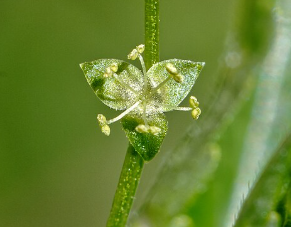
Dog’s Mercury is dioecious: individual plants ordinarily bear either male or female flowers, not both. Its flowers lack showy petals and each has three small green perianth segments.
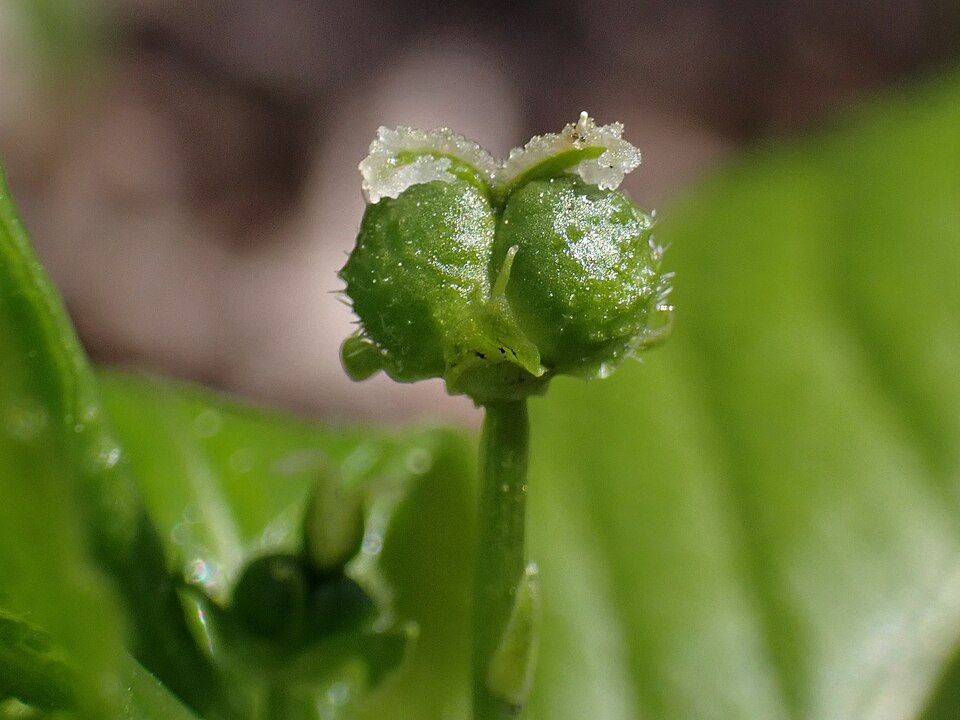
Male flowers grow in clusters along slender stalks rising from the leaf axils. They contain several stamens, whose yellow anthers become noticeable when the flowers open. Female flowers are shorter-stalked and less conspicuous. Each has an ovary with two chambers and two styles. After pollination, a small, usually two-lobed capsule develops.
Pollination is chiefly by wind, so the plant does not depend on colourful petals to attract insects.
Leaves and stems
The leaves grow in opposite pairs. Each leaf is oval to lance-shaped, with a pointed tip, sharply toothed edges and a short stalk. They are often a clear, fresh green and can feel slightly rough or hairy.
The upright stems arise from a network of creeping underground rhizomes. Because neighbouring shoots are often connected, a single colony can spread across a substantial area of woodland floor.
Habitat
Dog’s Mercury is widespread in many British broadleaved woods, especially on fertile, neutral to alkaline soils. Look for it beneath ash, beech and other deciduous trees, along old hedgebanks and on shaded woodland slopes.
It is often associated with ancient woodland, but it can also establish in newer woods. A large patch is a useful woodland clue, though it does not prove the age of a site on its own.
Flowering period
Flowers normally appear from February to April, occasionally continuing into May. The leaves are most noticeable during spring, before the tree canopy becomes dense. Above-ground growth usually dies back later in the year.
Similar species
- Annual Mercury (Mercurialis annua) is also in the spurge family, but is generally a more branched annual of cultivated and disturbed ground rather than a woodland carpet.
- Good-King-Henry (Blitum bonus-henricus) has greenish flowers and was historically known as a kind of mercury, but its leaves are usually triangular and its growth habit is different.
- Young nettles can have similar toothed leaves; however, Dog’s Mercury lacks stinging hairs and has very different flowers.
Where the names come from
The name Mercurialis has long been associated with the Roman god Mercury and with plants called mercuries in old herbals. Perennis is Latin for ‘perennial’, referring to its ability to return year after year from underground stems.
In the common name, dog’s was traditionally used to suggest an inferior or unsuitable counterpart to the edible plants once called mercuries. Dog’s Mercury is poisonous, unlike those older culinary ‘mercuries’.
Folklore & history
Dog’s Mercury was known to herbalists for centuries, sometimes under names such as False Mercury and Boggard Posy. Its association with the supposedly lesser ‘dog’s’ form distinguished it from other plants once used as pot herbs.
Some historical herbals discussed its strong purgative effects. Despite these accounts, it was also recognised as a poisonous woodland plant.
Wildlife
Its dense spring growth provides cover in woodland. Various invertebrates use the plant, including some beetles, molluscs and speckled bush-cricket nymphs. The patches it forms also influence which other woodland-floor plants can establish nearby.