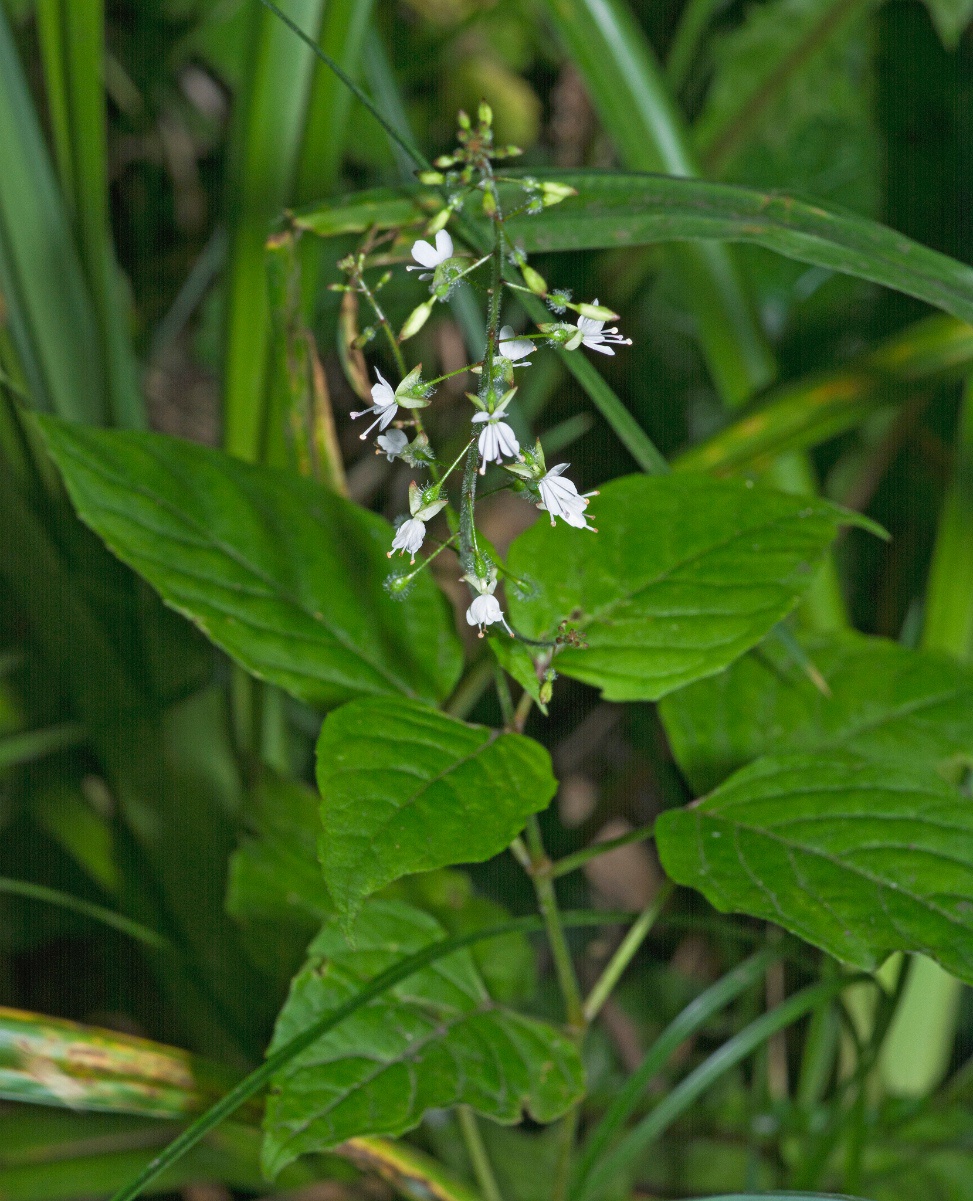
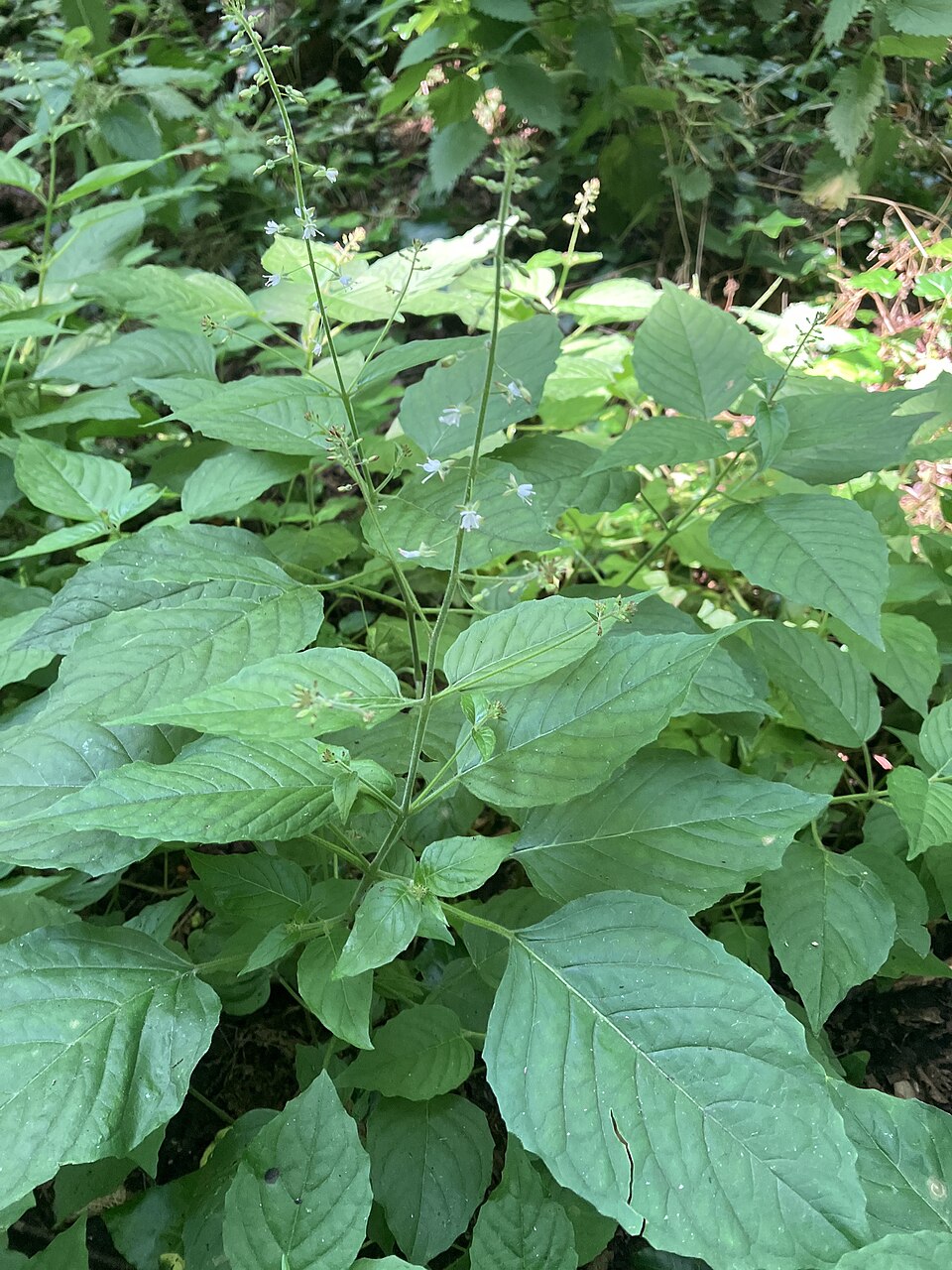
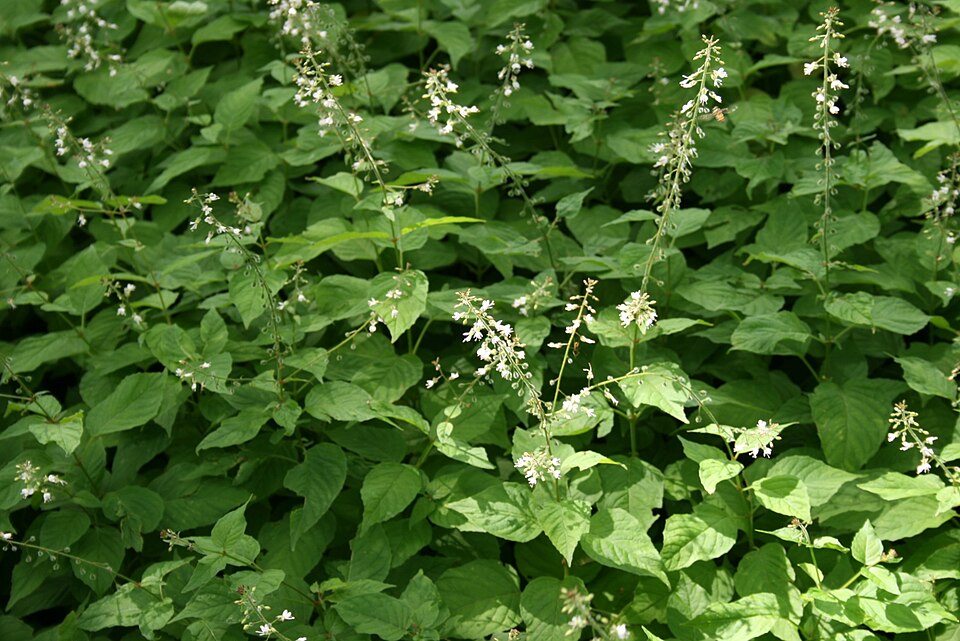
Enchanter’s-nightshade is a delicate perennial of damp, shaded woodland and hedgebanks. Tiny white flowers are held on slender stems above broad, pointed leaves. Despite its name, it is not related to the true nightshades: it belongs to the evening-primrose family, Onagraceae, alongside willowherbs.
Identification
- Usually 20–70 cm tall, often forming patches in moist, shaded places.
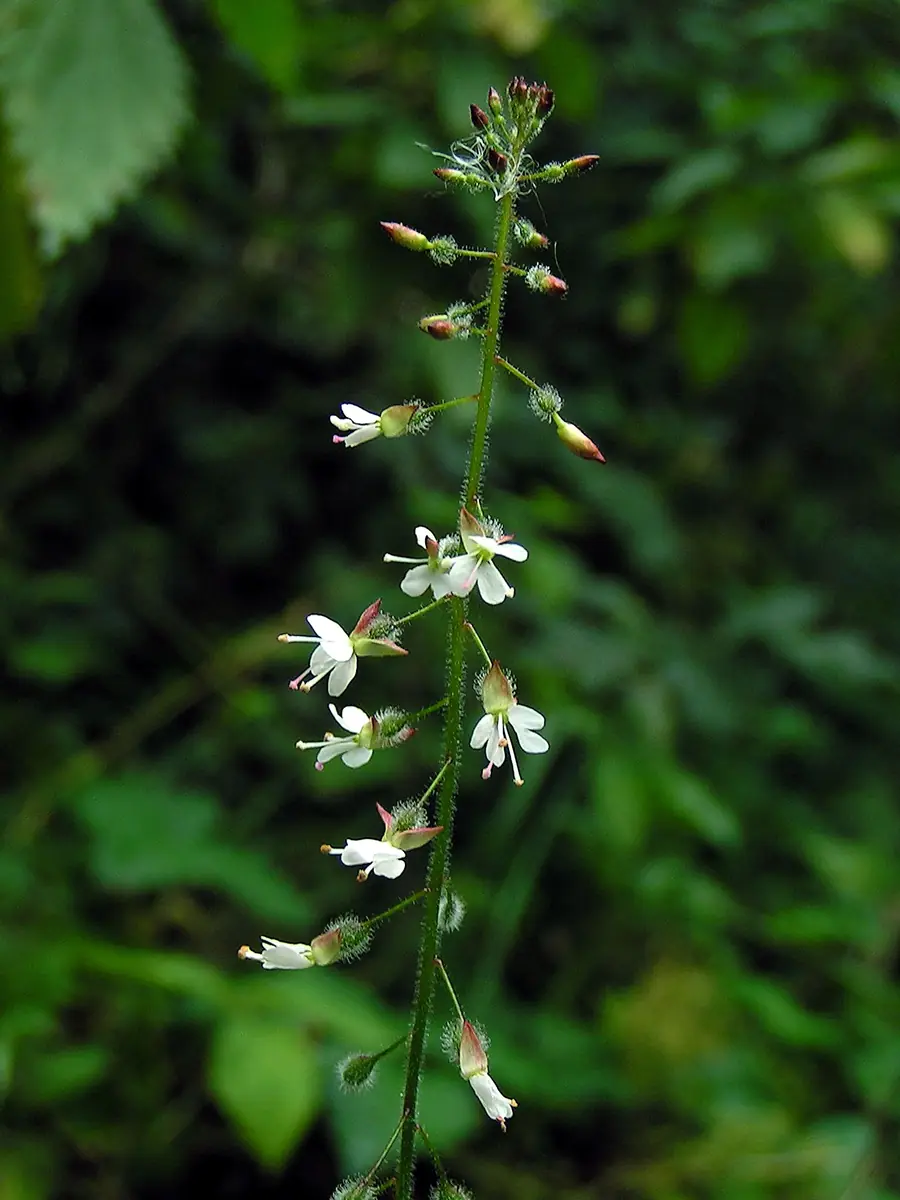
- Small white, sometimes pink-tinged flowers, about 4–7 mm across, sit on slender, open racemes.
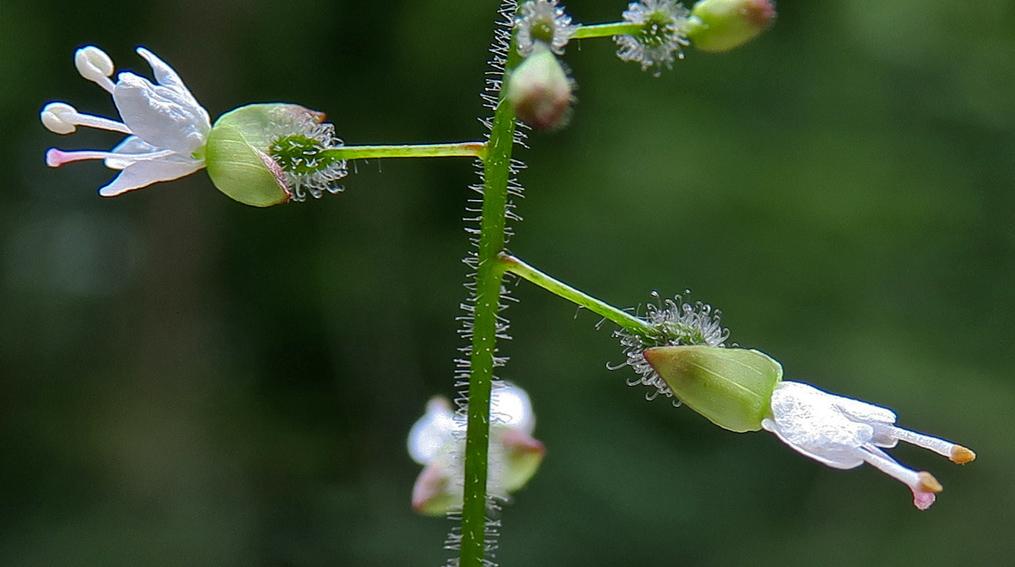
- Each flower has just two deeply notched petals, often appearing to have four.
- Leaves grow in opposite pairs, are broadly oval to heart-shaped, and narrow to pointed tips.
- The leaf edges are shallowly toothed or slightly wavy, with prominent branching veins.
- After flowering, small pear-shaped fruits develop, each covered in fine hooked bristles.
The combination of paired pointed leaves, tiny two-petalled flowers and bristly fruits is particularly useful for identification.
Flower structure
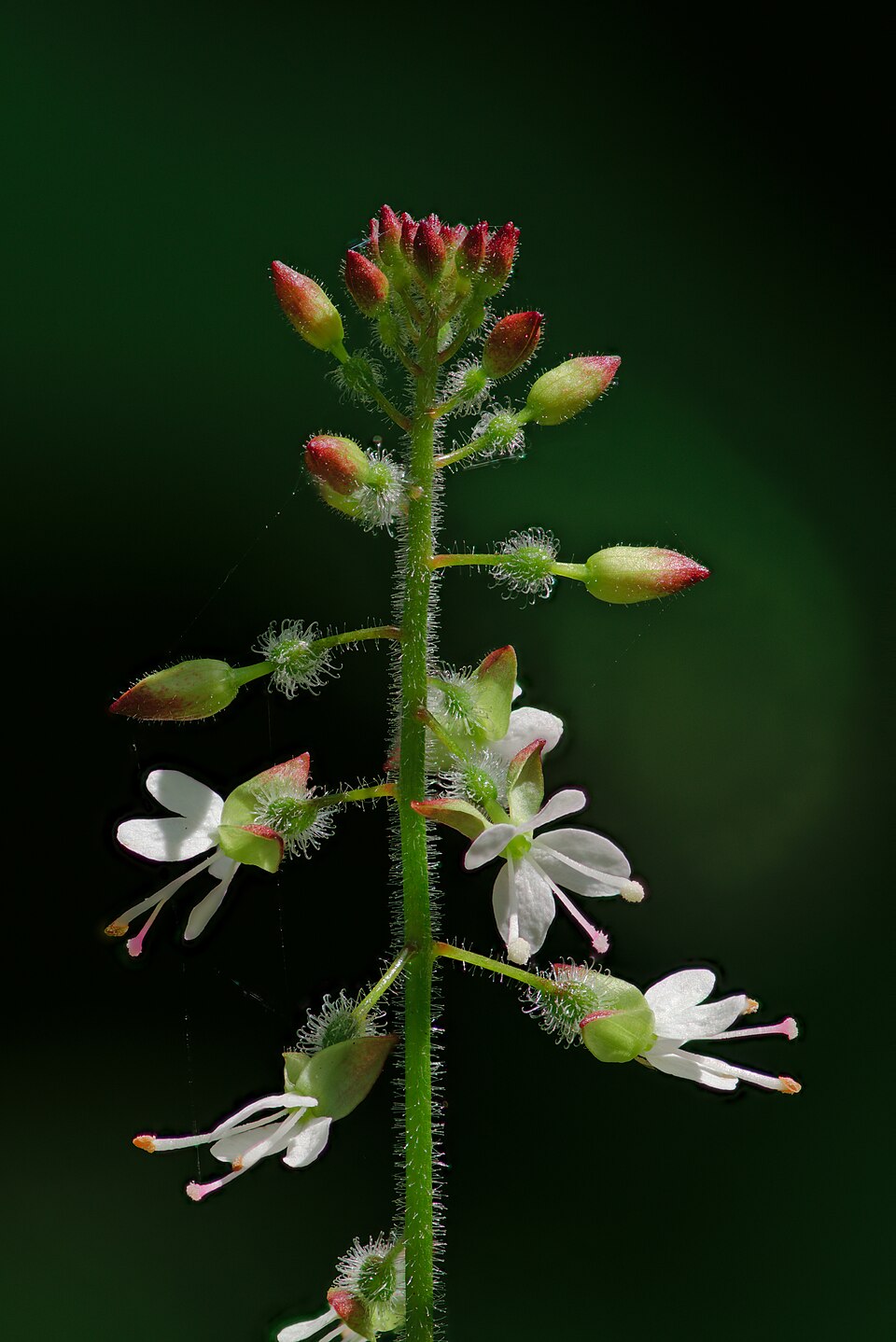
The flowers are unusual within Onagraceae. Each has two white, deeply notched petals and two small, often reddish sepals that bend backwards. The flowers also have two stamens and a projecting style ending in a stigma.
The flowers are carried on slender, sometimes branching racemes above the foliage. Pinkish buds open progressively along the stems. Close inspection is needed to see the petal divisions, as individual flowers are only a few millimetres across.
Leaves and stems
The leaves occur in opposite pairs on short to moderately long stalks. They are soft, broadly oval or somewhat heart-shaped at the base, with pointed tips, gently toothed margins and conspicuous veins. The leaves become smaller farther up the plant.
The upright stems and flower stalks may carry fine glandular hairs. Underground rhizomes allow the plant to spread and return each spring.
Fruits and seed dispersal
After flowering, small green, oval to pear-shaped fruits appear along the stems. Their surfaces are covered in hooked bristles, which catch on the fur of passing mammals or the feathers of birds and carry the fruits to new places.
The fruits can look like tiny prickly burrs when viewed close up. They are an excellent feature to photograph because they are so different from the long seed capsules of willowherbs.
Habitat
Enchanter’s-nightshade favours moist, humus-rich soils in partial or deep shade. It is frequent in broadleaved woodland, woodland rides, shaded hedges, streamside banks and older gardens. It can form extensive patches where conditions suit it.
Similar species
- Alpine Enchanter’s-nightshade (Circaea alpina) is a much smaller, more delicate plant of cool, damp woodland, with smaller, more heart-shaped leaves and finer flower spikes.
- Upland Enchanter’s-nightshade (Circaea × intermedia) is a hybrid with more strongly toothed, often more deeply heart-shaped leaves. It usually produces little or no viable seed, unlike Enchanter’s-nightshade.
- Deadly Nightshade (Atropa belladonna) is unrelated despite the shared name. It has larger, brownish-purple bell-shaped flowers and black berries, rather than tiny white flowers and bristly fruits.
Where the names come from
Circaea is named after Circe, the enchantress of Greek mythology, famed for her knowledge of herbs and magic. Lutetiana refers to Lutetia, the Roman name for Paris.
The name is misleading botanically: the plant is not a member of the nightshade family (Solanaceae), but of Onagraceae, the family that also includes willowherbs and evening-primroses.
Folklore & history
The connection with Circe gave this modest woodland plant a reputation for enchantment in older herbal traditions. Its name evokes the stories of magical herbs and love charms associated with the classical enchantress.
Enchanter’s-nightshade was familiar to generations of woodland walkers, though its inconspicuous flowers meant it attracted less attention than the showier summer plants. Its association with woodland shade and mysterious names helped it retain a place in British plant lore.
Wildlife
The tiny flowers are visited by small insects, including flies, while the foliage provides cover within the woodland understorey. The hooked fruits are dispersed when they attach to passing animals, helping the plant spread beyond an established patch.