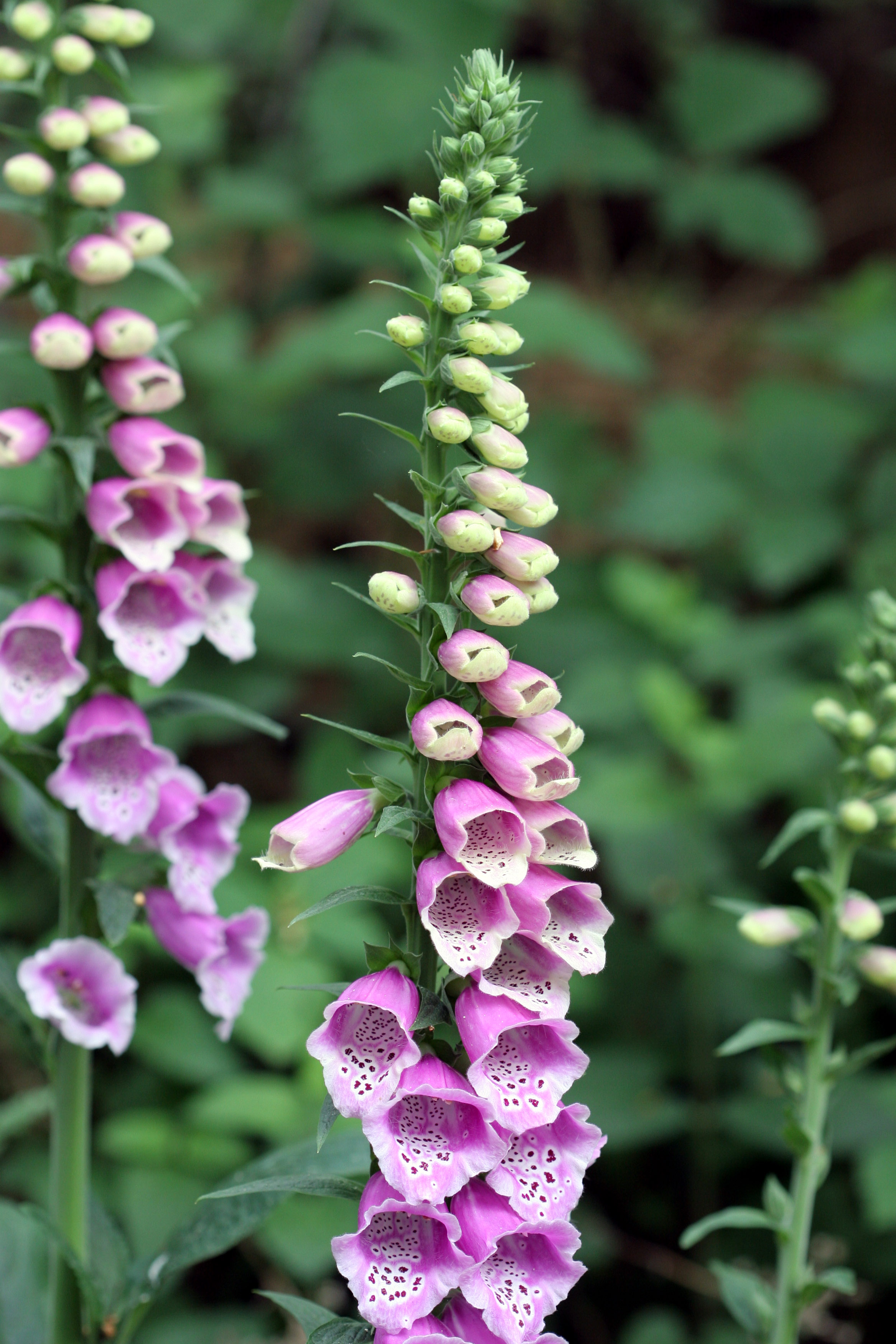


Foxglove is one of Britain’s most distinctive wildflowers. In its flowering year it sends up a tall spike hung with large purple-pink bells, their pale throats patterned with dark spots.
It belongs to Plantaginaceae, the plantain family, alongside plantains, speedwells and toadflaxes. The family is surprisingly varied in appearance, so flower structure and other details are often more useful than overall shape when comparing its members.
Identification
- Usually 60–150 cm tall, although vigorous plants can grow taller.
- Tall upright flower spike, generally with the flowers concentrated on one side.
- Large tubular or bell-shaped flowers, usually purple-pink, sometimes pale pink or white.
- Flower throats are paler and marked with dark purple spots.
- Large, softly hairy leaves with strongly marked veins and toothed margins.
- The first year’s growth is normally a low rosette of leaves; the flowering stem is produced later.
The combination of a tall spike, hanging tubular flowers and a basal rosette of large downy leaves makes Foxglove difficult to confuse when in flower.
Flower structure
The flowers are borne in a long raceme. Each tubular flower hangs outwards from the stem and has a broad lower lip that provides a landing platform for visiting insects.
The pale interior and dark spotting act as visual guides towards the nectar. Flowers usually open in sequence from the bottom of the spike upwards, so one stem can carry open flowers, buds and developing seed capsules at the same time.
Leaves
In its first year Foxglove usually forms a basal rosette of broad, oval to lance-shaped leaves.
The leaves are soft and downy, with a wrinkled surface, prominent network of veins and a toothed or crenate margin. On the flowering stem the leaves become progressively smaller and are arranged alternately.
Foxglove foliage can superficially resemble other large-leaved plants when no flowers are present, so identification from leaves alone should be made carefully.
Habitat
Foxglove is widespread in Britain and is especially associated with open or disturbed places, including:
- woodland edges and clearings
- recently disturbed or cleared woodland
- heathland and moorland
- hedgerows and banks
- roadside verges
- waste ground
- gardens and other cultivated places
It is particularly characteristic of places where bare ground has recently been exposed, and large displays can appear after woodland clearance or other disturbance.
Flowering period
Foxglove flowers mainly from June to September.
Similar species
Garden foxgloves and cultivated Digitalis varieties can escape into the wild and may have white, cream or differently coloured flowers. Their ancestry can make them very similar to Common Foxglove.
Yellow Foxglove (Digitalis lutea) and Large Yellow Foxglove (Digitalis grandiflora) are cultivated species that may occasionally occur as escapes, but their yellowish flowers are quite different from the usual purple-pink flowers of Digitalis purpurea.
When Foxglove is not flowering, its basal leaves can be mistaken for other broad, hairy leaves, so look for the combination of downy texture, strongly impressed veins and toothed margins.
Folklore & history
Foxglove has gathered a remarkable collection of traditional names, many linking it with fairies, magic and danger. Names recorded for the plant include fairy gloves, fairy fingers, witches’ gloves, dead men’s bells and lady’s fingers.
The origin of the name “foxglove” is uncertain. One old story claimed that foxes wore the flowers on their paws so they could move silently while hunting, while another explanation connects the plant with places near fox earths. The glove-like shape of the flower is much easier to understand, and the botanical name Digitalis comes from the Latin digitus, meaning finger.
Foxglove also has an important place in the history of medicine. Compounds obtained from foxglove led to digitalis medicines used to influence the action of the heart. This medicinal history sits alongside the plant’s dangerous side: all parts of Foxglove are poisonous if eaten, so the wild plant should never be used as a home remedy.
Its combination of beauty, toxicity and powerful medicinal compounds probably helped give Foxglove its strong association with magic, fairies and death in traditional folklore.
Wildlife
Foxglove is an important nectar and pollen source for insects, particularly bumblebees. The tubular flowers are especially well suited to long-tongued bees, which climb into the flower and brush against the reproductive parts as they feed.
The spotted lower part of the flower acts as a nectar guide, while the broad lower lip gives a visiting bee somewhere to land. A tall flowering spike can therefore function as a sequence of feeding stations, with freshly opened flowers available as the season progresses.