Germander Speedwell is one of those small spring wildflowers that rewards a closer look. Its brilliant blue flowers seem to have tiny white eyes, and in a sunny meadow or along a hedgebank they can make a surprisingly vivid display among the grass.
This native perennial belongs to the plantain family, Plantaginaceae, alongside foxgloves, plantains and toadflaxes. Its flowers look quite different from those of a foxglove, but their structure helps explain why modern classification places them in the same family.
Identification
- A low, spreading perennial, usually around 10–30 cm tall, with trailing stems that may root where they touch the ground.
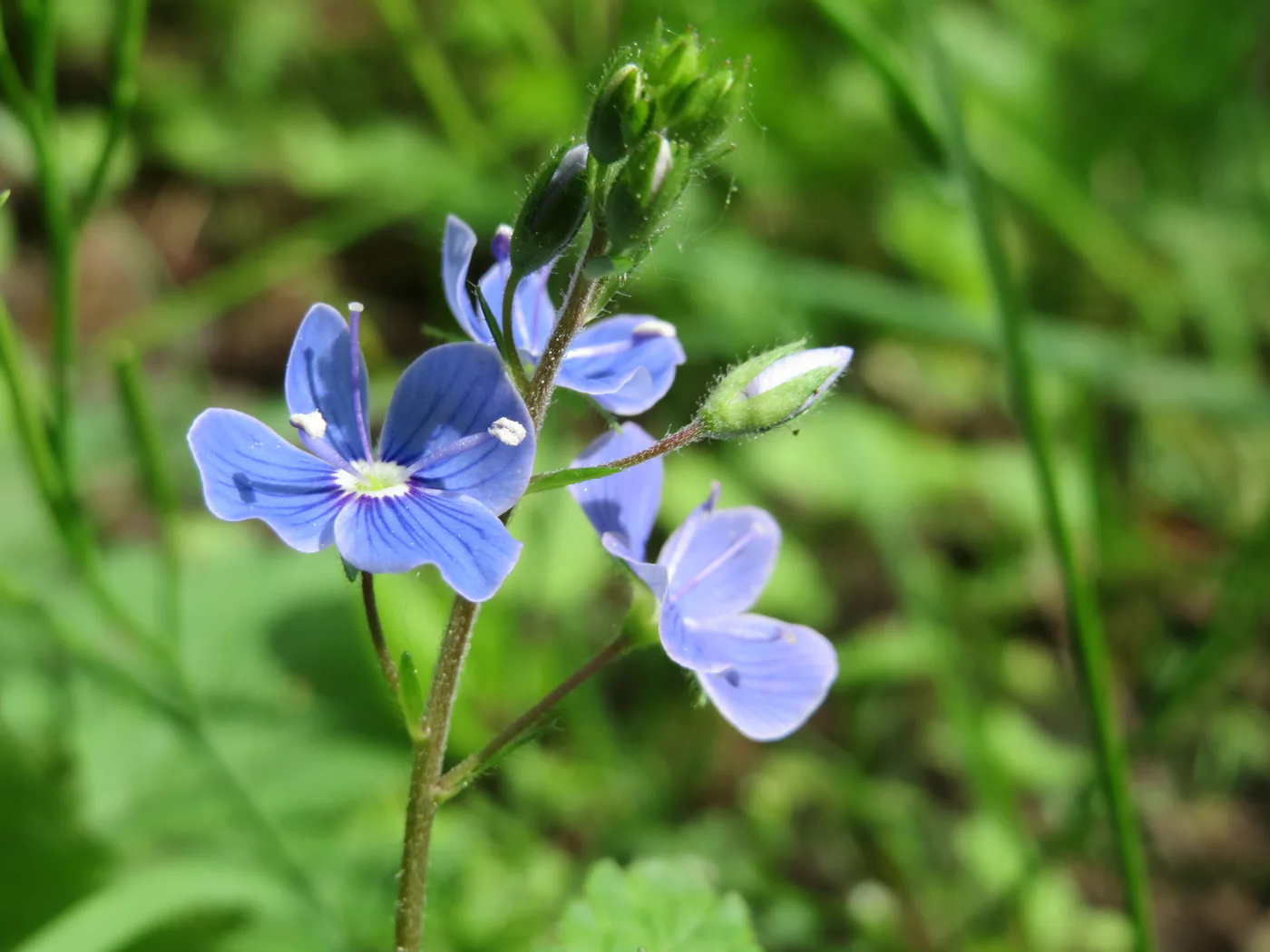
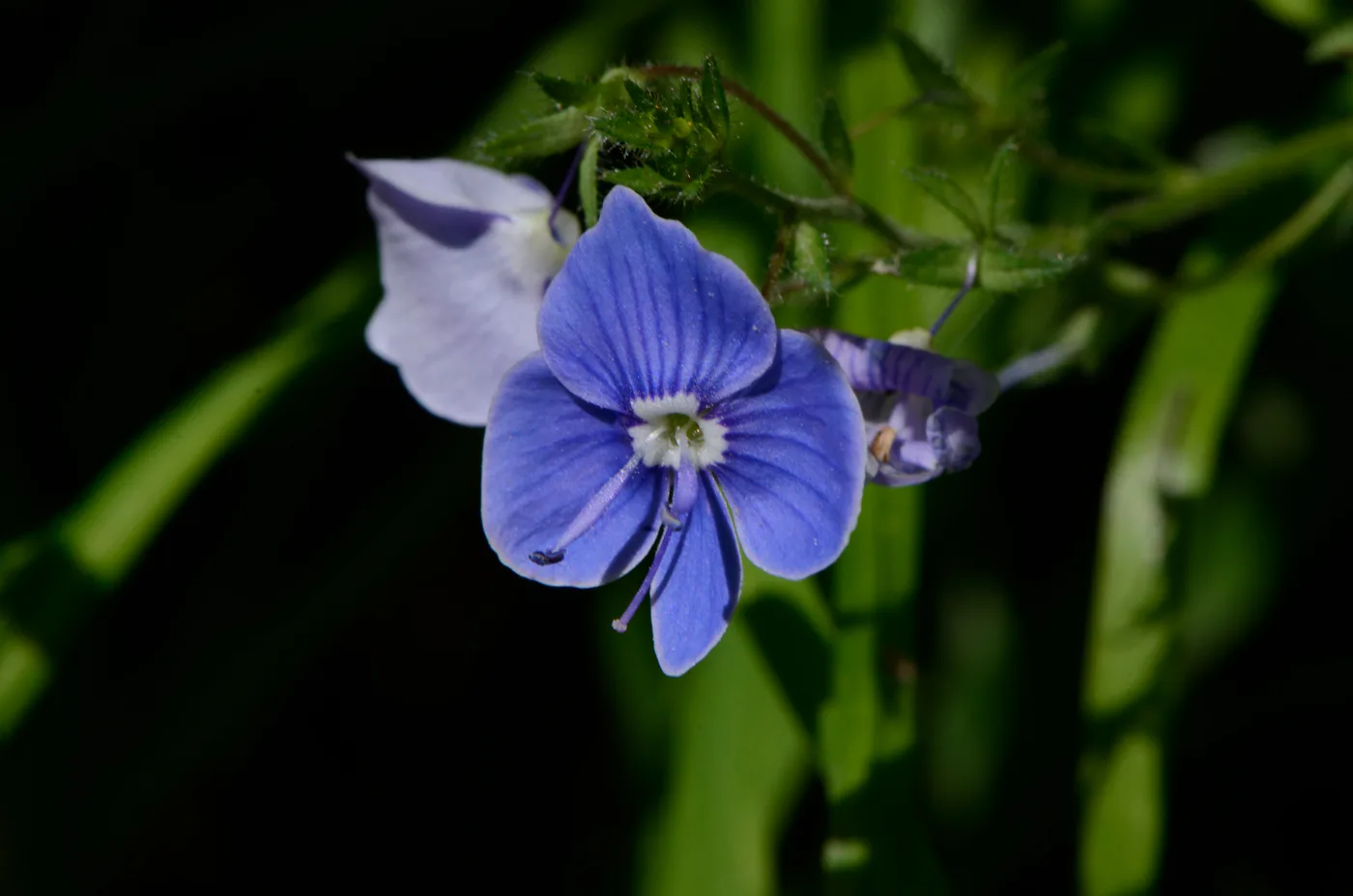
- Small, bright blue flowers with darker blue veins and a distinct white centre, normally about 1 cm across.
- Each flower has four blue lobes, with the lower one noticeably smaller and narrower than the other three.
- Two stamens project from the flower, one on either side of the central style.
- Flowers grow in loose clusters on stalks arising from the upper leaf axils, rather than singly from each axil.
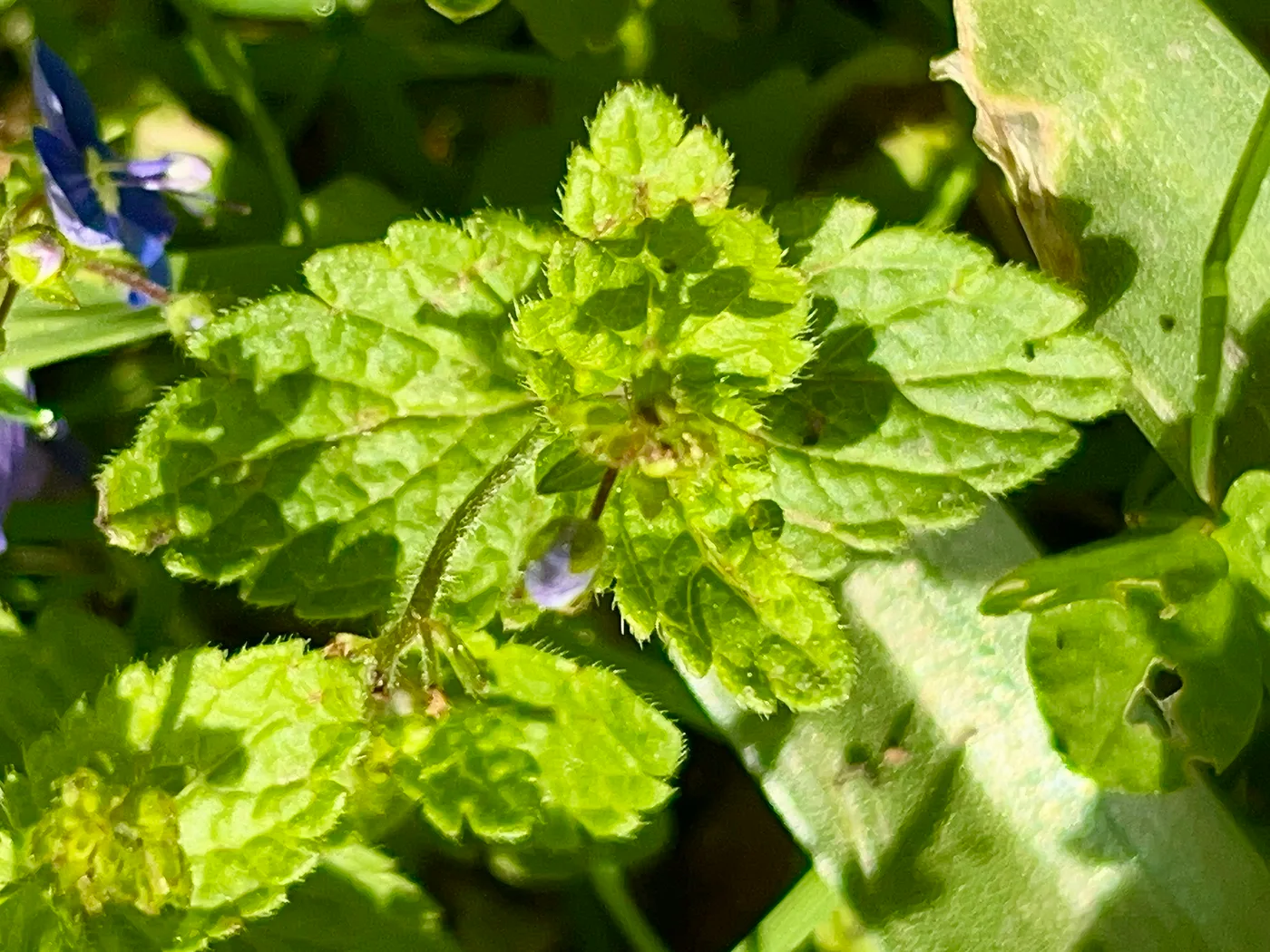
- The leaves occur in opposite pairs; they are broadly oval to triangular, with pointed tips and conspicuously toothed edges.
- Look closely at a flowering stem for two opposite lines of long, whitish hairs, rather than hairs distributed evenly all the way around it.
The two lines of stem hairs are one of the best ways to distinguish Germander Speedwell from other British speedwells, particularly when its flowers are past their best.
Flower structure
Each flower has a small corolla formed from four unequal blue lobes. Although these can look like four separate petals, they are joined at the base. The lower lobe is smaller, giving the flower a slight bilateral symmetry. Fine darker veins lead inwards towards its white centre.
There are two stamens, an unusually small number when compared with many other members of Plantaginaceae. Between them is a single style, arising from an ovary made of two fused carpels. The green calyx usually has four lobes and remains after the corolla falls.
The flowers are arranged in short, loose racemes that emerge from the axils of the upper leaves. A raceme has separate flower stalks, or pedicels, attached along a main axis. This is a useful distinction from some smaller speedwells, which carry solitary flowers directly in the leaf axils.
After flowering, the plant develops small, flattened capsules containing seeds.
Leaves and stems
The leaves grow in opposite pairs along the stem and are generally oval to triangular, with a pointed tip and large, rounded teeth along the edges. They have little or no obvious leaf stalk and are usually slightly hairy.
Germander Speedwell’s stems are slender, sometimes reddish, and often lie along the ground before turning upwards at the flowering tips. On the upright parts, the longer hairs are characteristically concentrated in two longitudinal lines on opposite sides of the stem.
This is worth checking with a hand lens. Other speedwells can have similar blue flowers, but their stem hairs are arranged differently.
Habitat
Germander Speedwell is widespread throughout much of Britain. It grows in both open grassland and lightly shaded places, including:
- meadows, pastures and rough grassland
- hedgebanks and woodland edges
- roadside verges and grassy paths
- lawns and churchyards
- woodland clearings and open woods
Its creeping habit allows it to spread into loose patches, while the flowering shoots rise above the surrounding leaves to catch the light.
Flowering period
Germander Speedwell is most often in flower from March to July, sometimes continuing into August. It is particularly noticeable in late spring and early summer.
Similar species
- Slender Speedwell (Veronica filiformis) also has blue flowers, usually a little paler. Its flowers are carried singly on long, slender stalks from the leaf axils, rather than in the short flower clusters typical of Germander Speedwell. Its leaves are smaller and more rounded.
- Wood Speedwell (Veronica montana) favours shady woodland and usually has paler blue or lilac flowers. Its stems are hairy all around, rather than displaying the two characteristic rows of hairs of Germander Speedwell.
- Heath Speedwell (Veronica officinalis) often grows in heaths and dry, acidic grassland. It has paler blue flowers in relatively narrow racemes and creeping, hairy stems. Again, it lacks the obvious two opposed rows of long hairs.
- Common Field-speedwell (Veronica persica) usually bears single flowers on long stalks from the leaf axils. It is familiar in cultivated ground and gardens, and its blue flowers often have a more conspicuously pale lower lobe.
Where the names come from
Speedwell is an old wish for a safe or successful journey. The ‘germander’ part refers to the resemblance of the leaves to those of true germanders, which are quite different plants.
Veronica has several proposed origins, including a traditional association with Saint Veronica, but no single explanation is certain. Chamaedrys derives from Greek words meaning ‘ground’ and ‘oak’, referring to a low plant with oak-like leaves.
Folklore & history
According to a familiar piece of folklore, travellers sometimes carried or wore speedwell as a token of good luck on their journey.
Germander Speedwell has also been called bird’s-eye, cat’s-eye and blue eyes. The names make sense when you see the little white centre staring out from a ring of brilliant blue. The plant appears in older herbals, where speedwells were made into infusions and washes for a range of traditional remedies.
There is something rather fitting about a wildflower associated with good journeys: its blue flowers are often found along the very lanes and paths people have travelled for centuries.
Wildlife
The open, shallow flowers offer pollen and nectar to small bees, hoverflies and other visiting insects. Their blue veining and pale centre help draw the eye towards the reproductive parts.
Germander Speedwell also contributes to the variety of low-growing wildflowers in grassland and along hedgerows, making these places more useful to pollinating insects during spring and early summer.