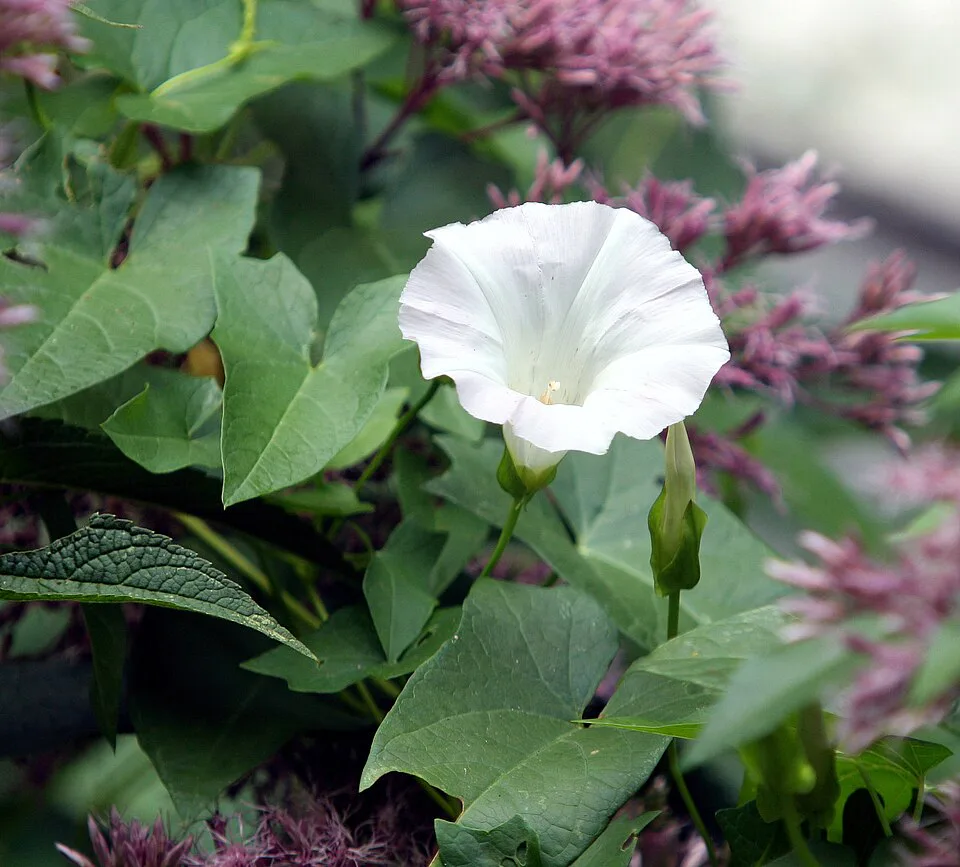
Hedge Bindweed is a familiar native climbing perennial of British hedgerows, riverbanks and woodland edges. Its long stems wind through neighbouring vegetation, carrying broad, arrow-shaped leaves and large white, trumpet-shaped flowers. It belongs to Convolvulaceae, the bindweed family.
Identification
- A vigorous climber with slender, twining stems that can reach 3 m or more.
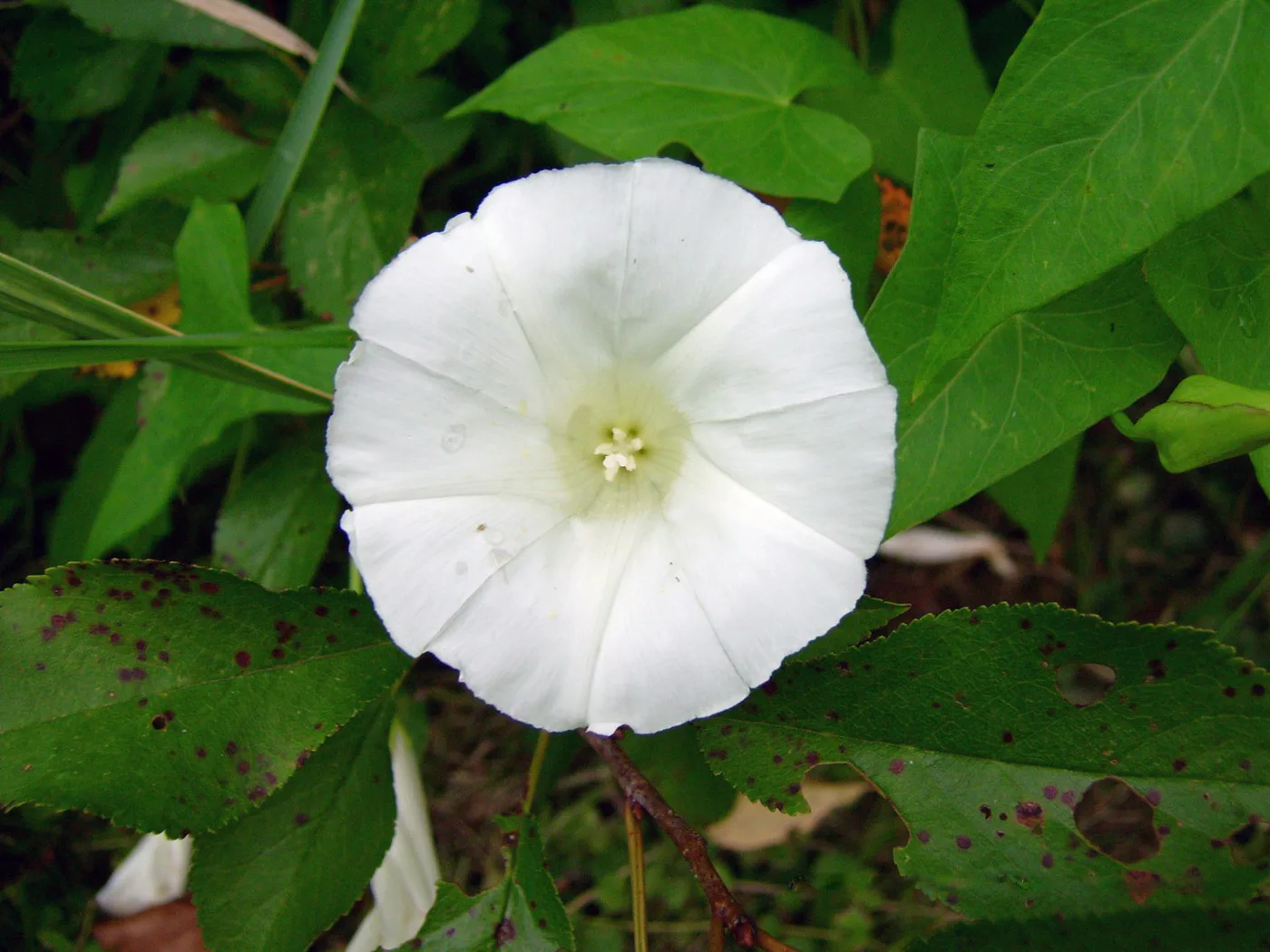
- Large, usually white, funnel-shaped flowers, commonly about 3–7 cm across.
- Flowers borne singly on long stalks from the leaf axils.
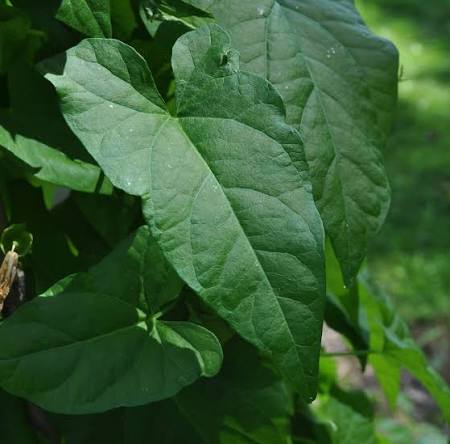
- Alternate, arrow-shaped leaves with two pointed lobes at the base.
- Two prominent green bracteoles immediately below each flower; in Hedge Bindweed they scarcely overlap, leaving the sepals partly visible.
- Spreading underground rhizomes from which new shoots emerge.
The flower’s size and the shape of its leaves are useful first clues. To distinguish it confidently from Large Bindweed, look at the two green bracteoles below the flower.
Flower structure
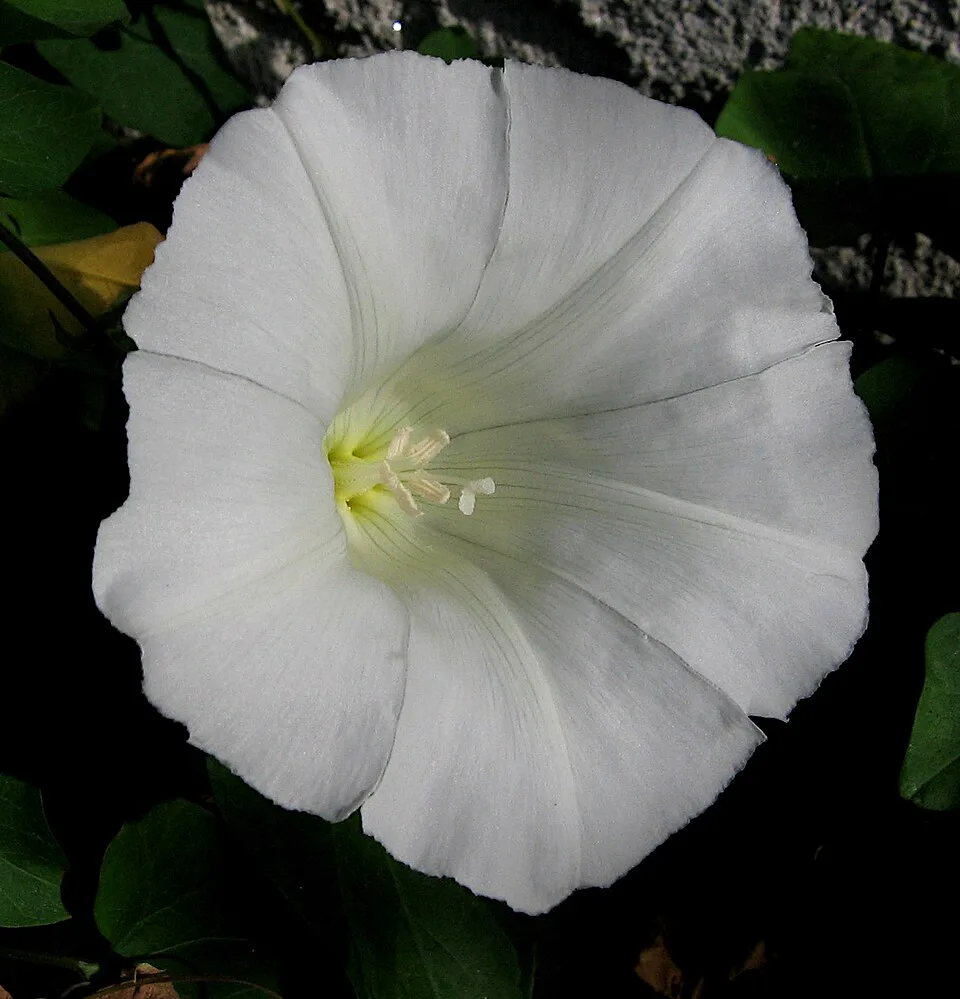
Each large trumpet is a single flower, not a cluster. Five fused petals form the wide, funnel-shaped corolla. The lines and folds running towards the centre show where the five petal regions meet.
Inside are five stamens with pollen-bearing anthers, surrounding a style that ends in two pale stigma lobes. The ovary is superior, sitting within the base of the flower.
Below the corolla are five green sepals and, outside them, two larger, leaf-like bracteoles. These bracteoles are especially useful when comparing closely related bindweeds. After flowering, a rounded capsule develops, containing a small number of seeds.
Leaves and stems
The leaves are usually triangular or arrow-shaped, with a long, pointed tip and two backward-pointing lobes where the leaf blade meets its stalk. They are arranged alternately along the stems.
The smooth, flexible stems climb by winding around other plants rather than using tendrils or clinging roots. Hedge Bindweed also spreads underground through an extensive network of rhizomes, allowing it to form dense patches.
Habitat
Hedge Bindweed is common in hedgerows, scrub, damp woodland margins, ditches, riversides and rough ground. It often grows among tall grasses, nettles and shrubs, where other plants provide support for its climbing stems. It grows in sun or partial shade.
Flowering period
The main flowering period is June to September. Individual flowers often open during the day and close again in dull weather or towards evening. New flowers continue to appear along the growing stems through summer.
Similar species
- Large Bindweed (Calystegia silvatica) also has broad white trumpet flowers and arrow-shaped leaves. Its two green bracteoles at the flower base are usually broader and overlap substantially, concealing most or all of the sepals. In Hedge Bindweed the bracteoles overlap little, so the sepals can be seen between them.
- Field Bindweed (Convolvulus arvensis) usually has smaller flowers, often white or pink with darker stripes, and narrower leaves. Its two small bracts sit farther down the flower stalk, rather than immediately beneath the sepals.
- Sea Bindweed (Calystegia soldanella) is a low, trailing coastal species with rounded, fleshy, kidney-shaped leaves and pink-and-white flowers. Its habitat and growth habit are very different from those of Hedge Bindweed.
Where the names come from
The common name describes the plant’s habit of binding itself around hedges and other vegetation as it climbs. It has also been called Bellbind and Hedge Bells, referring to its showy bell-like flowers.
Calystegia comes from Greek words relating to a covering or cup, an allusion to the large bracteoles enclosing the base of the flower. The Latin sepium means ‘of hedges’, referring to its usual habitat.
Folklore & history
Hedge Bindweed has accumulated many country names, including Bellbind, Bearbind, Hedge Bells and Lady’s Nightcap. Its white trumpets were likened to bells or small caps, while the twining stems gave rise to names suggesting that the plant could tie or bind things together.
It has long been a conspicuous plant of field boundaries and riverside thickets. Gardeners know it for the persistence of its underground stems, which can send up fresh shoots after the visible plant has been removed.
Wildlife
The flowers provide nectar and pollen for visiting insects, including bees and moths. Their broad, open trumpets make the floral centre accessible to a range of pollinators.
The leaves also serve as food for some moth caterpillars, including the Convolvulus Hawk-moth. Tangled stems can provide shelter within hedgerows and scrub.