Herb-robert is a familiar but easily overlooked wildflower of shady lanes, woodland edges and old walls. Its little pink flowers are held above finely cut leaves, and its slender stems often turn a striking red. Crush a leaf gently and you may notice its distinctive, rather pungent scent. It is a native member of Geraniaceae, the cranesbill family.
Identification
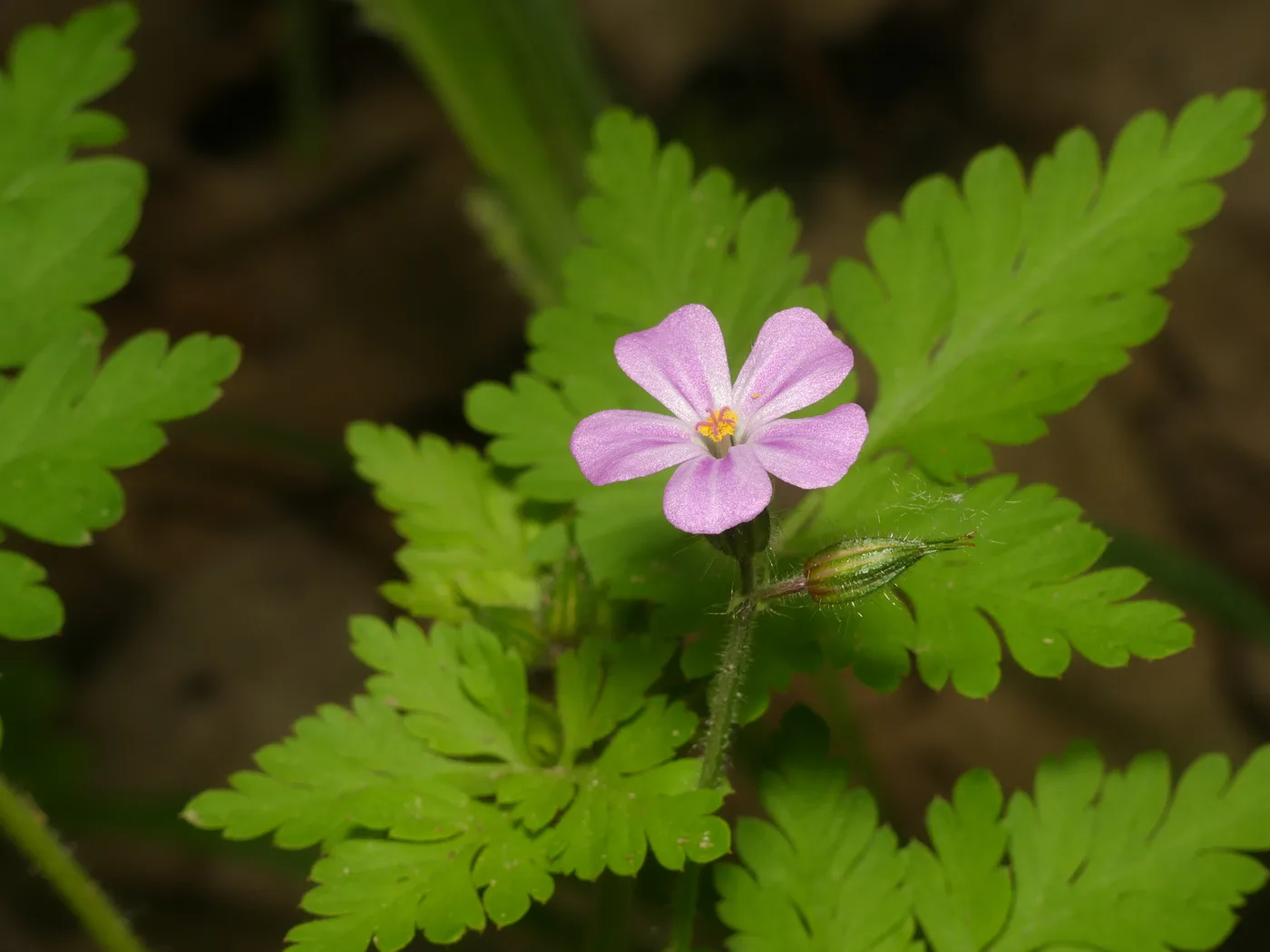
- Small, open, pink flowers, usually around 1–1.5 cm across, with five petals and often fine pale veins.
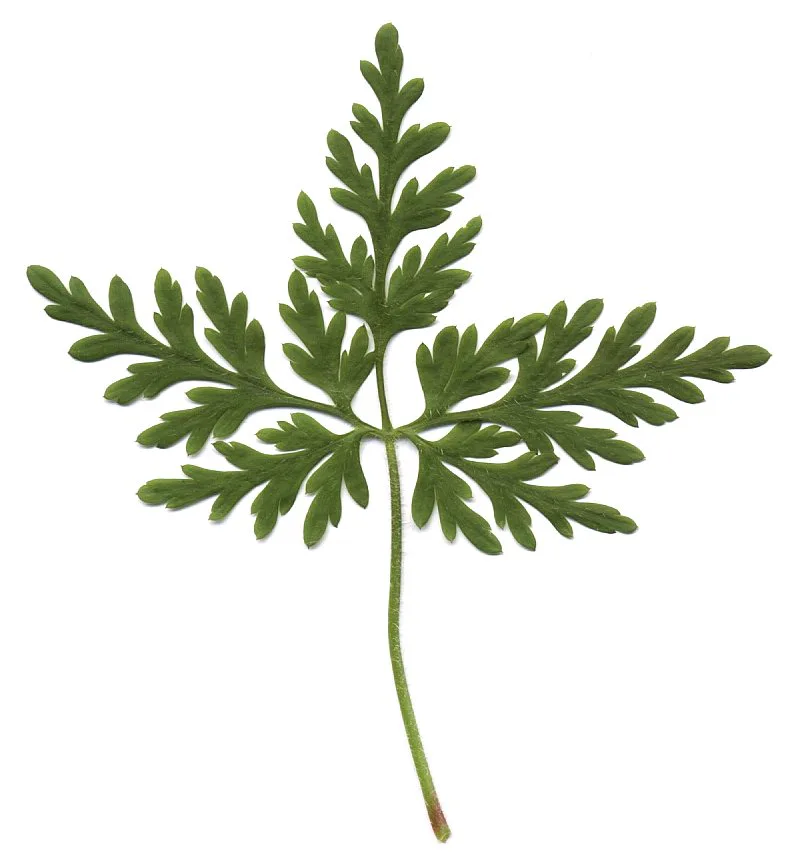
- Delicate leaves divided almost to their base into three to five main sections, each with smaller lobes.
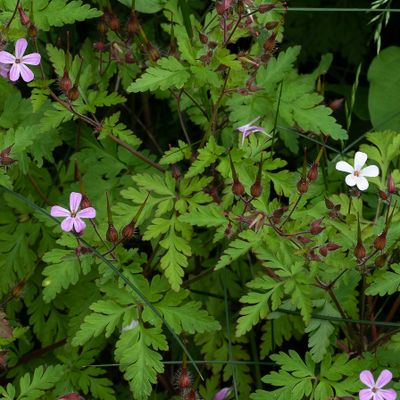
- Softly hairy stems and flower buds; the stems and older leaves often turn crimson, especially on exposed, dry or sunny sites.
- Leaves arranged in opposite pairs along the stems.
- A strong, rather musky or mousy smell when the foliage is rubbed or crushed.
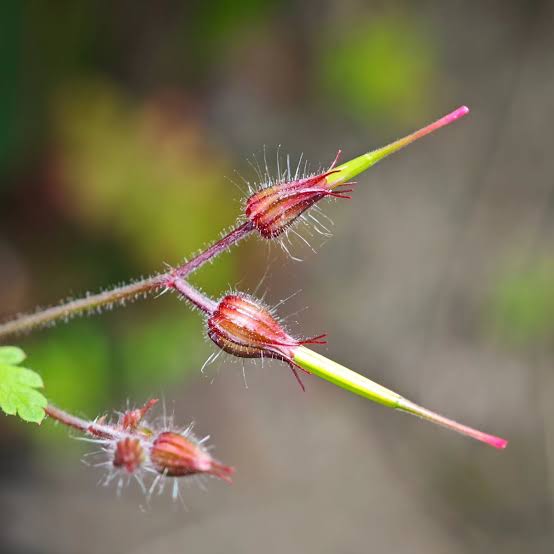
- After flowering, thin, pointed seed-bearing structures appear, recalling the long bill of a bird.
The combination of deeply divided foliage, small pink flowers and reddish stems is particularly distinctive. Herb-robert is usually an annual or biennial, and it often seeds itself into cracks where very little soil is visible.
Flower structure
Each flower has five separate petals, five sepals, usually ten stamens, and a central female structure formed from five joined carpels. The petals are typically pink with lighter veins and may have a slight notch at the tip. Most flower stalks carry one or two flowers.
Once the flower has been pollinated, the ovary grows into a slender, beak-like fruit. The name cranesbill refers to this long pointed shape, which resembles a crane’s beak. At maturity, the five one-seeded sections, called mericarps, separate as springy strips curl upwards and fling their seeds away from the parent plant.
Leaves and stems
The leaves are sometimes described as fern-like, though Herb-robert is a flowering plant rather than a fern. Each leaf is deeply divided from a common point in a roughly palmate arrangement, and the main divisions are themselves cut into smaller lobes. The overall shape is often triangular or pentagonal.
Young foliage is bright or dark green, but older leaves may develop reddish edges or turn entirely red. Stems are thin, branching and hairy, with reddish joints. This colouring is particularly noticeable on plants growing in sunlight or drought-stressed cracks in stonework.
A useful way to separate Herb-robert from other cranesbills is to combine the leaf shape with the strong scent of its bruised foliage.
Habitat
Herb-robert grows in woodland, hedgerows, along shady paths and beside walls, but it can also thrive on dry rocks, coastal cliffs and in garden corners. It frequently establishes itself between stones or in the mortar of old walls.
Although commonly associated with shade, it tolerates a surprisingly wide range of conditions. It is widespread in Britain and Ireland and is often one of the first wildflowers to appear in a neglected shady corner.
Flowering period
Herb-robert commonly flowers from April into October, with the strongest display often from late spring through summer. In mild places or favourable years, individual plants may begin earlier or continue into November.
Its long flowering season provides a useful supply of nectar and pollen to visiting insects.
Similar species
- Dove’s-foot Cranesbill (Geranium molle): has rounder, softly hairy leaves with broader, shallower lobes and generally smaller, notched pink petals.
- Hedgerow Cranesbill (Geranium pyrenaicum): usually a larger, more robust plant with rounder leaves and flowers often in pairs; it lacks Herb-robert’s especially finely dissected foliage.
- Shining Cranesbill (Geranium lucidum): has shiny, rounded leaves with broad lobes, rather than the matt, finely cut leaves of Herb-robert. Its stems can also become bright red.
Where the names come from
Herb-robert preserves an old name linked with ‘Robert’ or ‘Robin’, but exactly who or what it refers to is disputed. Suggestions include Saint Rupert or Robert, Robin Goodfellow, and a connection with the plant’s red colour.
Geranium comes from Greek geranos, ‘crane’, because the fruit has a long crane’s-bill shape. Robertianum is the Latinised form of the old Robert name; it does not establish which of the competing stories is correct.
Folklore & history
Herb-robert has collected a remarkable variety of old names, including Red Robin, Stinking Bob and St Robert’s Herb. Stories involving Robin Goodfellow, the mischievous spirit of English folklore, and a saintly herbal healer have both become attached to the plant.
Its conspicuously red stems and strong smell helped make it memorable in village folklore. It was sometimes carried as a charm for good luck or fertility. Traditional herbalists used the plant in preparations associated with wounds, nosebleeds and stomach complaints, and crushed leaves were also rubbed on the skin in attempts to repel insects.
These stories are part of the plant’s long cultural history, as much a feature of old lanes and cottage gardens as its pink flowers.
Wildlife
The small, open flowers are visited by bees, hoverflies and other insects, and their long flowering period makes them valuable in both gardens and woodland edges. The foliage also supports some moth larvae, including the Barred Carpet moth.
When its fruits ripen, Herb-robert disperses seeds with a spring-like flick, helping new plants appear some distance away in gaps, cracks and bare ground.