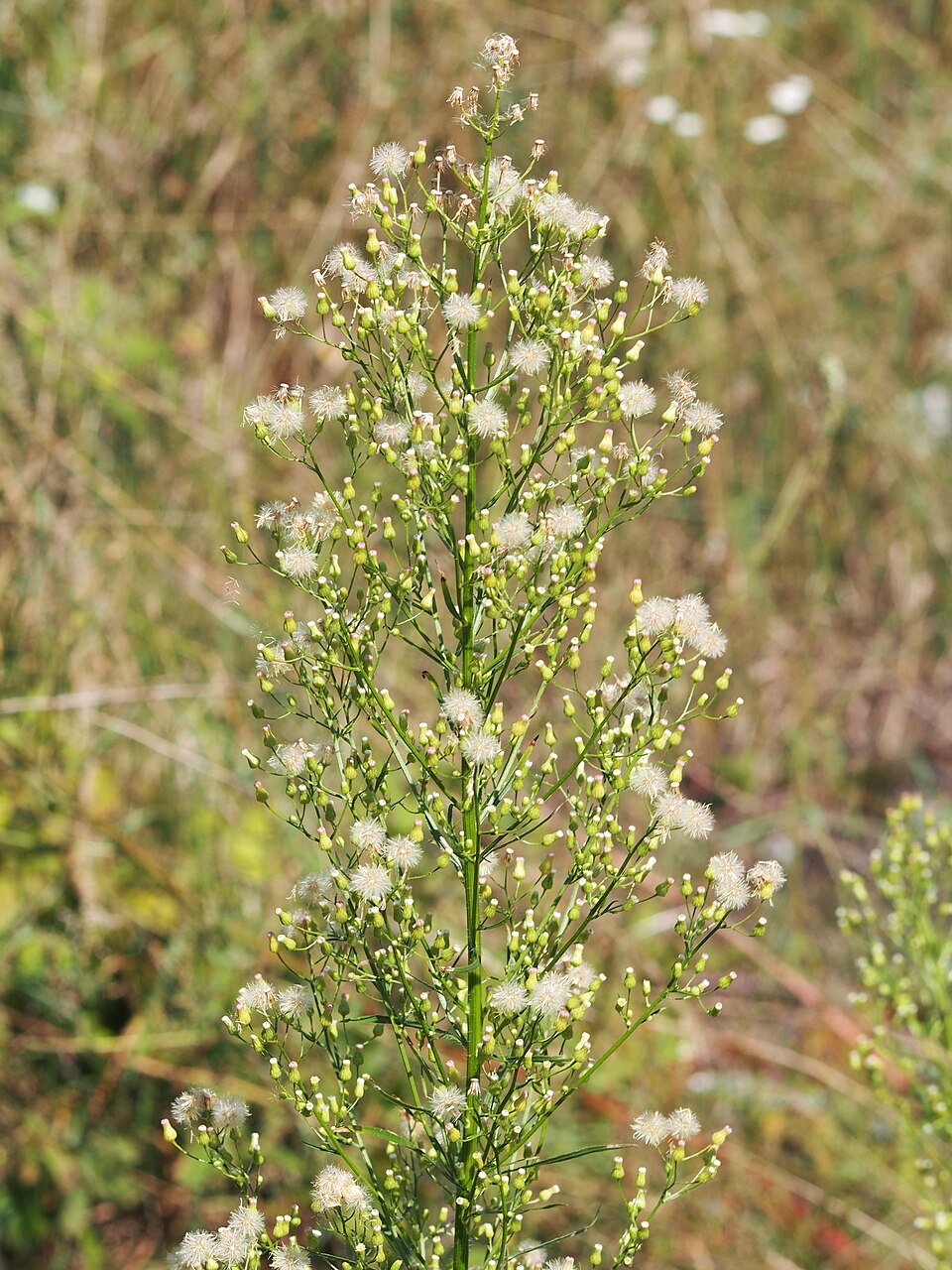
Horseweed, also called Canadian Fleabane, is a tall, slender annual of disturbed ground, roadside verges and cracks in paving. Its numerous tiny, pale flower heads can be easily overlooked, but the narrow leaves crowded along the upright stem and the broad, branching spray at the top give it a distinctive outline. It belongs to the daisy family, Asteraceae. Native to North America, it has become widely established in Britain.
Identification
- Usually 30–150 cm tall, sometimes taller in favourable conditions, with an upright, often hairy stem.
- Narrow, lance-shaped leaves crowded along the stem, becoming smaller towards the top.
- A branching, often pyramidal cluster of numerous tiny, greenish-white flower heads.
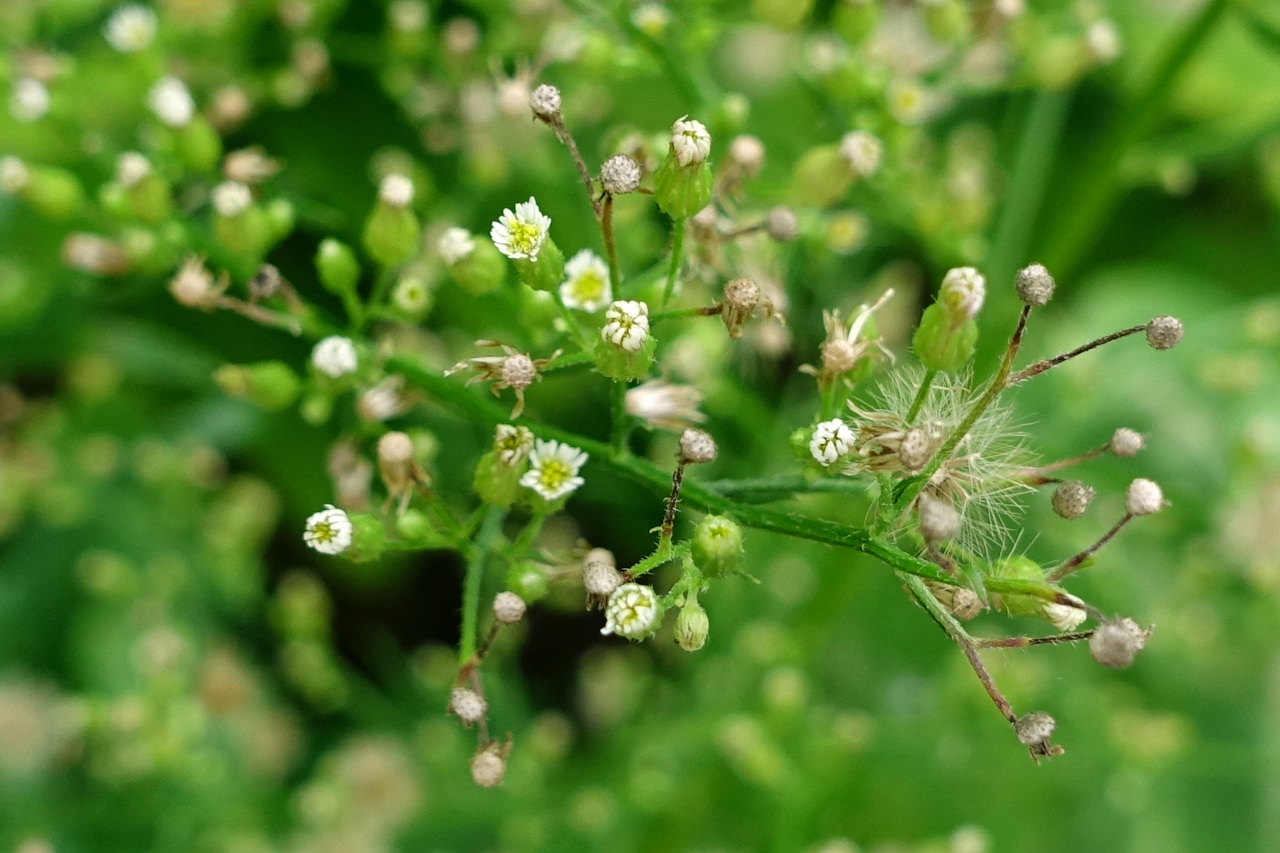
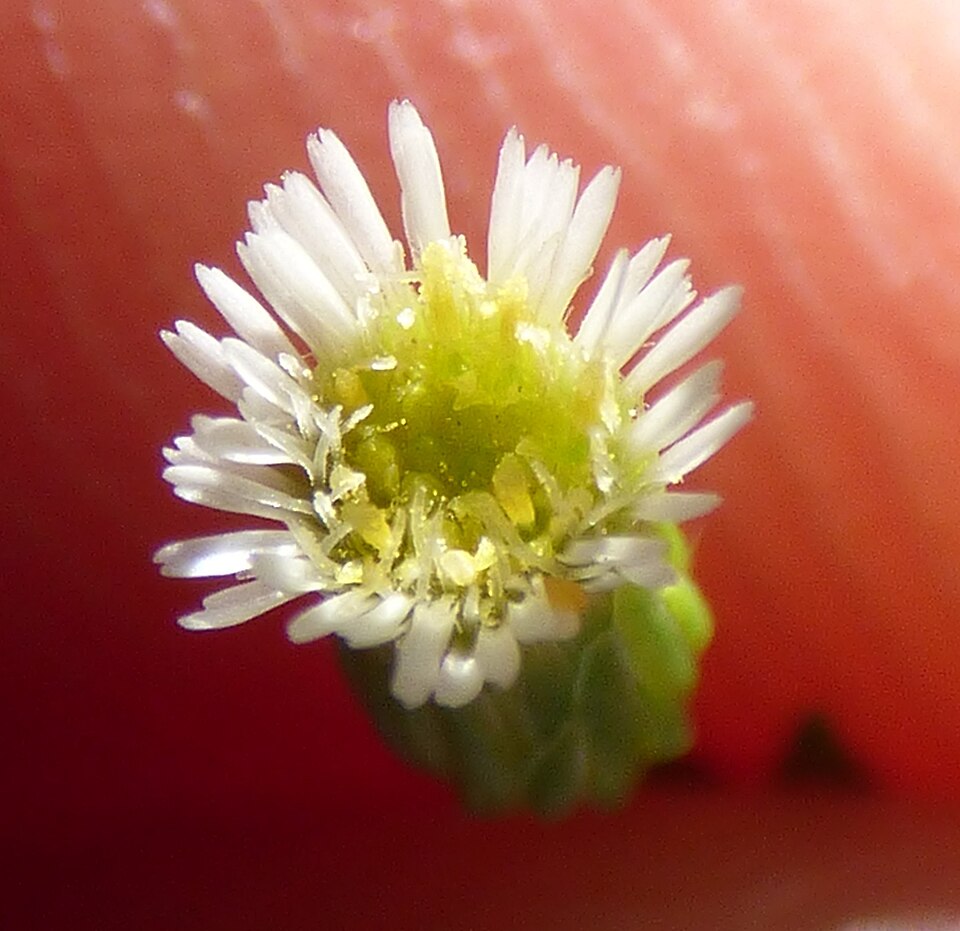
- Each head is only a few millimetres across, with extremely short white or slightly pinkish ray florets surrounding yellowish disc florets.
- Young plants begin as a low rosette of more broadly shaped, hairy leaves.
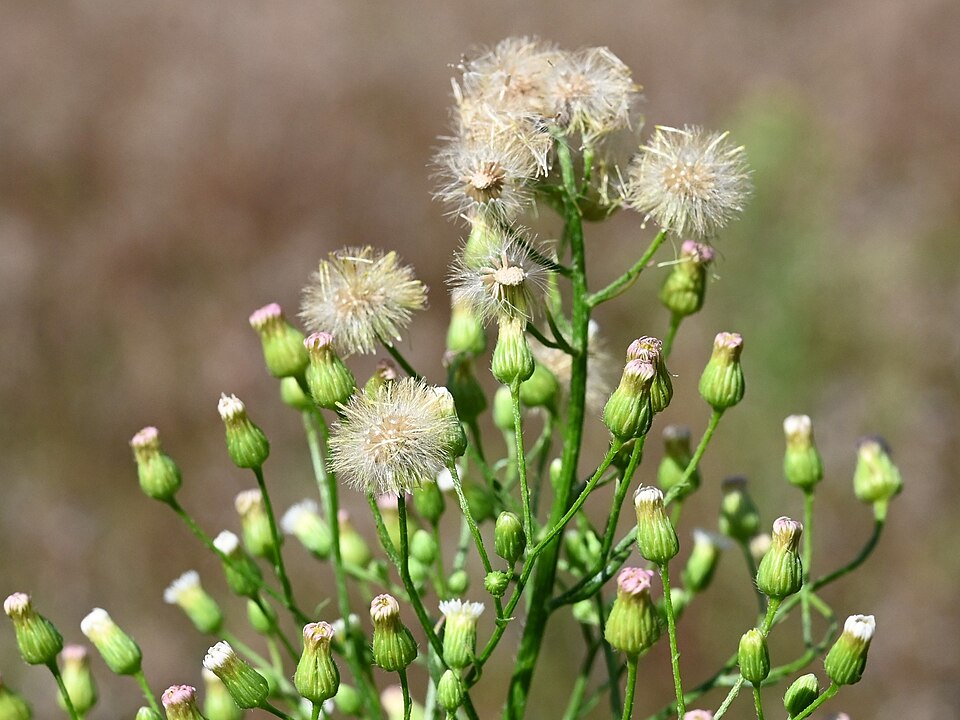
- The small dry fruits develop silky white hairs forming a pappus, helping the seeds travel in the wind.
The combination of an upright leafy stem, narrow leaves and a large spray of almost inconspicuous little flower heads is a useful recognition feature.
Flower structure
Although the flower heads are much smaller than those of most daisies, Horseweed has the same composite structure. Each head is a capitulum made up of many tiny individual florets, surrounded by overlapping green bracts.
The outer ray florets have very narrow white, sometimes pink-tinged, petals that scarcely project beyond the head. The central disc florets are tubular and yellowish. Seen without a hand lens, an open flower head can resemble a small green bud with a pale rim rather than a familiar daisy.
After flowering, each fertile floret produces a small, dry, one-seeded fruit, or achene. Its fine, white pappus hairs help carry it away from the parent plant.
Leaves and stems
The lower leaves are relatively broad, often lightly toothed and hairy. As the stem lengthens, the leaves become narrower and more numerous. They are arranged alternately, sitting close to the stem rather than forming obvious pairs.
The main stem remains upright, with much of the branching concentrated towards the top. This gives a mature Horseweed plant a narrow, column-like lower half and a loose, branching upper half.
Habitat
Horseweed thrives wherever vegetation has been disturbed and bare ground is available. It grows on waste ground, in pavement cracks, beside railway lines, on field margins and along roadsides. It can establish itself on dry, stony or sandy soils, often appearing quickly after ground is cleared.
It arrived in Europe from North America several centuries ago and is now widespread in lowland Britain, particularly in towns and other disturbed habitats.
Flowering period
Flowering is mainly from June to October in Britain. As autumn progresses, the inconspicuous heads develop into small, pale seed tufts, which may remain visible after the leaves have begun to fade.
Similar species
- Guernsey Fleabane (Erigeron sumatrensis) is a larger, often greyer-looking relative, with more conspicuously hairy stems and flower-head bracts.
- Bilbao Fleabane (Erigeron floribundus) also produces numerous small heads but tends to be coarser and more densely hairy.
- Common Fleabane (Pulicaria dysenterica) has much larger yellow flower heads and broad, often clasping leaves, making it easy to distinguish when flowering.
Where the names come from
Horseweed is one of several common names used for this plant. Canadian Fleabane refers to its North American origins, while the name Fleabane recalls the old belief that certain strongly scented plants could drive away fleas.
Erigeron comes from Greek words associated with ‘early’ and ‘old man’, referring to the appearance of the white seed hairs, sometimes seen while a plant is still flowering. Canadensis means ‘from Canada’. The plant is also widely known by its older scientific name, Conyza canadensis.
Folklore & history
Horseweed was introduced from North America and was recorded in Europe by the seventeenth century. Older herbals referred to Canadian Fleabane as Fleawort or Colt’s-tail, and described its use in preparations for diarrhoea and to help stop bleeding. The name Blood-stanch reflects this traditional use.
Its rapid spread along roads, railways and newly disturbed land is a familiar part of its history in Britain. What began as an introduced plant became an everyday feature of urban and agricultural landscapes.
Wildlife
The many small flower heads offer pollen and some nectar to visiting insects. Horseweed also produces large numbers of lightweight seeds. Their feathery pappus hairs allow them to be carried on the wind, helping the plant quickly colonise new patches of bare ground.