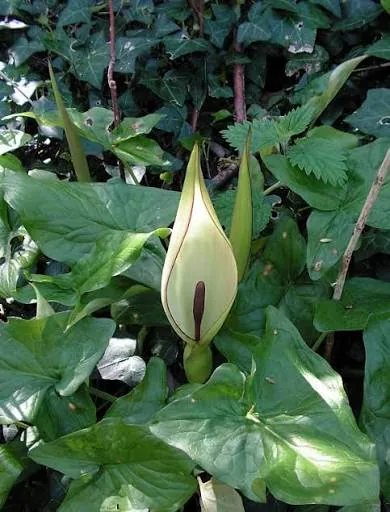
Lords-and-ladies is a distinctive woodland plant with glossy arrow-shaped leaves and one of the most unusual flower structures among common British wildflowers. In spring, a pale green hood surrounds a club-shaped central spike; later in the year, the plant can be recognised by its conspicuous column of orange-red berries.
It is also widely known as Cuckoo-pint and belongs to the arum family, Araceae.
Identification
- Usually around 15–40 cm tall.
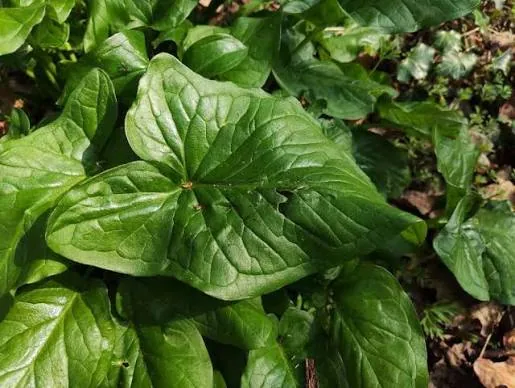
- Leaves are glossy, arrow-shaped or spear-shaped, with two backward-pointing basal lobes.
- Leaves may be plain green or marked with dark purple or blackish spots.
- The flowering structure has a pale green, hood-like spathe.
- Inside the spathe stands a club-shaped spadix, usually purple-brown or yellowish.
- The actual flowers are tiny and hidden low down on the spadix.
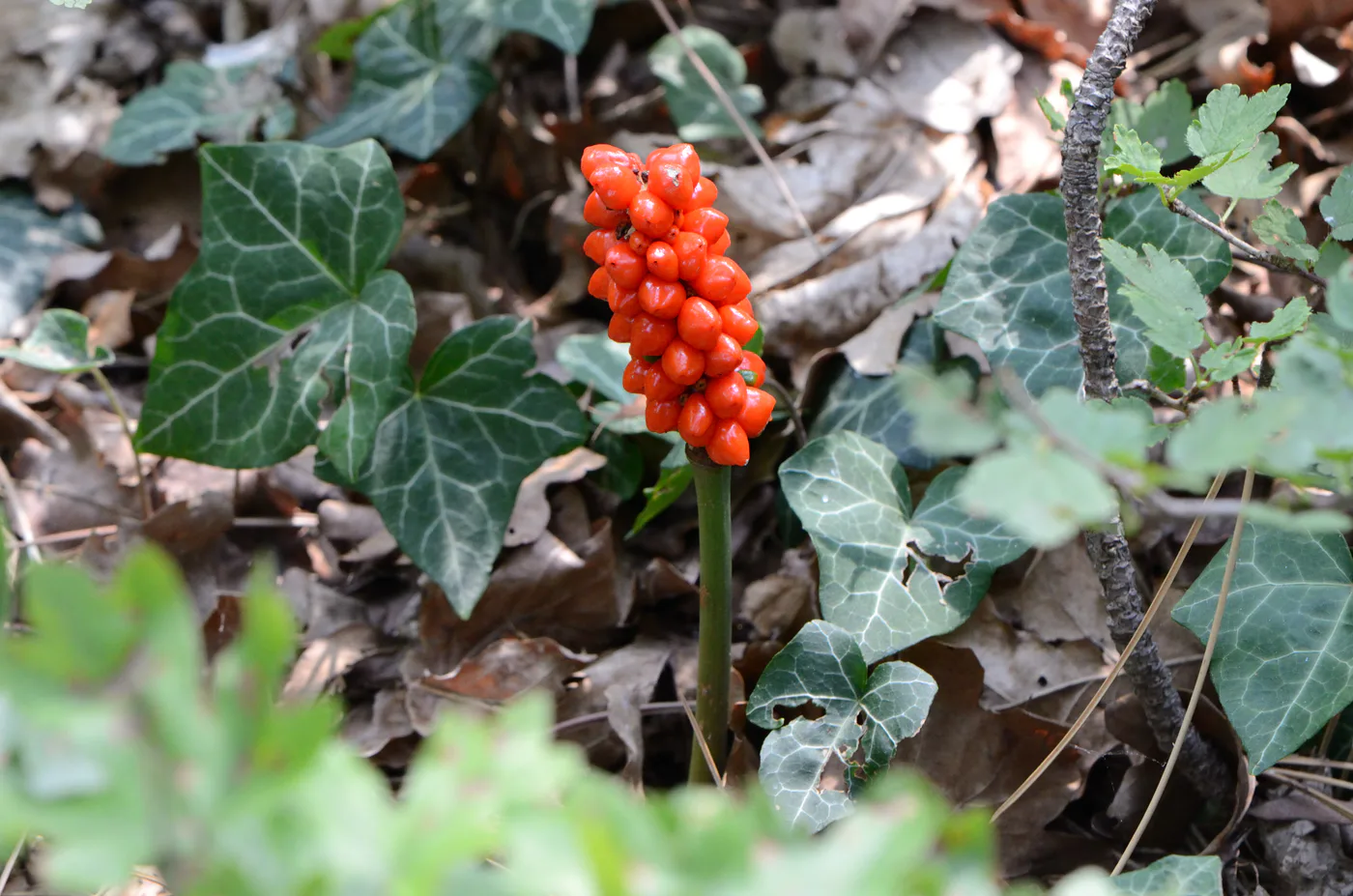
- Later, the flowering structure is replaced by a dense upright spike of orange-red berries.
- The foliage normally dies back before the berries become fully conspicuous.
The combination of shiny arrow-shaped leaves, the hooded spring inflorescence and the later red berry spike is highly distinctive.
Flower structure
What looks like one large flower is actually a specialised inflorescence.
The pale green outer structure is the spathe, a modified leaf that wraps around the central spadix.
The visible upper part of the spadix is not itself a flower. The tiny true flowers are grouped lower down, hidden inside the base of the spathe. Female flowers occur below the male flowers.
The plant has an extraordinary pollination system. The spadix can warm up and release an unpleasant dung-like smell that attracts small flies, especially moth flies. The insects enter the lower chamber and are temporarily trapped, helping transfer pollen between plants before they escape.
Leaves
The leaves emerge in spring and are glossy and arrow-shaped.
The two basal lobes point backwards, producing the characteristic arrowhead outline. Some plants have obvious dark spots on the leaves, while others are completely unspotted, so the absence of spots does not rule out Lords-and-ladies.
By summer the leaves usually wither and disappear.
Berries
After flowering, the female flowers develop into a tight spike of berries.
The fruits begin green and ripen through orange to a vivid orange-red. Because the leaves have often disappeared by then, the berry spike can seem to rise from the ground by itself.
The berries and other parts of the plant are poisonous and should not be eaten. The plant contains irritating needle-like calcium oxalate crystals.
Habitat
Lords-and-ladies is particularly associated with shady and semi-shady places.
Typical habitats include:
- deciduous woodland
- woodland edges
- hedgerows
- shaded banks
- shady roadside verges
- old lanes and tracks
It is common across much of England and Wales and occurs in many long-established woods and hedgerows.
Flowering and fruiting
The unusual green flower structure is usually seen in April and May.
The bright orange-red berries become conspicuous later in summer and into autumn.
Similar species
- Italian Arum (Arum italicum) is often grown in gardens and can escape into the wild. Its leaves commonly have conspicuous pale or whitish veins, giving them a marbled appearance. Lords-and-ladies normally has greener, less strongly veined leaves, although its leaves may carry dark spots.
Where the names come from
Lords-and-ladies is one of several suggestive folk names inspired by the flower’s unusual hood and upright central spike. Cuckoo-pint is another old English name, associated with the season when cuckoos return; the exact sense of ‘pint’ is debated.
Arum comes from the ancient Greek name aron for plants of this kind. Maculatum means ‘spotted’ in Latin, referring to the dark blotches that often mark the leaves, although not every plant has them.
Folklore and history
Few British plants have accumulated as many local names as Arum maculatum. Along with Lords-and-ladies and Cuckoo-pint, names recorded for it include Jack-in-the-pulpit and many older names inspired by the suggestive shape of the inflorescence.
Its unusual form also gave rise to a considerable amount of bawdy folklore.
Historically, starch was extracted from the underground tuber after elaborate processing, but the fresh plant is strongly irritating and poisonous.
Wildlife value
Lords-and-ladies has a particularly specialised relationship with small flies that pollinate its hidden flowers.
Its spring leaves also contribute to the ground flora of deciduous woodland, alongside plants such as Bluebell, Wood Anemone and Wild Garlic.