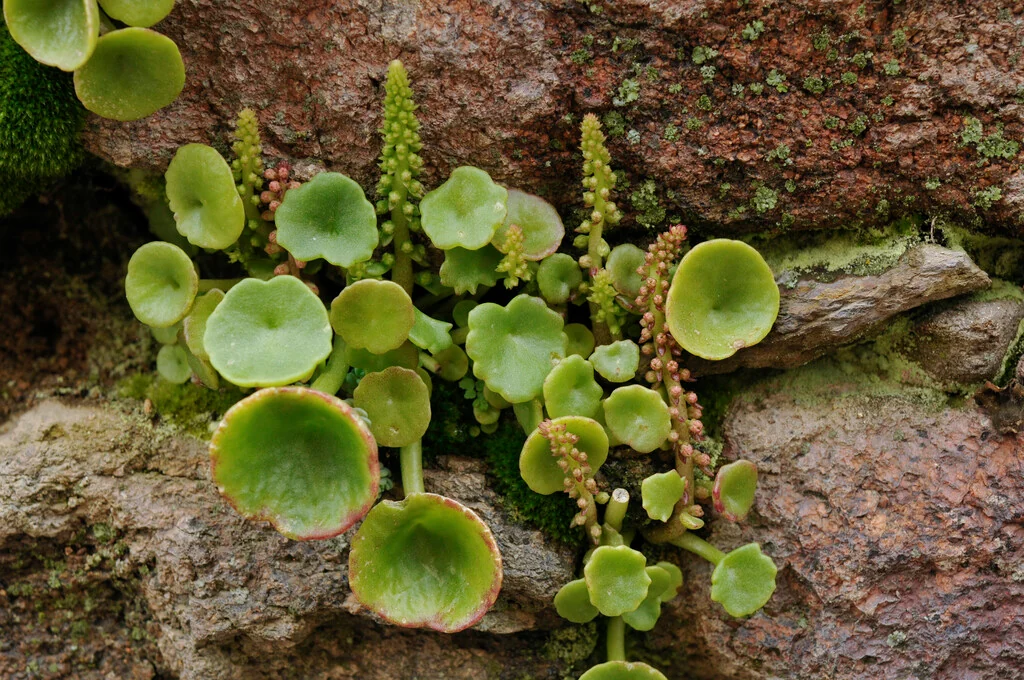
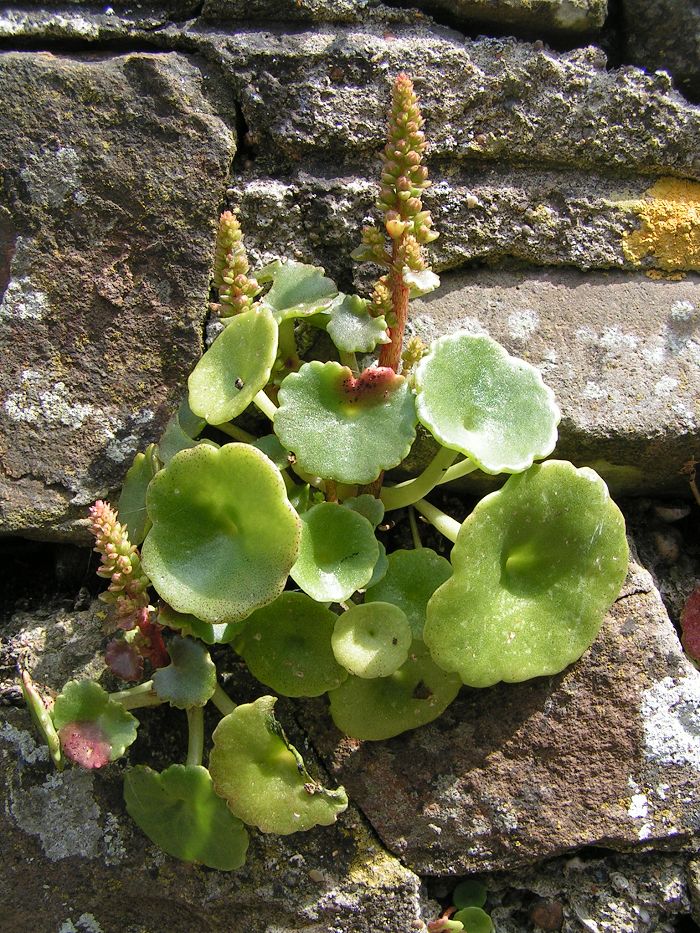
Navelwort, also called Wall Pennywort, is a distinctive native perennial of western Britain and Ireland. It is often found growing out of old stone walls, rocky banks and shaded crevices. Its fleshy, almost circular leaves look like little green coins, while slender stems bear drooping, pale flowers in early summer. It belongs to Crassulaceae, the stonecrop family.
Identification
- A small, hairless, succulent plant, usually around 10–30 cm tall but sometimes reaching 40 cm in flower.
- Rounded, fleshy, shallowly scalloped leaves, usually clustered near the base.
- A conspicuous small depression in the middle of each leaf blade, where the stalk joins on the underside.
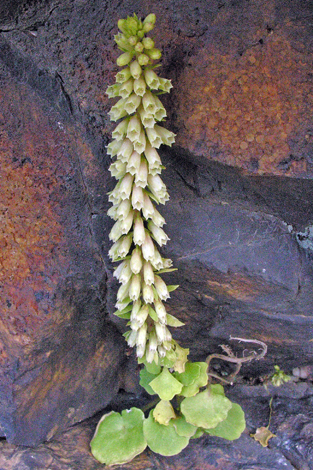
- Slender, upright flowering stems bearing many small, hanging, greenish-white to straw-coloured flowers.
- Usually growing from walls, rocky outcrops or stony banks, especially in damp or sheltered places.
The circular leaves are often the easiest way to recognise Navelwort, even when it is not in flower.
Flower structure
The flowering stem carries an elongated raceme of small, pendent flowers. Each flower has a short tubular to bell-shaped corolla, usually pale green, cream or straw-coloured, with five small lobes at the tip. The flowers tend to hang downwards rather than face outwards, giving the spike a delicate appearance.
Each flower has five sepals, ten stamens and five separate carpels. As the flowers mature, the carpels develop small, dry fruits containing numerous tiny seeds.
Leaves and stems
The leaf blades are nearly circular, fleshy and slightly scalloped around the edge. The stalk attaches to the underside near the middle, rather than to the edge. Botanists call this a peltate leaf. Looking down into the shallow central depression explains the common name Navelwort.
Most of the larger leaves grow near ground level, while those farther up the flowering stem become progressively smaller. Their succulent tissues allow the plant to store water, an advantage in thin soil pockets and wall crevices.
Habitat
Navelwort is characteristic of western Britain, particularly Wales, south-west England and western Ireland, and occurs farther north and east more locally. It favours the cracks of old walls, rock ledges, shaded banks, coastal cliffs and occasionally tree bases where moisture and a little soil collect.
It is especially noticeable in mild, moist areas, sometimes growing in large groups on walls and rocky banks.
Flowering period
Navelwort usually flowers from June to August. The pale flowers open along the upright spikes, and the flowering stems often persist after the blooms have faded.
Similar species
- Marsh Pennywort (Hydrocotyle vulgaris) also has rounded, centrally attached leaves, but it grows in wet ground and has creeping stems and tiny clustered flowers, rather than tall spikes.
- Garden Nasturtium (Tropaeolum majus) has rounded, centrally stalked leaves but much larger, brightly coloured flowers and a sprawling habit.
- Other stonecrops (Sedum species) have fleshy leaves and may grow on walls, but their leaves are not usually round and centrally stalked like those of Navelwort.
Where the names come from
Navelwort refers to the small, navel-like hollow in the centre of each leaf. Wall Pennywort describes both its favourite habitat and the coin-like shape of the leaves.
The scientific name Umbilicus is Latin for ‘navel’, while rupestris means ‘growing on rocks’. The plant was also known historically as Navel of Venus and Kidneywort.
Folklore & history
Navelwort has a long history in British and Irish herbal traditions. Its cool, fleshy leaves were laid on burns, cuts and sore skin, and were also used in poultices and ointments. Old regional names such as Corn-leaves reflect its use for treating corns and warts.
In parts of Ireland, Navelwort was traditionally planted on thatched roofs as a protection against lightning and fire. Medieval medicinal recipes also mention wall pennywort among plants used in preparations for wounds.
Wildlife
Its small flowers are visited by tiny bees, flies and other insects. Navelwort also provides greenery and cover in the sheltered, sometimes sparsely vegetated crevices where it grows.