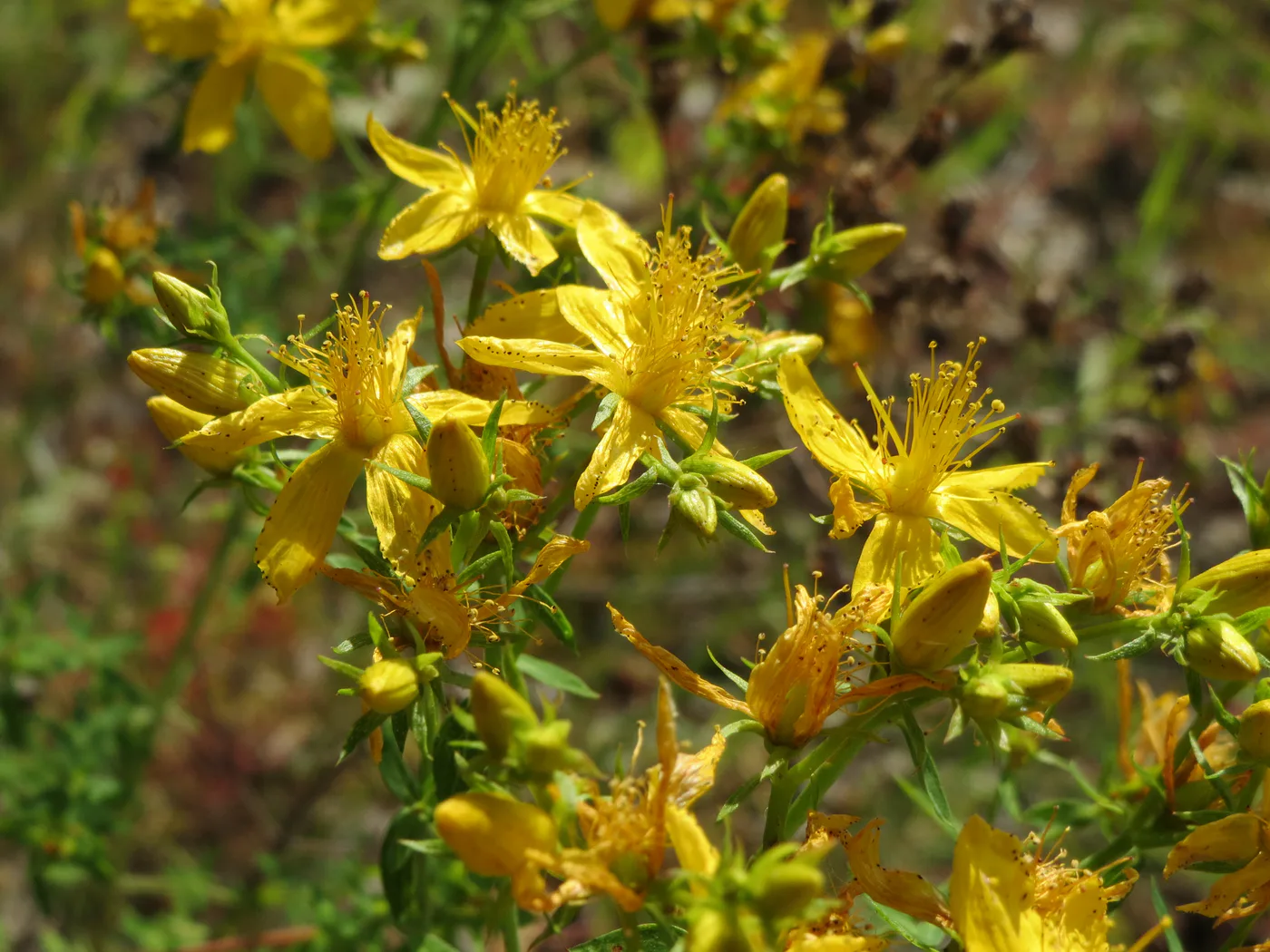
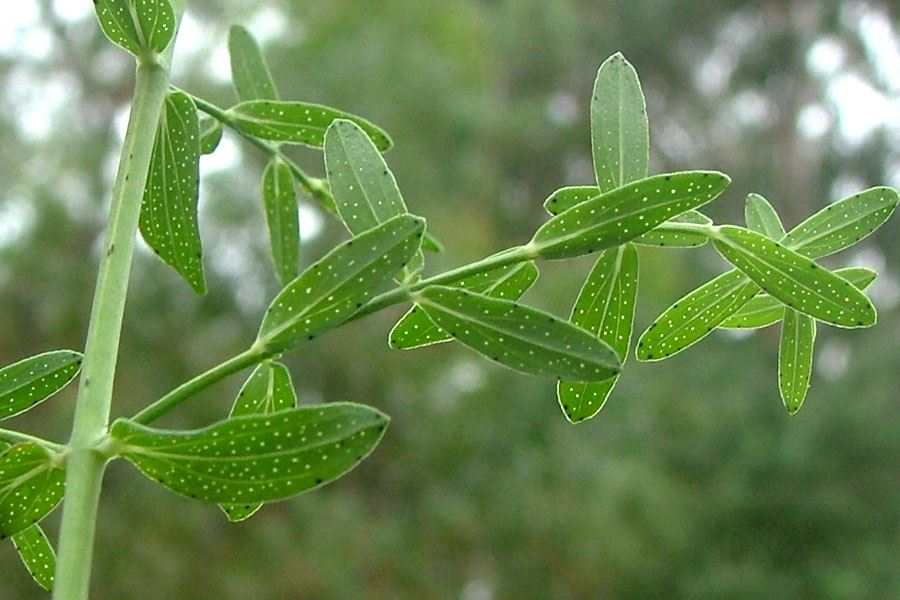
Perforate St John’s-wort is a native perennial wildflower of grassy banks, hedgerows and open ground. Its bright, golden-yellow flowers seem to catch the summer sunshine, with five spreading petals and a fountain of long yellow stamens. Its most distinctive feature, however, is hidden in the leaves: hold one against the light and it appears sprinkled with tiny pinholes. It belongs to Hypericaceae, the St John’s-wort family.
Identification
- An upright, usually hairless perennial, typically 30–80 cm tall but sometimes reaching about 1 m, with slender branching stems.
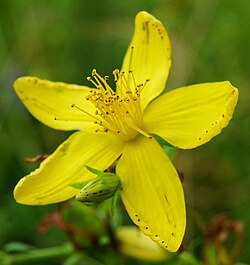
- Bright yellow, star-like flowers, roughly 2 cm across, each with five petals and numerous long yellow stamens.
- Tiny black dots or short dark streaks are often visible along the petal edges, particularly when viewed closely.
- Small, oval to narrow leaves arranged in opposite pairs, without obvious leaf stalks.
- Numerous colourless, translucent glands in the leaves; they look like small holes when a leaf is held towards the light.
- A rounded stem with two raised longitudinal ridges running along opposite sides — a valuable clue when distinguishing it from other St John’s-worts.
- After flowering, the plant forms small dry capsules containing many seeds.
The combination of translucent leaf dots, black-spotted yellow petals and a two-ridged stem is particularly useful for recognising this species.
Flower structure
Each flower has five separate yellow petals, five green sepals and a striking mass of stamens, usually grouped into three bundles. Unlike a daisy, this is a single flower, not a head made from lots of tiny florets.
The dark marks on the petals and sepals are pigment-bearing glands. Crushing a flower bud can release a reddish-purple liquid, giving a surprising contrast to the otherwise golden plant. The ovary develops into a dry seed capsule after pollination.
The individual flowers are carried in loose, branched clusters near the stem tips.
Leaves and stems
The leaves grow in opposite pairs along the stem and are small, oval to narrow, with little or no stalk. Their most striking feature is the multitude of tiny translucent glands. These give the leaves a perforated appearance when held against the light, although no tissue is missing. The clear spots are oil-containing glands that allow light to pass through them, and they are easy to see even without a hand lens.
The stem is generally smooth and rounded, but has two raised lines running down opposite sides. This two-ridged stem is a particularly useful feature for separating Perforate St John’s-wort from its close relatives.
Habitat
Look for Perforate St John’s-wort in dry or moderately dry grassland, rough meadows, hedgebanks, woodland edges, roadside verges and disturbed ground. It favours sunny or lightly shaded places.
It is widespread across much of Britain, particularly in England and Wales.
Flowering period
Perforate St John’s-wort generally flowers from June to September, with the first flowers often appearing around midsummer. Its golden-yellow flowers can continue well into late summer.
Similar species
- Square-stalked St John’s-wort (Hypericum tetrapterum) has a distinctly four-winged stem rather than two narrow ridges and is usually found in damper places.
- Imperforate St John’s-wort (Hypericum maculatum) also has yellow flowers, but its leaves generally lack the conspicuous translucent dots, and its stems have four ridges rather than two.
- Hairy St John’s-wort (Hypericum hirsutum) has noticeably hairy stems and leaves, unlike the usually smooth, hairless Perforate St John’s-wort.
Where the names come from
The name Perforate refers to the translucent glands that make the leaves appear pierced with tiny holes. The species name perforatum has the same meaning.
St John’s-wort reflects the plant’s association with the feast of St John the Baptist on 24 June. The old English word wort simply means a plant or herb. Hypericum is an ancient Greek plant name. One traditional explanation links it with placing the herb above religious images for protection.
Folklore & history
Few summer wildflowers are as closely linked with midsummer customs. St John the Baptist’s feast day falls on 24 June, near the summer solstice, when the plant begins to flower. Its radiant yellow flowers became symbols of sunlight and protection, while the reddish juice from its crushed buds was associated in Christian tradition with the blood of St John.
In European folklore, sprigs were gathered around Midsummer Eve and hung above doors, windows or religious images to guard a home against witches, evil spirits and misfortune. The plant was sometimes known as a ‘devil chaser’, and its reputation as a protective herb reaches back through many centuries of custom.
St John’s-wort also has a long herbal history. Its flowers were steeped in oil to produce a reddish preparation used for wounds, burns and skin injuries. Old herbals describe the plant under names including Touch and Heal and Balm of the Warrior’s Wound.
Wildlife
Its flowers supply pollen for bees and other visiting insects. Because the stamens are so abundant and exposed, pollen-seeking insects can work their way around the flower quite easily. The plant also supports insects associated with St John’s-worts.