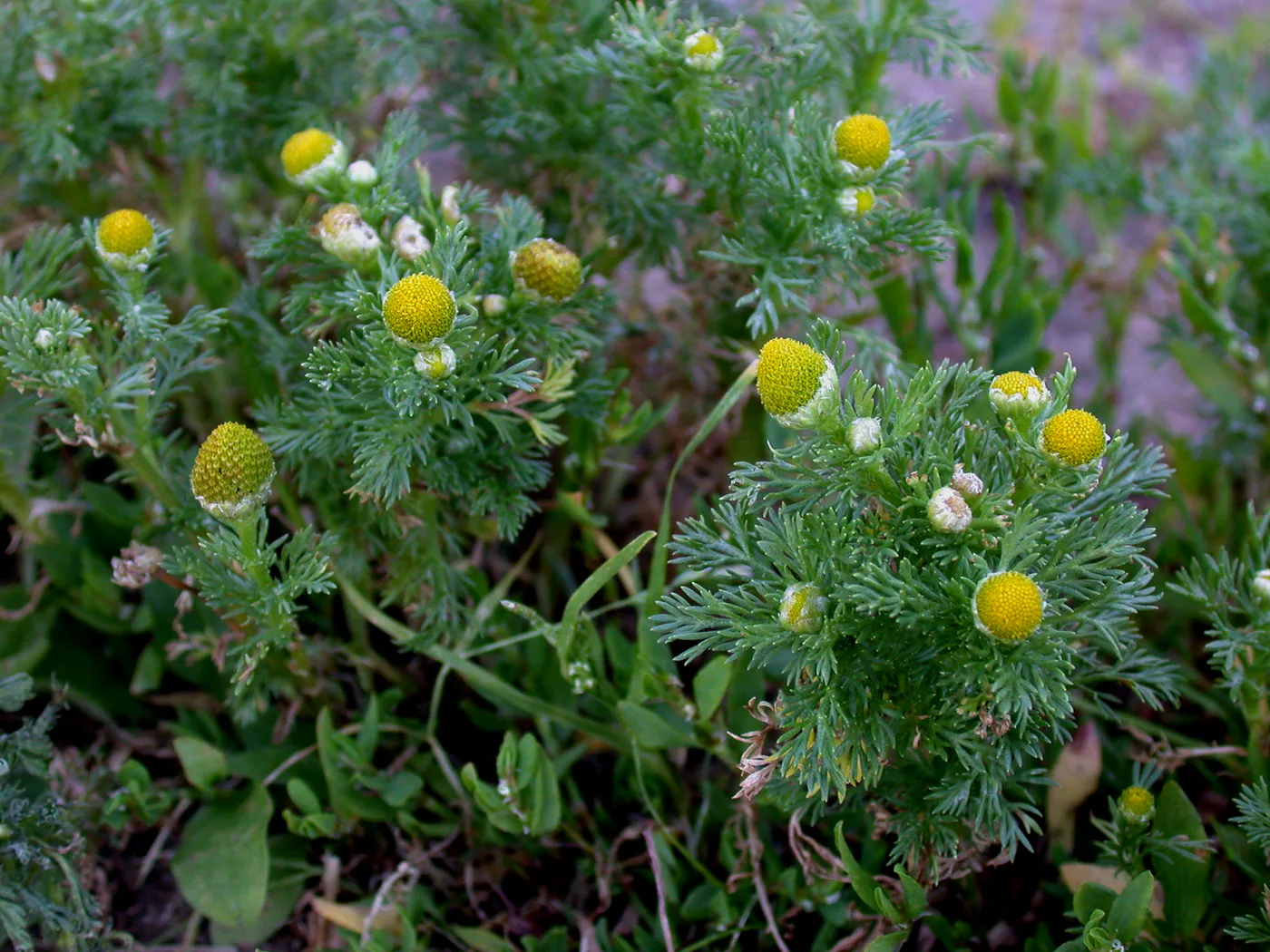
Pineappleweed is a small annual wildflower of paths, tracks, pavements, gateways, waste ground and other frequently disturbed places. It is particularly well adapted to compacted ground and is now widespread throughout Britain.
It belongs to the daisy family, Asteraceae. Like other members of this family, what looks like a single flower is actually a capitulum containing many individual florets.
Identification
- Usually low-growing, although plants can reach around 30–35 cm in favourable conditions.
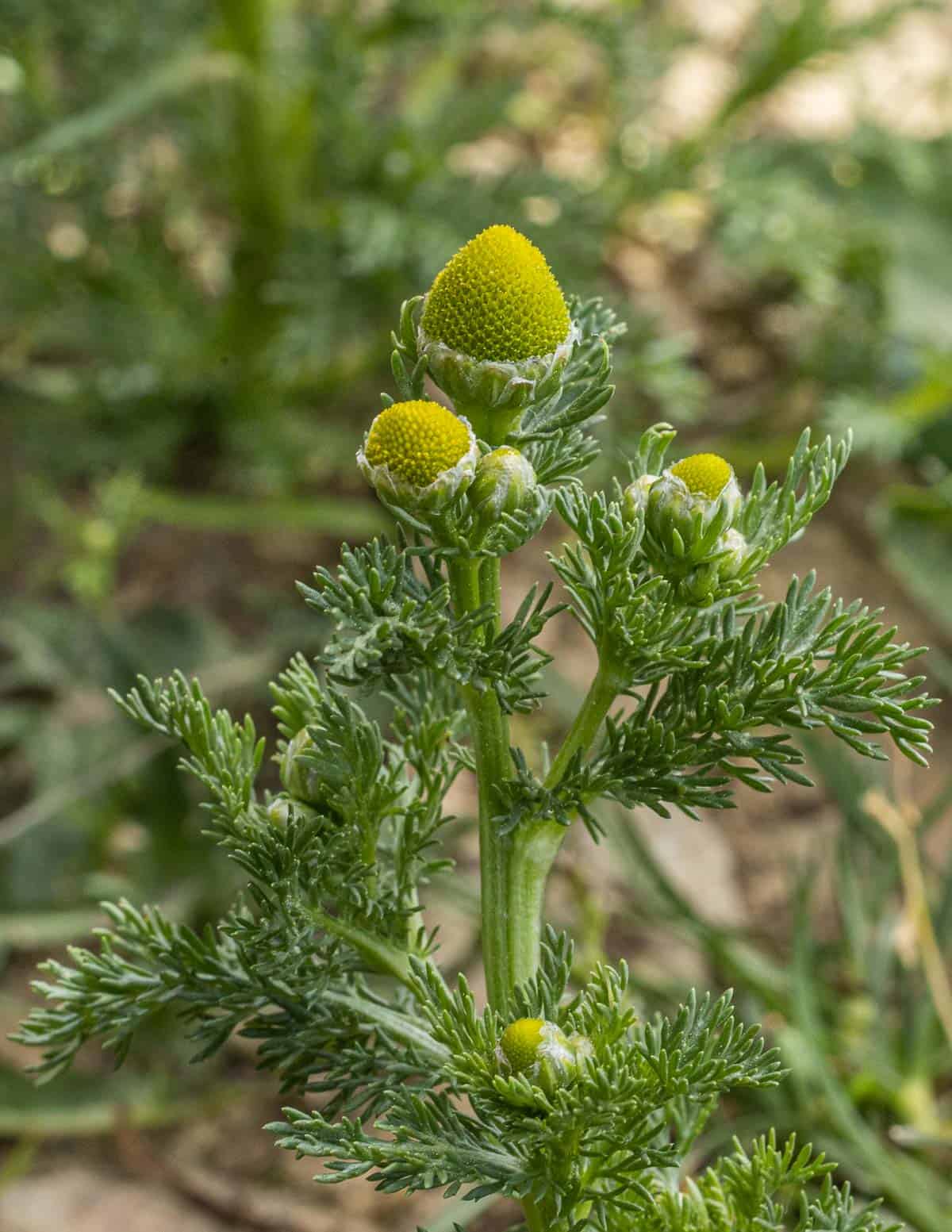
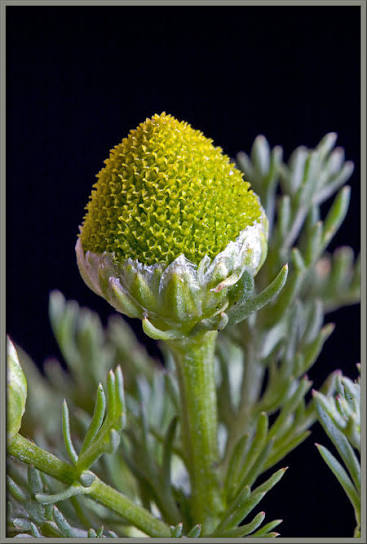
- Flower heads are small, rounded to conical and yellow-green.
- The heads have no obvious white or coloured “petals”.
- Leaves are bright green, soft-looking and very finely divided into narrow segments.
- Crushing the leaves or flower heads often releases a sweet pineapple-like scent.
- Stems branch freely, especially on plants growing in open ground.
- It commonly grows where the soil is compacted or repeatedly disturbed.
The combination of finely divided leaves, rayless conical flower heads and the characteristic scent makes Pineappleweed particularly distinctive.
Flower structure
Each flower head is a capitulum made up of numerous small tubular disc florets.
Unlike an Oxeye Daisy or Common Ragwort, Pineappleweed has no ray florets around the outside of the head. This is why the flower heads look like small rounded yellow-green buttons rather than conventional daisies.
The head becomes more distinctly conical as it matures, and is surrounded at the base by small green bracts.
Leaves and stems
The leaves are arranged alternately along the stems.
They are:
- bright to yellowish green
- deeply divided several times
- made up of narrow, almost thread-like segments
- soft rather than stiff or spiny
- strongly aromatic when crushed on many plants
The finely divided foliage gives the plant a feathery appearance.
Habitat
Pineappleweed is especially associated with places where vegetation is kept open by trampling, traffic or repeated disturbance.
Typical habitats include:
- paths and footways
- pavement cracks
- gateways
- tracks and farmyards
- roadside edges
- compacted waste ground
- field margins
- disturbed ground in towns and gardens
Its tolerance of trampling allows it to grow in places where many taller plants struggle to survive.
Flowering period
Pineappleweed can flower from May to November, with the main display usually occurring through summer.
In mild conditions flowering plants can sometimes persist surprisingly late into the year.
Similar species
- Scented Mayweed (Matricaria chamomilla) also has finely divided aromatic leaves, but its flower heads have obvious white ray florets surrounding a yellow centre.
- Scentless Mayweed (Tripleurospermum inodorum) has larger daisy-like heads with white ray florets and normally lacks the strong pineapple scent.
- Several related species have finely divided leaves, but Pineappleweed is unusual in combining a strongly aromatic plant with small conical heads that entirely lack showy ray florets.
Where the names come from
Pineappleweed gets its everyday name from the surprising pineapple-like scent given off when its foliage or flower heads are crushed. Another name, Rayless Mayweed, points to its lack of the showy white ray florets seen in many related daisies.
Matricaria is traditionally associated with Latin matrix, meaning ‘womb’, an allusion to historical herbal uses of plants in the group. Discoidea means ‘disc-like’, referring to the rounded flower heads composed of tiny disc florets.
Folklore & history
Pineappleweed is not native to Britain. It became established here during the late 19th century and spread rapidly during the following decades.
Its success has often been linked with roads and transport. Seeds can be moved in mud on feet, hooves, wheels and vehicle tyres, helping the plant travel between disturbed sites.
Pineappleweed has also been used traditionally in parts of its native range in ways similar to chamomile, particularly as an aromatic plant.
Wildlife
The small flower heads contain many individual florets, but they are less visually conspicuous to insects than the broad ray-and-disc heads of many other members of the daisy family.
Pineappleweed nevertheless contributes to the diversity of disturbed urban and farmland habitats, and its success in heavily trampled ground makes it one of the most characteristic wild plants of paths and gateways.