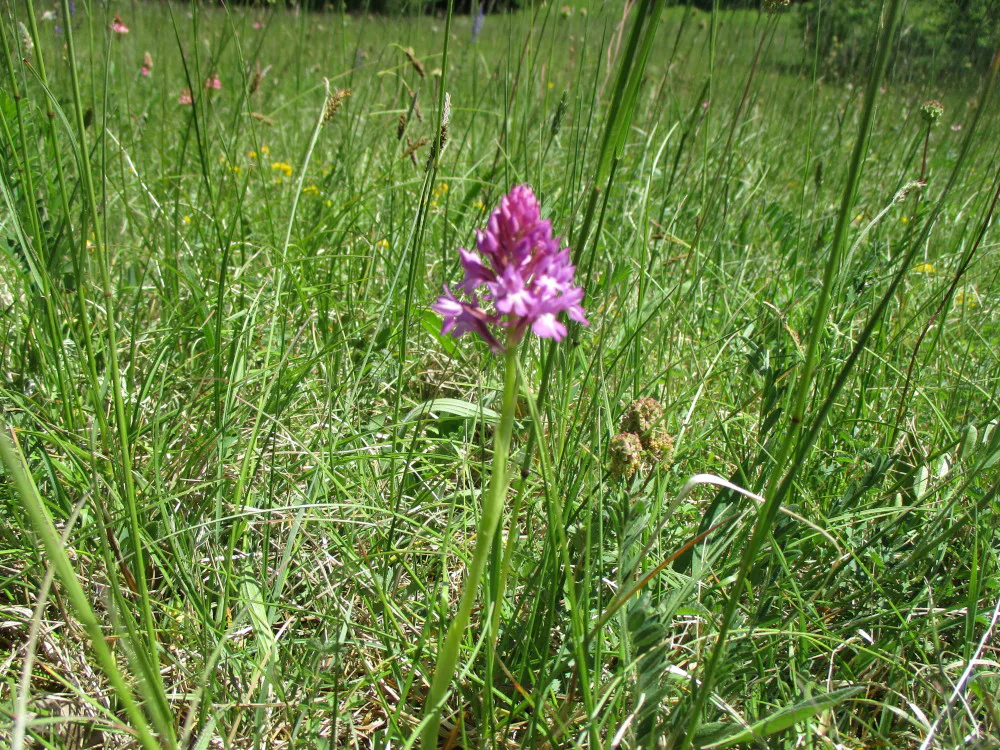
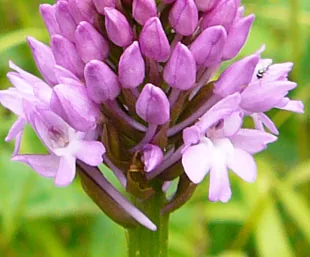
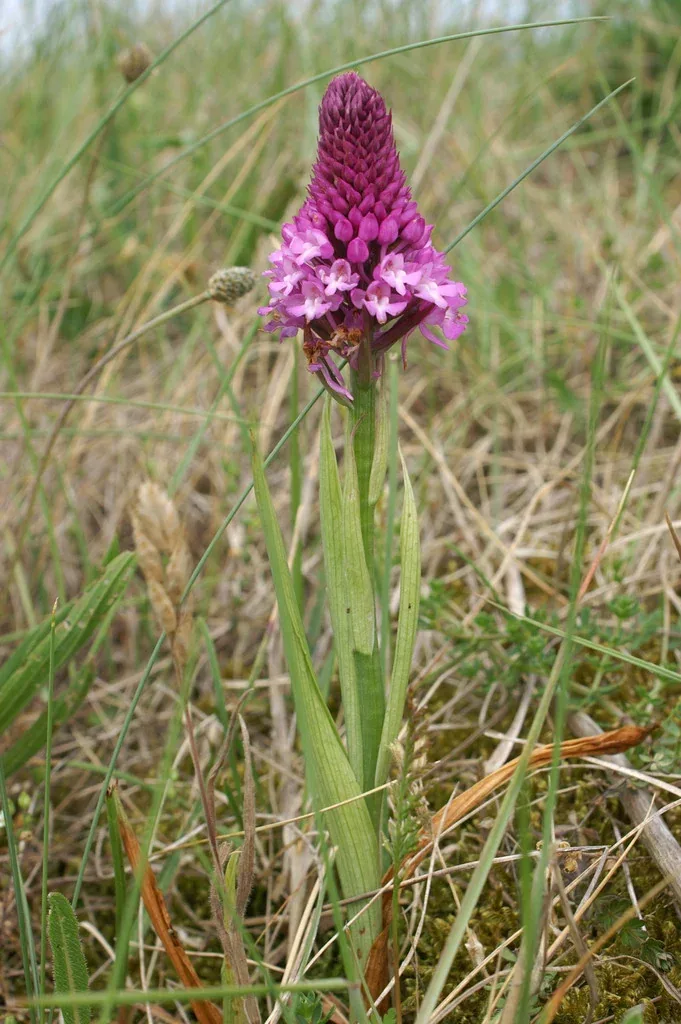
Pyramidal Orchid is one of the most distinctive British orchids when in flower. Its dense spike of bright pink to pinkish-purple flowers starts off broadly pyramid-shaped, giving the plant its common name, although the spike often becomes more cylindrical as it matures.
It belongs to the orchid family, Orchidaceae.
Identification
- Usually around 20–55 cm tall.
- The flower spike is dense and distinctly pyramidal when young.
- As more flowers open, the spike often becomes longer and more cylindrical.
- Flowers are usually bright pink to pinkish-purple, although paler forms occur.
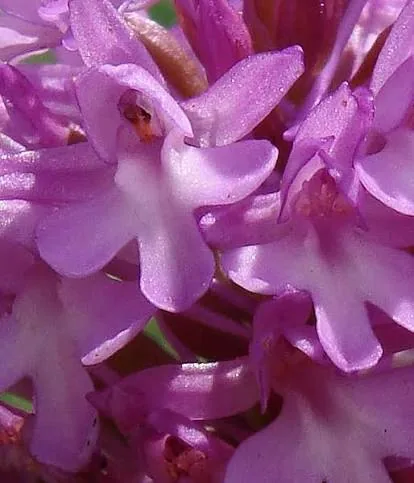
- Each flower has a broad lower lip divided into three lobes.
- A long, slender spur projects backwards from each flower.
- Leaves are narrow, pointed and grey-green to yellowish-green.
- Basal leaves form a loose rosette, while smaller leaves sheath the flowering stem.
The combination of the dense pink flower spike, narrow leaves and long-spurred flowers makes Pyramidal Orchid fairly easy to recognise.
Flower structure
The flowers are arranged in a tightly packed spike that can contain many individual blooms.
Like other orchids, the flower is strongly specialised. The broad lower petal forms the labellum, or lip, which is divided into three lobes. Behind the flower is a long, narrow spur.
The upper petals and sepals form a small hood above the centre of the flower. The reproductive structures are combined into the characteristic orchid column.
Pyramidal Orchid attracts butterflies and moths, whose long mouthparts are well suited to probing the narrow flower spur.
Leaves
The leaves are long, narrow and taper gradually to a fine point.
Near the base they form a loose rosette. Higher up the stem, several smaller leaves clasp or sheath the flowering stalk. The leaves are usually smooth and rather glossy.
Outside the flowering season the narrow basal rosettes can sometimes be spotted in suitable short grassland.
Habitat
Pyramidal Orchid particularly favours open ground on lime-rich soils.
Typical habitats include:
- chalk and limestone grassland
- coastal grassland
- sand dunes
- roadside verges
- railway embankments
- old quarries
- spoil heaps and other disturbed calcareous ground
It is especially associated with southern Britain, although it occurs farther north in suitable habitats.
Flowering period
Pyramidal Orchid flowers mainly from June to August, with June and July usually the best months to see it.
Similar species
- Common Spotted-orchid usually has broader leaves, often marked with dark spots, and its flower spike is not normally as sharply pyramidal when young.
- Fragrant-orchids can also have dense pink flower spikes, but their individual flowers differ in shape and the flower head is usually more cylindrical. Their scent can also be noticeable at close range.
Where the names come from
Pyramidal Orchid is named for its flower spike, which often begins flowering in a pointed, pyramid-like shape before becoming rounder as more flowers open. ‘Orchid’ ultimately derives from the Greek name for the paired underground tubers of some orchids.
Anacamptis comes from Greek for ‘bending back’, a name associated with the form of parts of the flowers, particularly the spur. Pyramidalis simply means ‘pyramid-shaped’.
Folklore and history
Like other British orchids, Pyramidal Orchid has long attracted attention because of its unusual flowers and specialised relationship with insects and fungi.
Orchid seeds are extremely small and contain very little stored food. To germinate successfully they depend on a relationship with particular soil fungi, known as mycorrhizal fungi.
Wildlife value
The flowers are visited by a range of butterflies and moths. The long spur and narrow flower structure are particularly suited to insects with long mouthparts.
As with other native orchids, the plant is best enjoyed where it grows rather than picked or dug up.