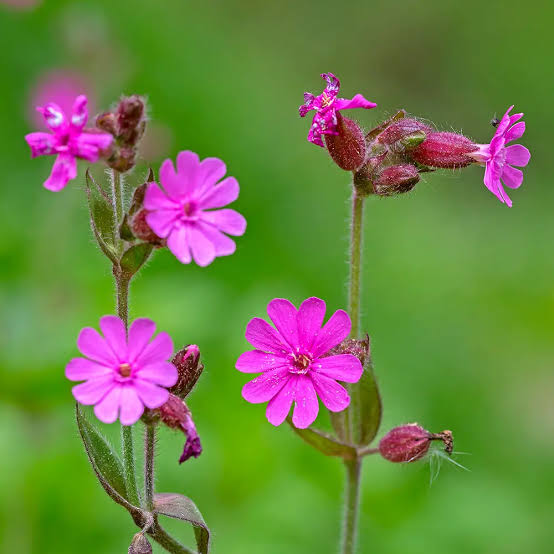
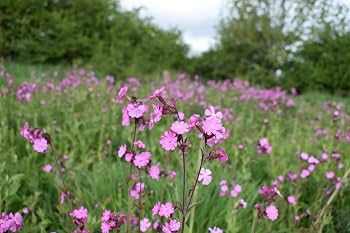
Red Campion is a familiar perennial wildflower of hedgerows, woodland edges and other partly shaded places. Its bright pink-red flowers are especially conspicuous in spring and early summer.
Identification
Red Campion usually grows between 30 and 90 cm tall.
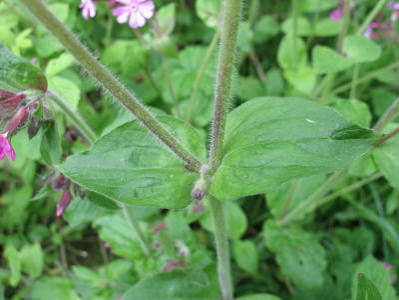
The stems and leaves are softly hairy. The leaves occur in opposite pairs and are oval to lance-shaped, with the lower leaves usually having short stalks and the upper leaves becoming more sessile.
The flowers have five deeply notched petals, which can make them appear to have ten petals at first glance.
Male and female flowers
Red Campion is dioecious, meaning that male and female flowers occur on separate plants.
Male flowers contain stamens that produce pollen, while female flowers contain the ovary and styles.
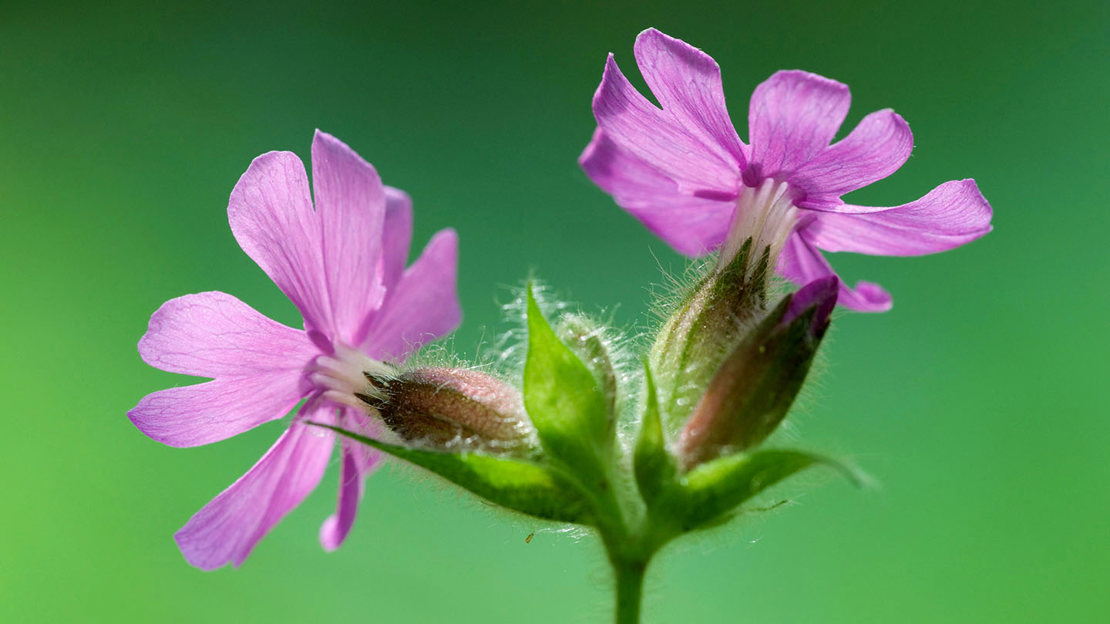
The calyx can also help distinguish them. Male flowers generally have a narrower calyx with 10 prominent veins, while female flowers have a broader calyx with 20 veins that becomes swollen as the seed capsule develops.
Flower structure
The five petals are usually pink to reddish-pink and are deeply divided at their tips.
At the base of the petals is a tubular calyx formed from fused sepals.
The flowers are borne in loose branching clusters known as cymes.
Leaves
The leaves are:
- opposite
- simple
- softly hairy
- usually oval to lanceolate
- with an entire margin
The lower leaves are generally broader and have short petioles, while the upper leaves are more likely to be sessile.
Habitat
Red Campion is particularly associated with:
- woodland edges
- hedgerows
- shady roadside verges
- banks
- scrub
- lightly shaded grassland
It generally favours reasonably fertile soils and is particularly characteristic of partly shaded places.
Similar species
Red Campion can sometimes be confused with White Campion (Silene latifolia).
White Campion normally has white flowers, although the two species can hybridise where they grow together, producing plants with intermediate flower colours.