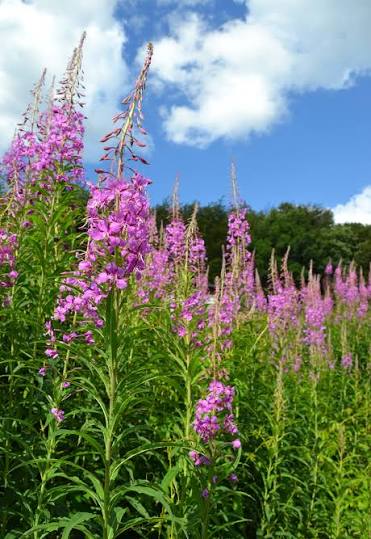
Rosebay Willowherb is one of Britain’s most conspicuous summer wildflowers. Tall stems topped by vivid pink flower spikes can form extensive drifts on railway banks, roadsides, woodland clearings and disturbed ground.
It belongs to the evening-primrose family, Onagraceae. It is a classic pioneer plant, able to colonise open ground rapidly after disturbance.
Identification
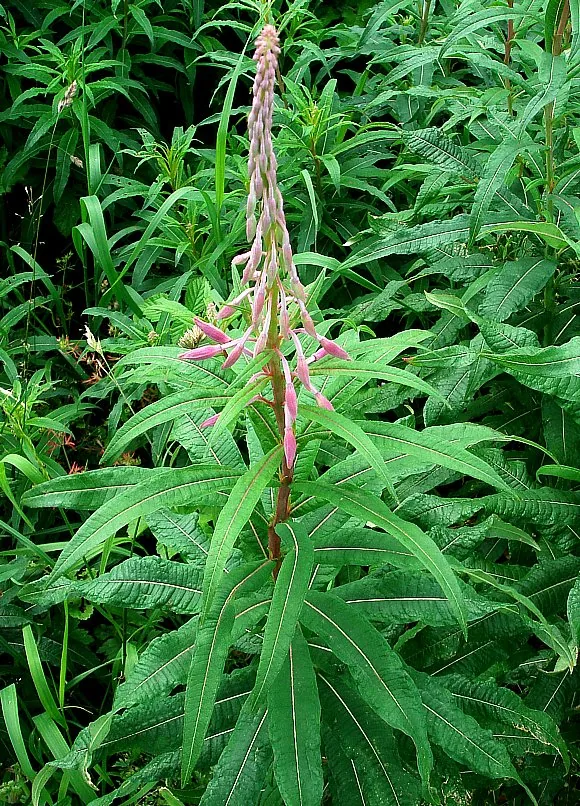
- Tall upright perennial, commonly reaching around 1–1.5 m.
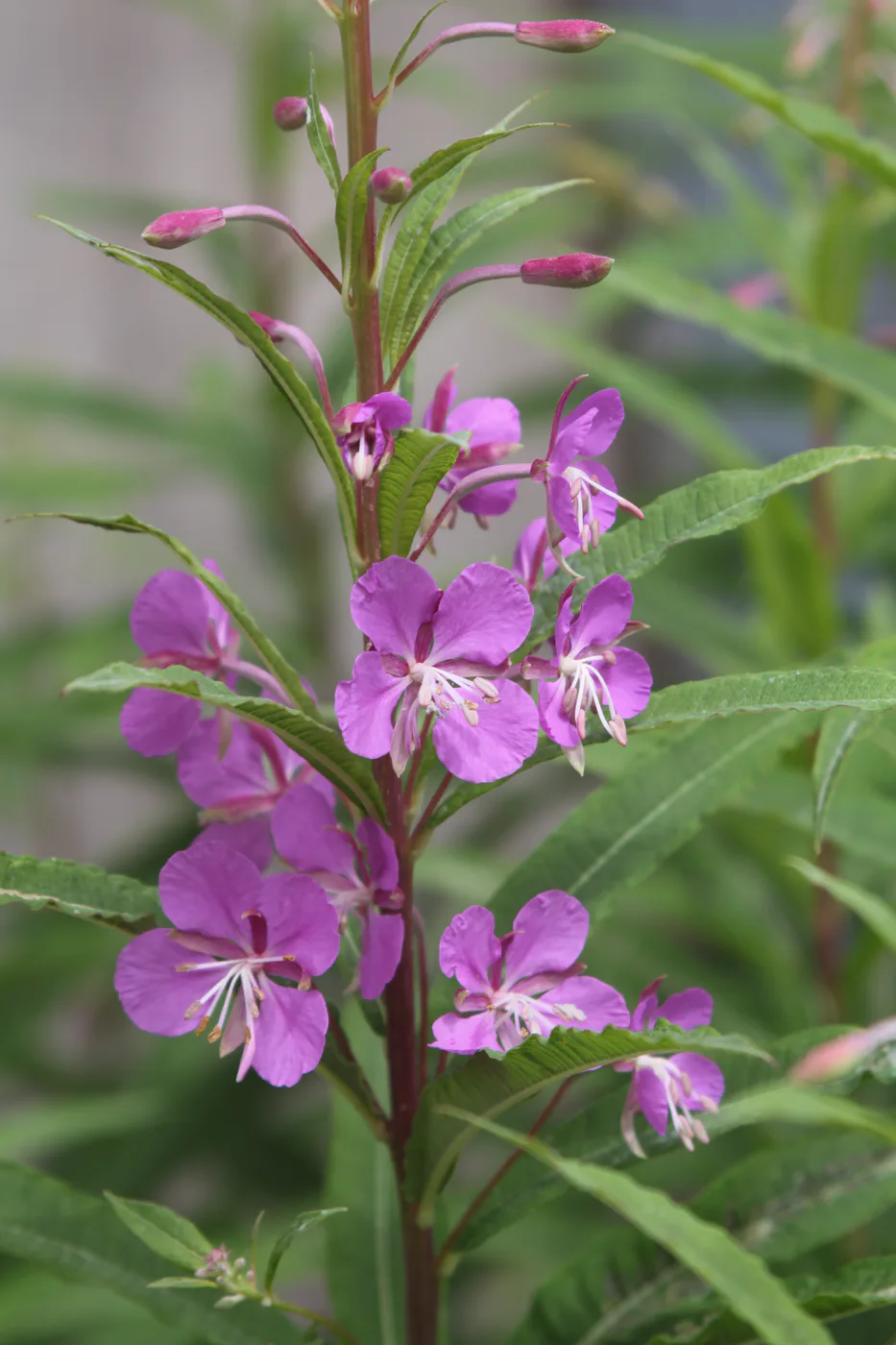
- Bright pink to pinkish-purple flowers are arranged in a long tapering terminal raceme.
- Flowers open progressively from the bottom of the spike upwards.
- Each flower has four broad petals, usually with a slight notch at the tip.
- Leaves are long, narrow and lance-shaped.
- Leaves are arranged alternately or in a loose spiral around the stem.
- A useful leaf feature is the vein running close to the leaf margin.
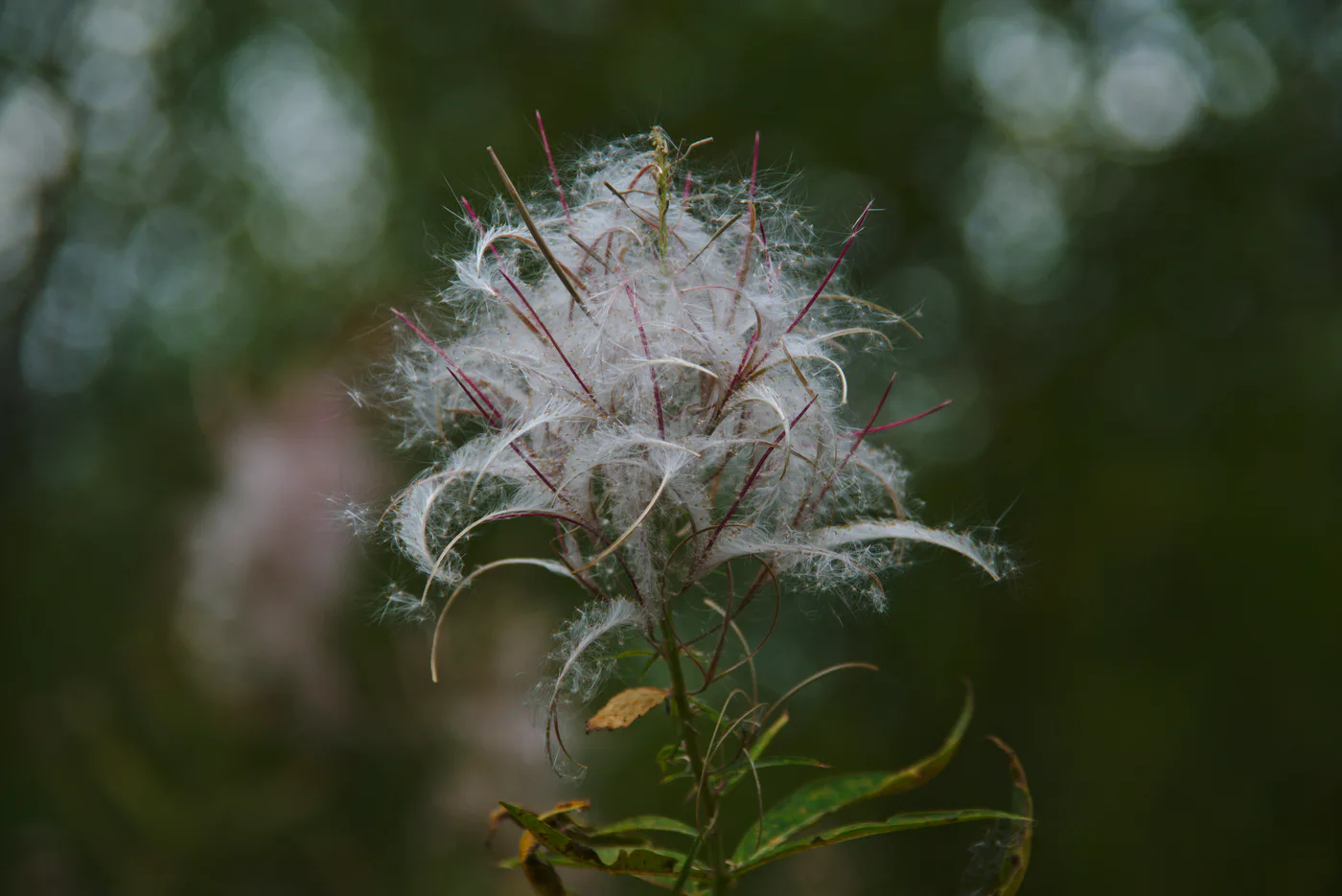
- After flowering, long narrow seed capsules develop along the stem.
- The capsules eventually split and release large numbers of tiny, silky-haired seeds.
The combination of tall dense stands, narrow willow-like leaves and long pink flower spikes makes Rosebay Willowherb easy to recognise in summer.
Flower structure
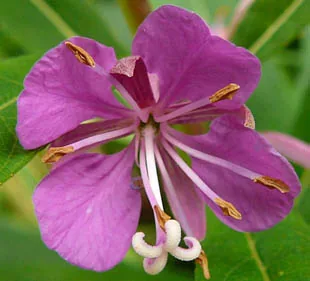
Each flower has four pink petals and four narrow sepals.
There are eight stamens, surrounding a style that ends in a four-lobed stigma.
The flowers are held on a long terminal raceme. The lower flowers normally open first, while buds remain closed towards the top of the spike. This gives flowering plants their characteristic tapering appearance.
After pollination, the inferior ovary develops into a long, slender capsule.
Leaves and stems
The leaves are:
- long and narrowly lance-shaped
- usually alternate or spirally arranged
- finely toothed or almost entire
- darker green above and paler beneath
- marked by a distinctive vein running close to the margin
The common name willowherb refers to the resemblance of the narrow leaves to those of willows.
Stems are upright and often grow close together, producing dense stands.
Seed capsules
The fruits are long, narrow capsules.
As they mature they split lengthways, exposing many tiny seeds. Each seed carries a tuft of silky hairs which acts like a parachute, allowing it to travel considerable distances on the wind.
This highly effective seed dispersal is one reason Rosebay Willowherb can colonise newly disturbed ground so quickly.
Habitat
Rosebay Willowherb is especially associated with open or recently disturbed places, including:
- waste ground
- railway banks and cuttings
- roadside verges
- woodland clearings
- recently felled woodland
- grassland
- river banks
- burned or otherwise disturbed ground
It is widespread across Britain and is particularly noticeable where large colonies develop.
Flowering period
Rosebay Willowherb flowers mainly from June to September.
Large stands are especially conspicuous during July and August, when much of the flowering spike may be open at once.
Similar species
- Great Willowherb (Epilobium hirsutum) also has pink flowers, but they are larger and carried more loosely rather than in the tall, narrow spike of Rosebay Willowherb. Its leaves are broader and the plant is usually associated with damp ground.
- Broad-leaved Willowherb (Epilobium montanum) is much smaller and has broader leaves and relatively small pink flowers.
- Several smaller Epilobium species can occur on disturbed ground, but none normally produces the tall, dense, tapering pink flower spike typical of Rosebay Willowherb.
Where the names come from
Rosebay Willowherb combines a description of its rosy flower spikes with a comparison between its long, narrow leaves and those of a willow. In North America the plant is often called Fireweed because it readily colonises burnt ground.
Chamerion is derived from Greek elements commonly interpreted as ‘low’ or ‘ground’ and ‘oleander’, a comparison with the narrow leaves of an oleander. Angustifolium is Latin for ‘narrow-leaved’. You may also find the same species called Chamaenerion angustifolium or Epilobium angustifolium in botanical sources.
Folklore & history
Rosebay Willowherb is a famous pioneer species: a plant that can rapidly colonise bare or disturbed ground.
In Britain it acquired the name Bombweed during and after the Second World War. It spread dramatically across bomb sites and other disturbed ground in London and other cities, where its tall pink drifts became one of the characteristic plants of damaged urban areas.
This association with bomb sites and recovery helped make Rosebay Willowherb an enduring symbol of vegetation returning to devastated ground.
Wildlife
The flowers provide nectar and pollen for bees and other insects during summer.
Willowherbs are also important food plants for several moth caterpillars. The striking Elephant Hawk-moth is particularly associated with willowherbs, including Rosebay Willowherb.
Once flowering is over, the plant’s masses of wind-borne seeds provide one of the most familiar late-summer sights on disturbed ground.