Shepherd’s Purse is a small but remarkably widespread wildflower, often growing unnoticed beside paths, in gardens and on disturbed soil. Its tiny white flowers are easily overlooked, but the flat, heart-shaped seed pods make it unmistakable. It belongs to Brassicaceae, the cabbage family, alongside Garlic Mustard and Honesty.
Identification
- A slender annual, occasionally biennial, usually 5–50 cm tall but sometimes reaching 60 cm.
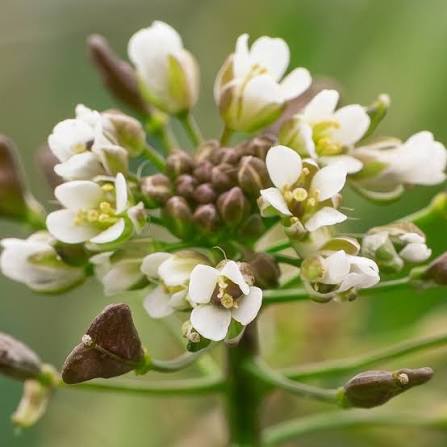
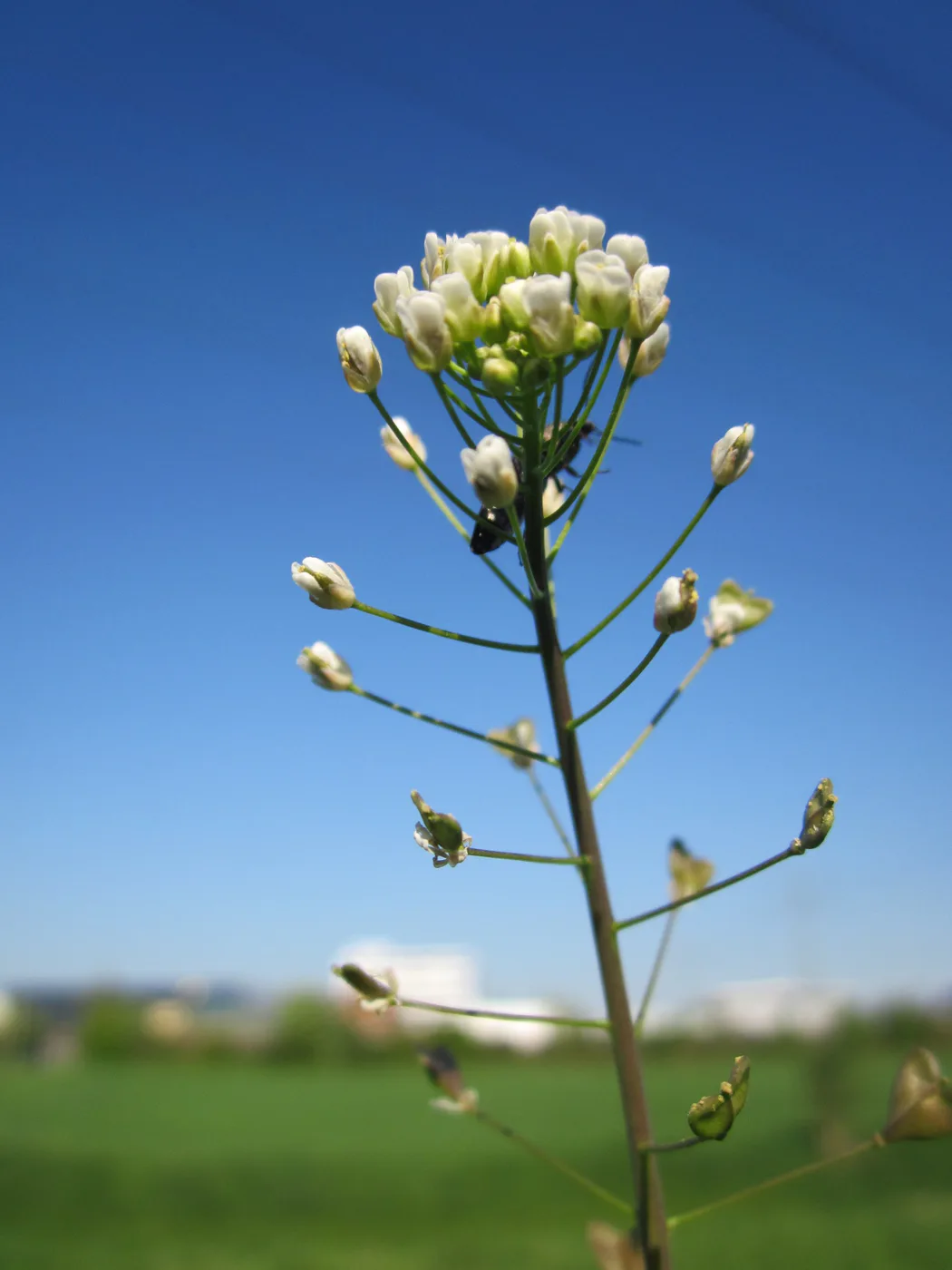
- Tiny white flowers in loose clusters at the tops of the upright stems, each with four petals arranged crosswise.
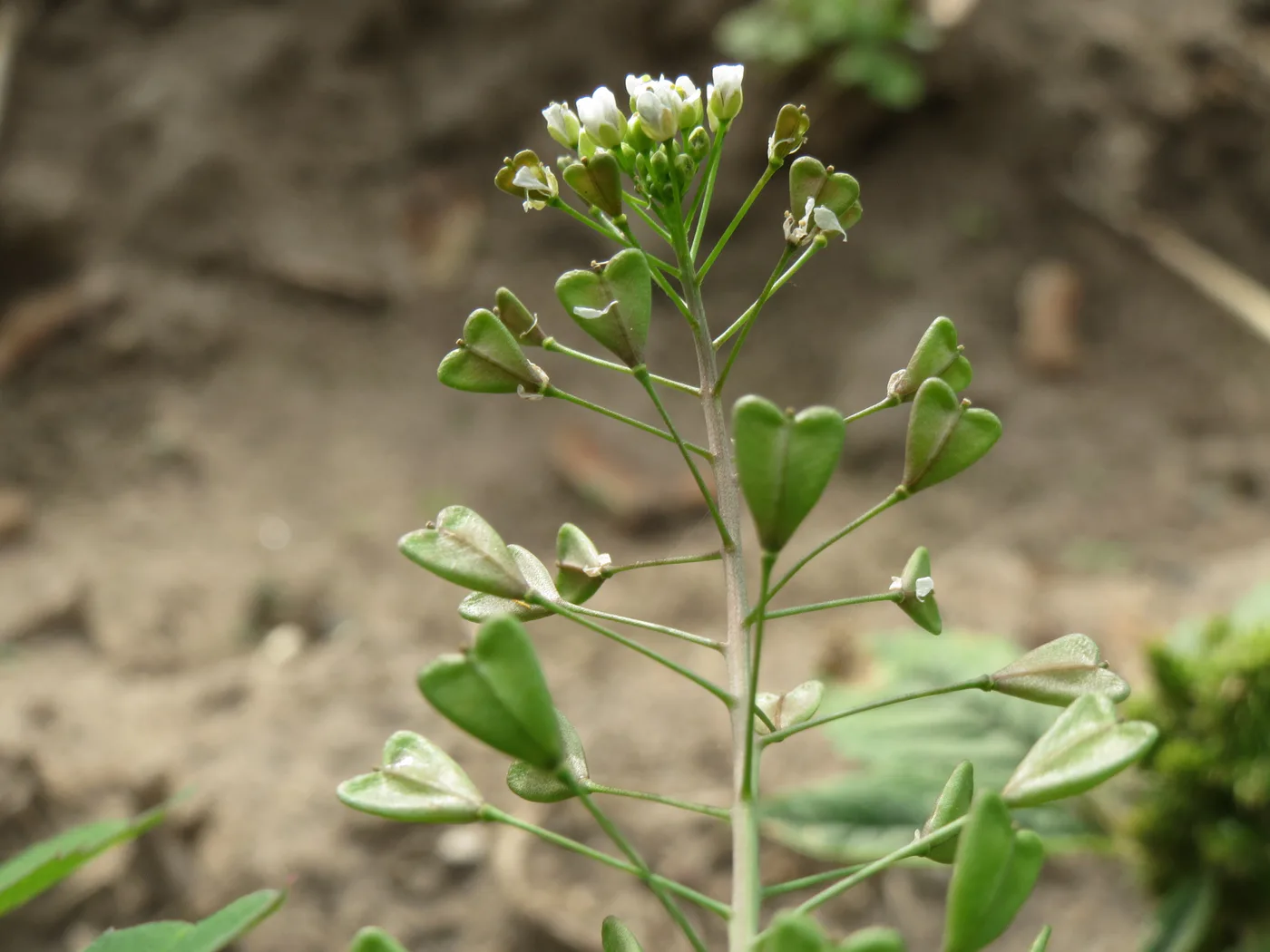
- Flat, green, triangular or heart-shaped seed pods with a distinct notch at the wider end, borne on thin spreading stalks.
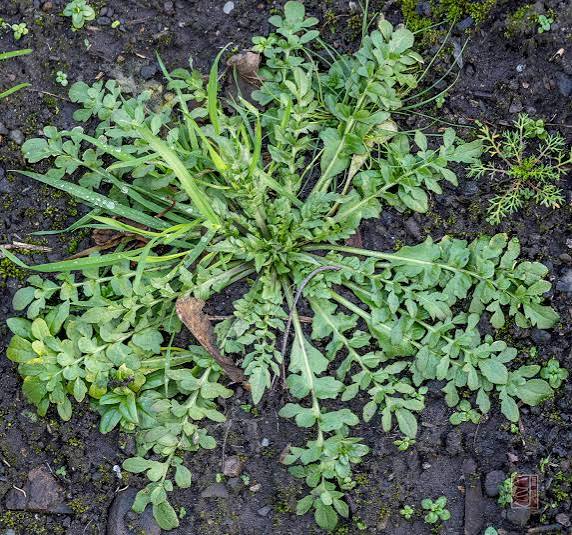
- A basal rosette of leaves which may be toothed, shallowly lobed or deeply divided.
- Small, narrow upper leaves growing alternately and often clasping the stem.
- Several stages can be present together: buds and open flowers near the tip, with developing fruits farther down the stem.
The heart-shaped fruits are the best identification feature, particularly when the plant is mixed with other small white-flowered members of the cabbage family.
Flower structure
Each small flower has four white petals, arranged in a cross, or cruciform pattern, and four sepals below them. Inside are six stamens, usually four longer and two shorter — the tetradynamous arrangement characteristic of the cabbage family — surrounding a central pistil.
The flowers are borne in a raceme, a cluster with individual flowers on short stalks along a central axis. The cluster extends as the plant grows, so the newest flowers appear at the top while the fruits mature below.
Leaves and stems
Most of the leaves are in a low rosette at ground level. Their shape varies greatly: some have simple toothed margins, while others are deeply cut into narrow lobes pointing back towards the leaf base. The leaves may also be slightly hairy.
The flowering stems are thin, upright and sometimes branched. Their few upper leaves are smaller, usually unstalked and often have two pointed lobes at the base which clasp the stem. These stem leaves contrast with the longer, more divided leaves in the basal rosette.
Fruits and seed dispersal
The fruits are the most memorable part of Shepherd’s Purse. Each is a flattened, green, triangular or inverted heart-shaped pod, generally around 4–8 mm long, with a notch at the broad end. These short cabbage-family fruits are called silicles.
As a fruit ripens, its two outer valves separate to release many small brown seeds. The thin central partition, or septum, can remain briefly on the fruit stalk. A single plant can produce a large number of seeds, allowing it to spread quickly wherever the soil is disturbed.
Habitat
Look for Shepherd’s Purse in cultivated fields, vegetable plots, field margins, roadsides, gravelly paths, gardens and patches of bare or disturbed ground. It often grows in places where larger, more competitive plants have been removed or where the ground has recently been turned over.
It is very common and widespread across Britain, including towns and villages. It can germinate in different seasons and may overwinter as a small leafy rosette.
Flowering period
Shepherd’s Purse can flower in almost any month during mild weather, although it is most conspicuous from spring through autumn. Because plants grow and set seed quickly, flowers and green fruits often appear together on the same stem.
Similar species
- Common Whitlowgrass (Erophila verna) is another tiny white-flowered member of the cabbage family, usually seen in spring on dry, open ground. Its leaves are mostly in a small basal rosette, but its fruits are longer and more oval rather than distinctly heart-shaped.
- Hairy Bittercress (Cardamine hirsuta) also grows in gardens and disturbed places, with four-petalled white flowers. Its leaves are divided into rounded leaflets and its fruits are long, narrow seed pods rather than flat, heart-shaped ones.
- Several small cresses have similar white flowers. Checking the mature fruits is usually the easiest way to distinguish them: Shepherd’s Purse has broad, notched, heart-shaped pods, whereas many of its relatives have narrow ones.
Where the names come from
The name Shepherd’s Purse comes from the shape of the seed pods, which were thought to resemble the little leather pouches carried by shepherds in earlier centuries. The plant is also known as Mother’s Heart, another reference to its heart-shaped fruits.
The botanical name Capsella means ‘little box’ or ‘small case’, while bursa-pastoris comes from Latin words meaning ‘shepherd’s purse’. Both names refer to the distinctive fruit.
Folklore & history
The seed pods inspired an old children’s game: one child would invite another to break a heart-shaped pod, then tell them they had ‘broken their mother’s heart’. The name Mother’s Heart preserves this tradition.
Shepherd’s Purse also has a long history as a wayside herb. It was gathered for use in traditional remedies, particularly for stopping bleeding, and its young leaves were eaten as a peppery spring green. In Somerset it was among the plants known as Poor Man’s Purse — another name prompted by its tiny pouch-like fruits.
Wildlife
The tiny flowers provide pollen and nectar for small visiting insects. The seeds are eaten by small birds, including finches, while the plant’s ability to grow on bare ground lets it provide food in places with relatively little other vegetation.