Snowdrop is one of the earliest flowers of the year, often brightening woodland edges, churchyards and shady gardens while winter is still lingering. Its small white bells hang from slender stems above narrow, grey-green leaves. Although now familiar across Britain, Common Snowdrop is an introduced plant that has become naturalised in many places. It belongs to Amaryllidaceae, the amaryllis family.
Identification
- A bulbous perennial, usually about 7–25 cm tall when flowering.
- A single nodding white flower is carried at the end of each leafless flowering stalk.
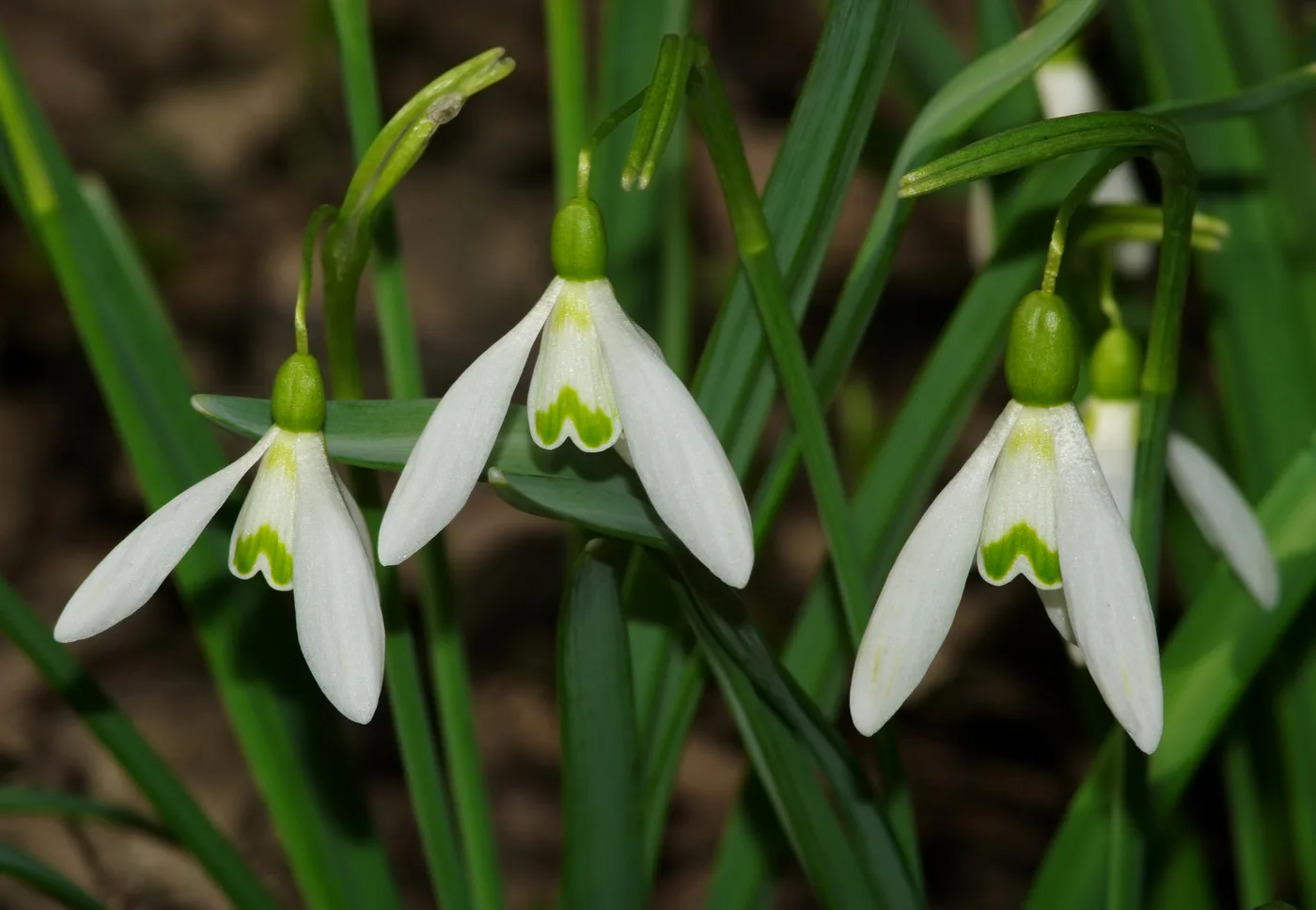
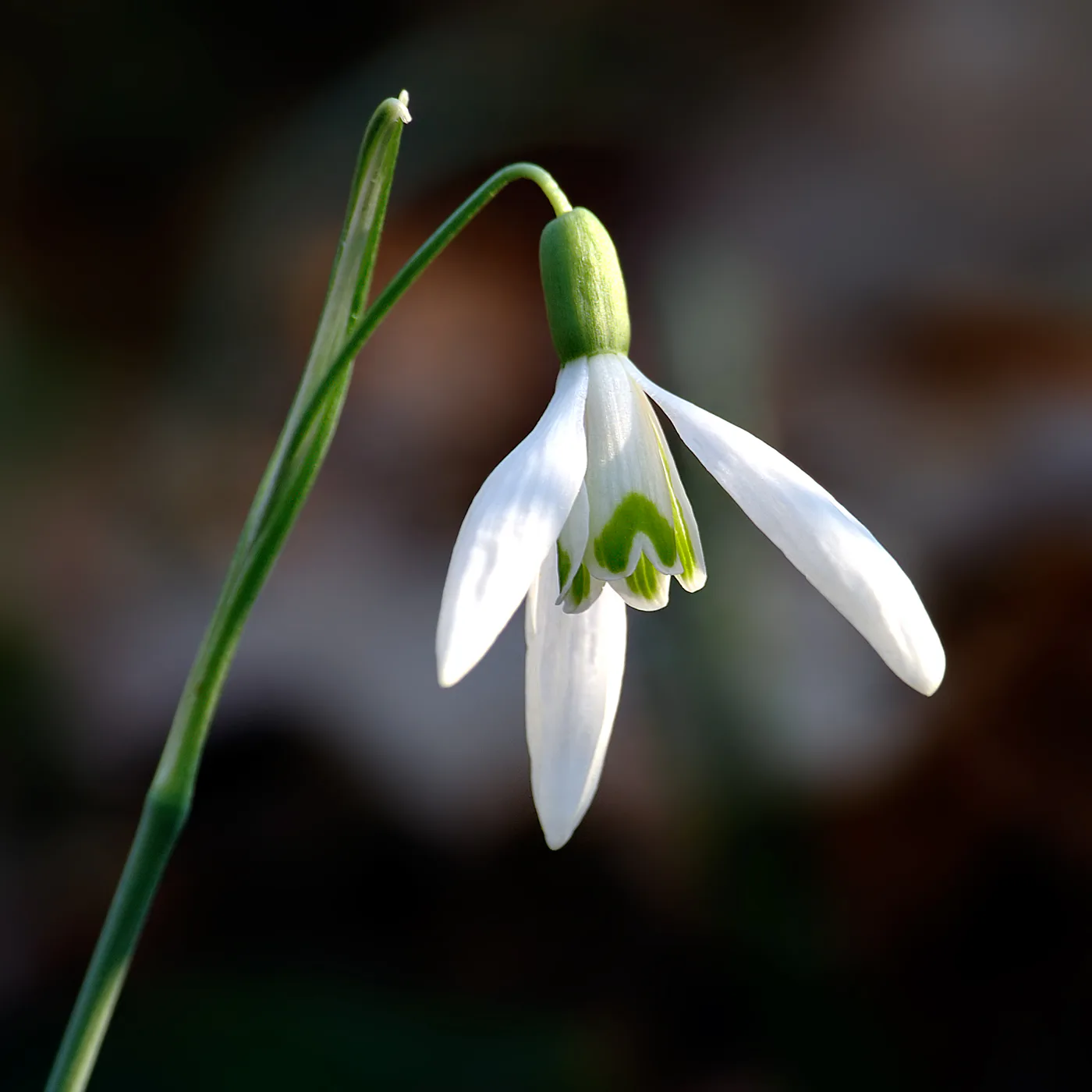
- Each flower has three long outer tepals and three much shorter inner tepals.
- The inner tepals are notched at the tips, with a green mark usually shaped like an inverted V or U.
- Two, occasionally three, narrow, smooth, grey-green leaves rise from the base of the plant.
- Plants frequently grow in clumps or loose colonies, especially beneath deciduous trees.
- Flowers most commonly appear between January and March.
The difference in length between the outer and inner tepals, together with the green marks on the inner three, is especially useful for recognising Common Snowdrop.
Flower structure
A Snowdrop flower has six tepals, arranged in two whorls of three. They are called tepals rather than petals and sepals because both sets are petal-like. The three outer tepals are long, pure white and often spread slightly as the flower opens. The three inner tepals are shorter, each with a small notch and a green marking near its tip.
Inside the flower are six stamens surrounding the central female structure. The ovary is inferior, meaning it sits below the point where the tepals and stamens are attached. After pollination, it can develop into a rounded seed capsule.
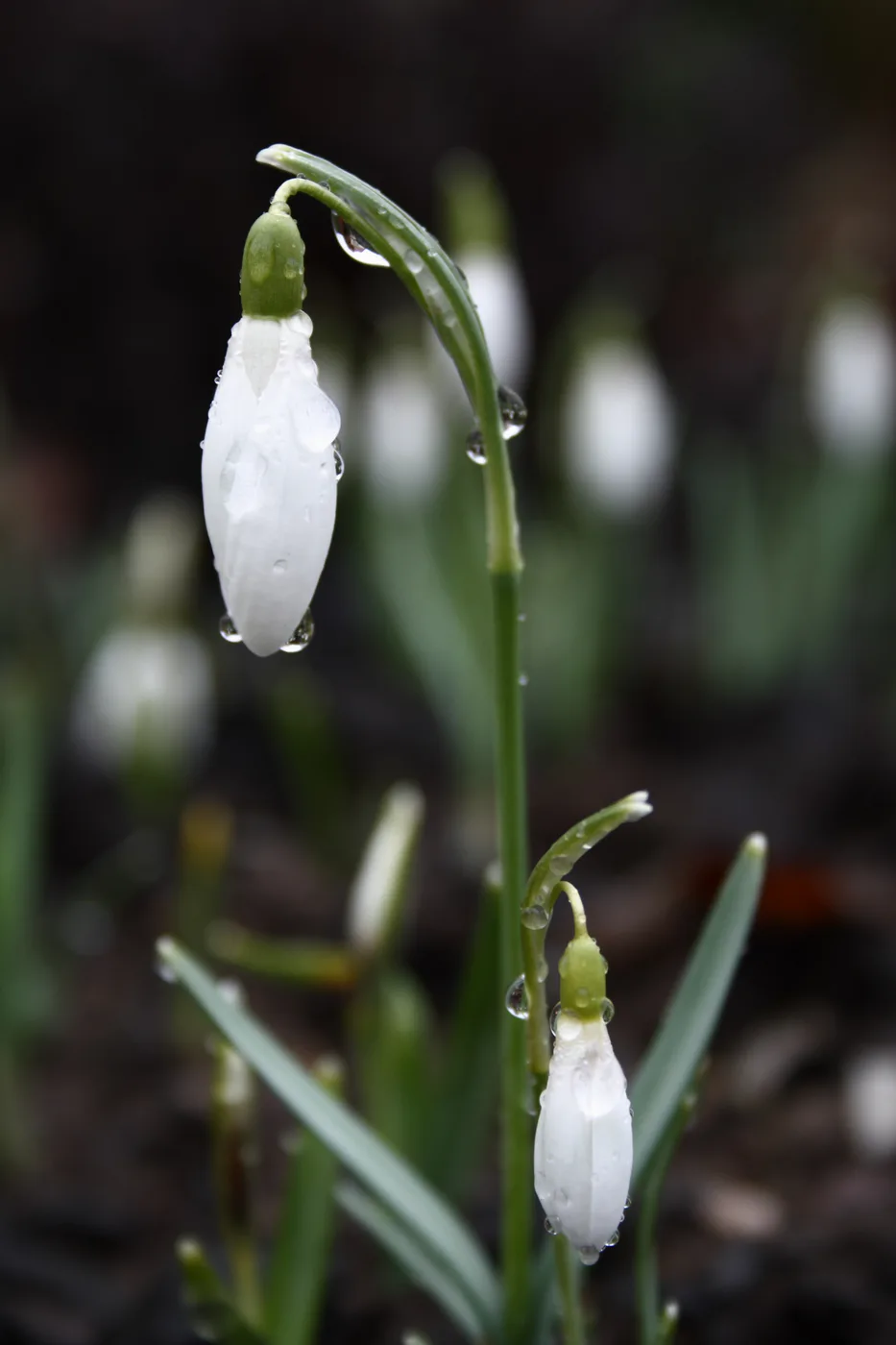
Each flower hangs on a slender curved stalk. A thin, papery bract near the upper end of the main stem protects the developing flower while it is still in bud.
Leaves and stems
The leaves are narrow, strap-like and slightly blue-grey or grey-green, with smooth edges and parallel veins. They arise directly from the base of the plant, usually as a pair. Unlike the broader leaves of some garden snowdrops, those of Common Snowdrop are relatively slim and flat.
Snowdrops survive the rest of the year underground as bulbs, storing energy for a rapid return in late winter. The above-ground leaves normally die back after spring, while the bulb remains beneath the soil. Clumps can increase as bulbs produce offsets.
Habitat
Snowdrops are often found under deciduous trees, in damp woodland, beside old hedges, on grassy banks, in churchyards and around former gardens. They favour soil that stays reasonably moist during growth without remaining waterlogged.
The species is native to parts of continental Europe, not Britain. It was grown in British gardens centuries ago and has since escaped or been planted widely enough to become naturalised. Large colonies can therefore be long-established without being part of Britain’s original native woodland flora.
Flowering period
Common Snowdrop usually flowers from January to March, sometimes earlier during mild winters. In many places the flowers open while the surrounding trees are still bare, taking advantage of light reaching the woodland floor.
The leaves continue growing for a while after the flowers fade, helping the bulb replenish its reserves before dormancy.
Similar species
- Spring Snowflake (Leucojum vernum) has six flower segments of approximately equal length, each with a green or yellowish mark near its tip. Snowdrop has three long outer tepals and three distinctly shorter inner ones.
- Summer Snowflake (Leucojum aestivum) is usually taller and commonly carries several white, green-tipped bells on one stem, rather than a single flower.
- Greater Snowdrop (Galanthus elwesii) generally has broader, often more blue-green leaves and more extensive green markings on the inner tepals.
- Pleated Snowdrop (Galanthus plicatus) has noticeably folded or pleated leaf edges, a feature that helps distinguish it from the flatter-leaved Common Snowdrop.
Where the names come from
The English name Snowdrop reflects the plant’s white, drooping flowers and its habit of appearing in the coldest part of the year. The flowers resemble small drops of snow hanging from their stems.
Galanthus comes from Greek words meaning ‘milk’ and ‘flower’, a reference to the pure white bloom. Nivalis is Latin for ‘snowy’ or ‘of the snow’, echoing the English name.
Folklore & history
Snowdrops have long been associated with the return of light after winter and became symbols of hope, renewal and purity. They were often called Candlemas Bells because they flower near Candlemas on 2 February, when white flowers were used to decorate churches.
Folklore was not always cheerful, however. In some places, carrying a single Snowdrop indoors was considered unlucky or an omen of death, while seeing a group of flowering Snowdrops outdoors was welcomed as a sign of spring.
The plant became familiar in British gardens from at least the early modern period, although it was not recorded growing wild in Britain until the late eighteenth century. Its gradual spread into woodland and churchyards helped make it one of the best-loved sights of late winter.
Wildlife
On mild late-winter days, Snowdrop flowers can provide early pollen and nectar for bees and other visiting insects. Their flowering season is so early that there may be few insects active during colder spells.
Snowdrops also spread effectively by producing new bulbs beside the parent plant, which helps explain the dense clumps and drifts found in established colonies.