Spear Thistle is one of Britain’s most recognisable native thistles. Its large purple flower heads sit above fiercely prickly leaves and stems, often in rough grassland, pastures and along roadside verges. Although it may look like a single purple flower, each head contains many tiny flowers. It belongs to Asteraceae, the daisy family.
Identification
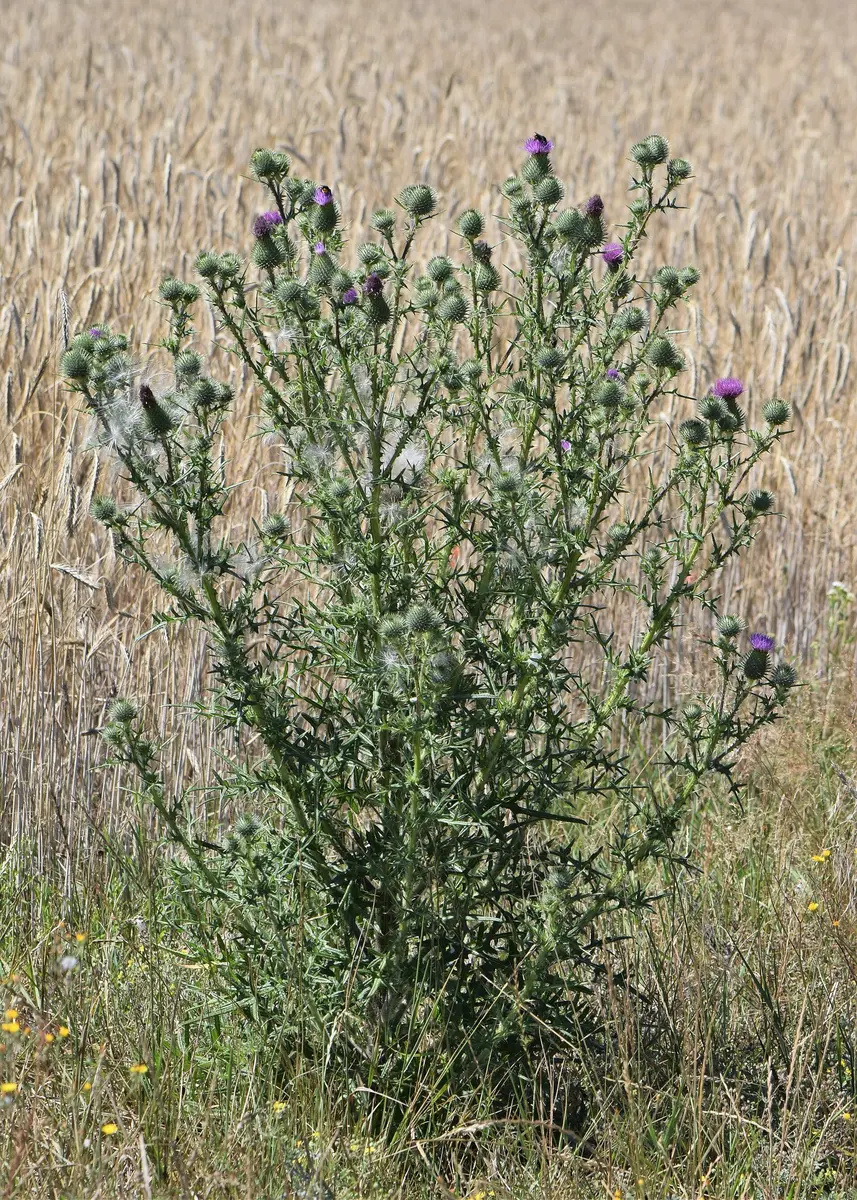
- A robust biennial, usually 30–150 cm tall, sometimes taller.
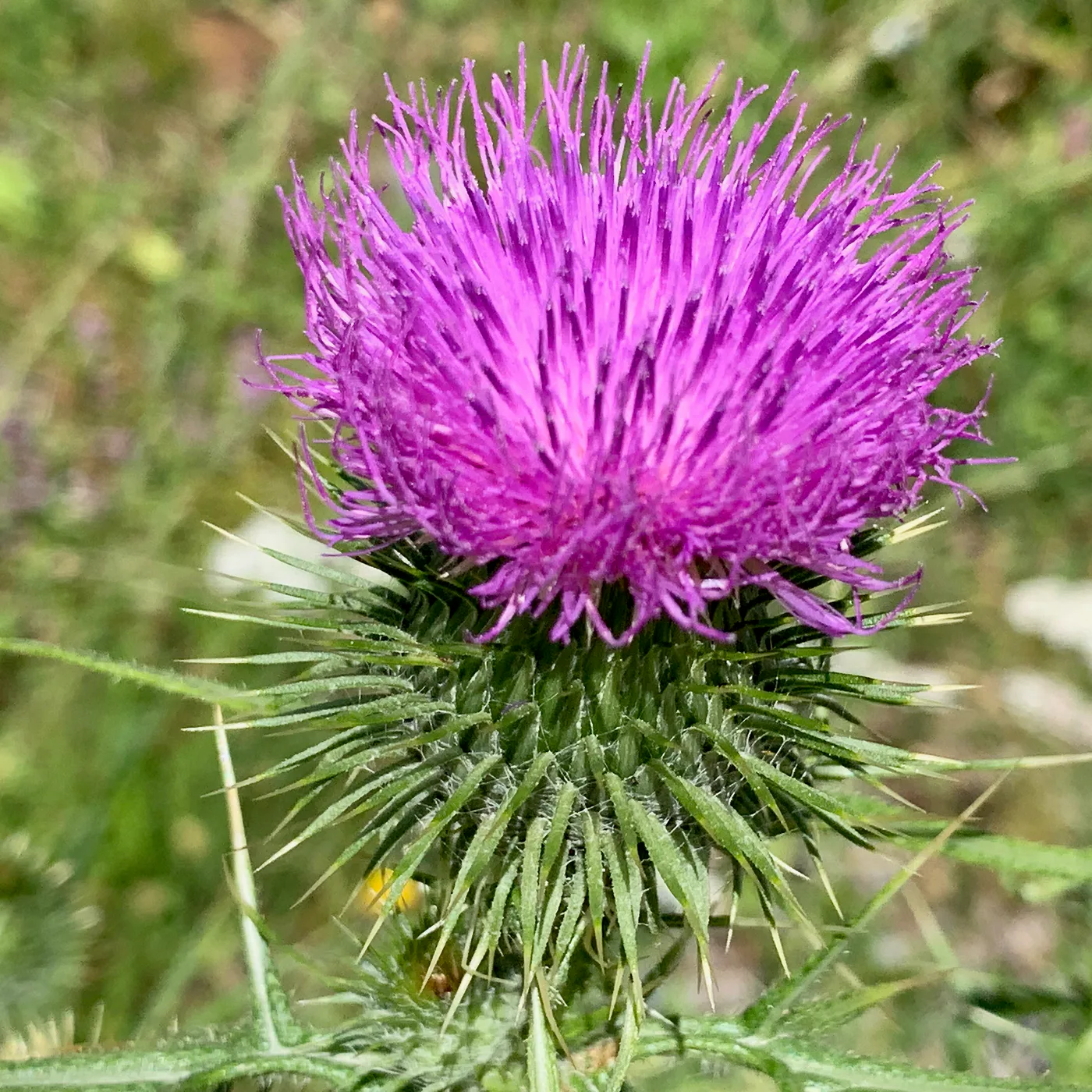
- Large, reddish-purple flower heads, often about 3–5 cm long, borne singly or in small, loose groups.
- Each flower head sits in a cup of overlapping green bracts that end in long, rigid, outward-pointing spines.
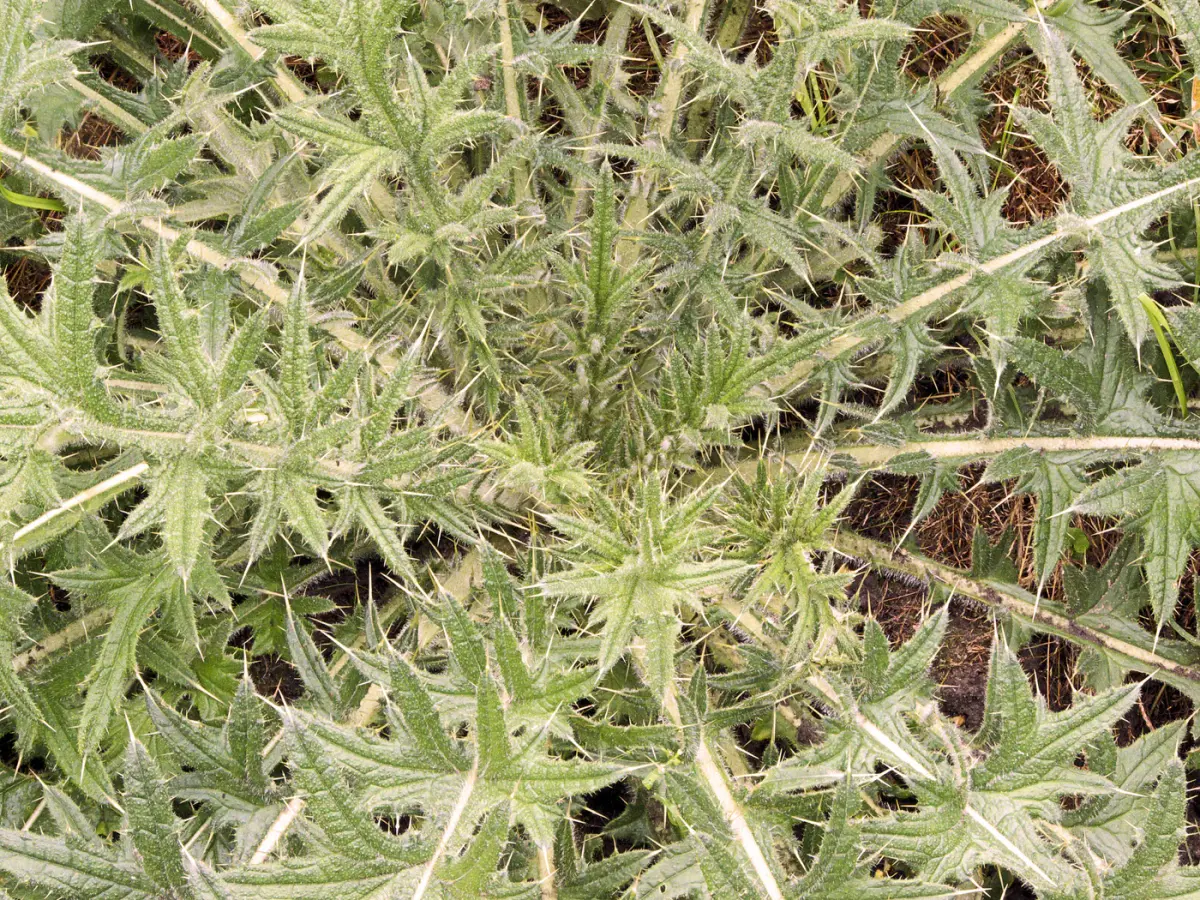
- Deeply lobed, prickly leaves with long, narrow, spear-like tips ending in sharp spines.
- Stems bear distinct spiny wings extending downwards from the leaf bases.
- The upper surfaces of the leaves have stiff prickly hairs, while the undersides can look pale and woolly.
- First-year plants form a low rosette of spiny leaves before producing a flowering stem.
The combination of large purple heads, spreading spiny bracts, spiny-winged stems and sharply divided leaves makes Spear Thistle relatively easy to recognise.
Flower structure
Each apparent flower is actually a capitulum, made up of numerous individual florets crowded onto a common receptacle. Unlike an Oxeye Daisy, Spear Thistle has no conspicuous outer ring of strap-shaped ray florets: its florets are tubular and purple.
Each floret has a narrow tubular corolla. Below the florets is an involucre of overlapping bracts, each tapering into a sharp spine. These bracts are among the most useful identification features in thistles.
After pollination, the florets produce small, dry, one-seeded fruits, each bearing a feathery pappus. Together these form the familiar silvery-white thistledown that can be carried away by the wind.
Leaves and stems
In its first year, Spear Thistle grows mainly as a basal rosette. The leaves are long and deeply divided into narrow lobes, each with strong spines; their prickly upper surfaces often feel rough to the touch.
In the flowering year, an upright, branching stem develops. The leaves are arranged alternately, and their bases run down the stem to form narrow, sharply toothed, spiny wings. This feature is particularly helpful when distinguishing Spear Thistle from Creeping Thistle, whose stems lack these conspicuous spiny wings.
The plant develops a substantial taproot, and usually dies after flowering and setting seed.
Habitat
Spear Thistle is widespread across Britain and Ireland. Look for it on rough or disturbed ground, along tracks and roadsides, in pastures, on field margins and in open grassland. It is especially frequent where the soil has been disturbed and where competing vegetation leaves openings for seedlings.
It can be conspicuous on grazed ground because its formidable spines discourage many grazing animals.
Flowering period
Spear Thistle usually flowers from July to October in Britain, with many plants at their best in midsummer and early autumn. The flowering heads are followed by pale, fluffy seed heads as the fruits ripen.
Similar species
- Creeping Thistle (Cirsium arvense) is a perennial that spreads by creeping roots and usually forms patches. It has smaller flower heads in clusters and stems without the prominent spiny wings of Spear Thistle.
- Marsh Thistle (Cirsium palustre) often has smaller, darker purple heads crowded together near the stem tips. Its stems have conspicuous spiny wings, so the flower-head arrangement is especially useful in comparison.
- Cotton Thistle (Onopordum acanthium) is a larger, heavily woolly, grey-looking thistle with broad spiny wings and huge heads. It is introduced rather than native in Britain.
Where the names come from
The name Spear Thistle refers to the long, narrow, sharply pointed leaf lobes that end in strong spines, rather like miniature spears.
Cirsium is traditionally linked to the Greek kirsos, meaning a swollen vein, reflecting old associations between thistles and herbal remedies. The Latin vulgare means common or widespread.
Folklore & history
Thistles have been a symbol of Scotland for centuries, representing resilience, vigilance and defence. A familiar legend tells of a barefoot raider stepping on a thistle and crying out, thereby warning sleeping Scottish defenders of an approaching attack. The precise thistle represented in Scottish heraldry is not firmly established, but Spear Thistle is often suggested as a likely model.
In traditional country life, thistles were both troublesome pasture plants and useful plants in their own right. Old herbals described various thistles for medicinal purposes, while tender shoots and stalks of some species were prepared as food after removing their spines.
Wildlife
Spear Thistle is an excellent nectar and pollen source for bumblebees, butterflies and other insects. Its exposed purple florets make the flower heads particularly attractive in summer, and the plant supports a range of invertebrates.
Later in the year, goldfinches and other seed-eating birds visit the ripe heads to extract the small fruits. The fluffy pappus also helps some of those fruits disperse on the wind, allowing new plants to establish on disturbed soil.