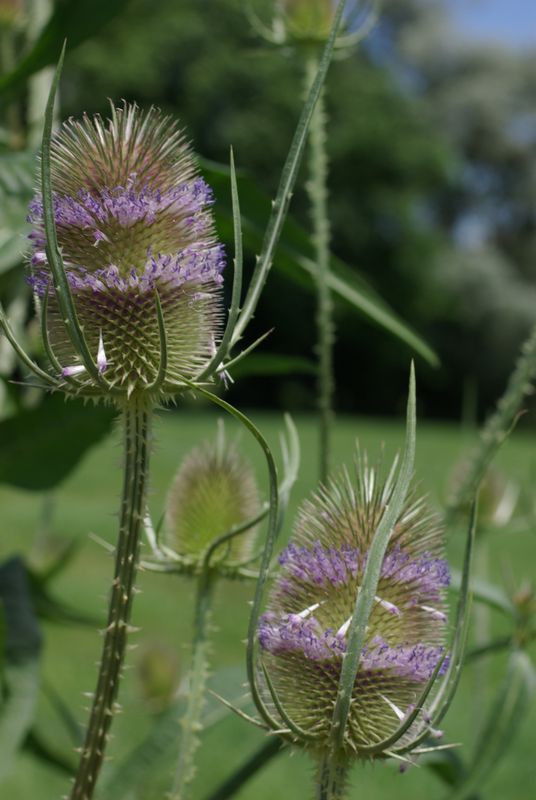
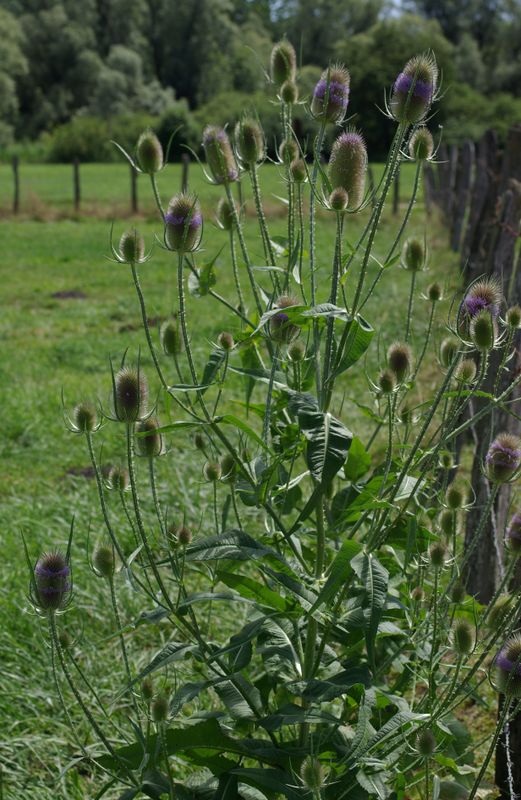
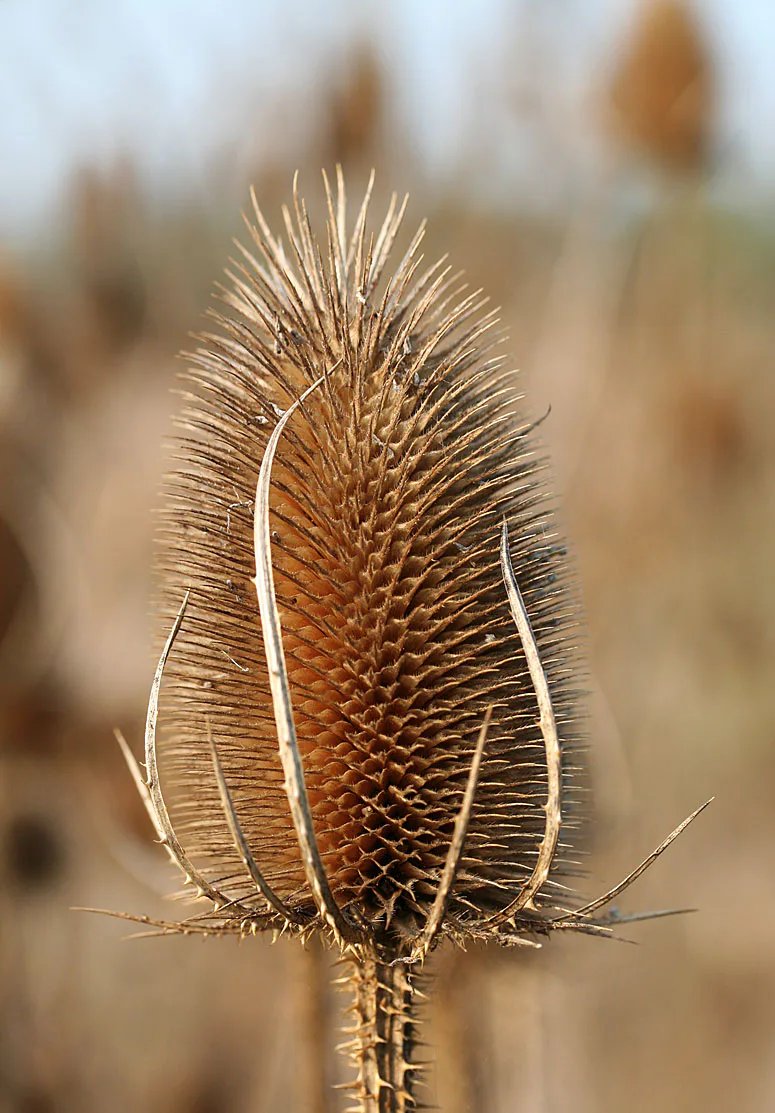
Teasel is one of the most recognisable plants of rough grassland, banks and roadside verges. In its second year it sends up tall, stiff, prickly stems, each carrying an oval head covered in sharp bracts. During summer, bands of tiny lilac-purple flowers travel around the head; by autumn it has become the familiar brown structure that persists through winter.
It belongs to Caprifoliaceae, the honeysuckle family. Older botanical books may place teasels in a separate family, Dipsacaceae.
Identification
- An upright biennial, often 1–2 m tall, with prickles along the stem and leaf midribs.
- A flat rosette of large, wrinkled leaves in its first year, before the flowering stem develops.
- Firm, oval to cylindrical flower heads armed with many stiff, pointed bracts; longer narrow bracts curve upwards from beneath each head.
- Numerous small lilac or pale-purple flowers opening in bands, rather than all at once.
- Long, narrow stem leaves arranged in opposite pairs, often joined at their bases around the stem.
- Brown, prickly seed heads that remain upright long after the flowers and leaves have died back.
Although the heads can resemble those of a thistle, Teasel is not a member of the daisy family (Asteraceae). Its flower structure, leaves and fruits are different.
Flower structure
Each apparently single, oval flower head is actually a dense collection of individual florets, with stiff, pointed bracts between them. Each little flower has a tubular corolla that usually ends in four lobes and contains four stamens.
The flowers often open first in a ring around the middle of the head. As flowering continues, two bands can be seen: one progresses upwards and the other downwards. This creates Teasel’s striking striped appearance and is an excellent feature to look for in summer.
The head develops into a mass of small, dry, single-seeded fruits sheltered among the stiff bracts. It does not become a thistle-like cloud of fluffy seed hairs.
Leaves and stems
Teasel’s leaves change noticeably between its first and second years. The first-year plant forms a low rosette of long, wrinkled, slightly toothed leaves. When the flowering stem grows, its leaves appear in opposite pairs and become progressively narrower higher up the plant.
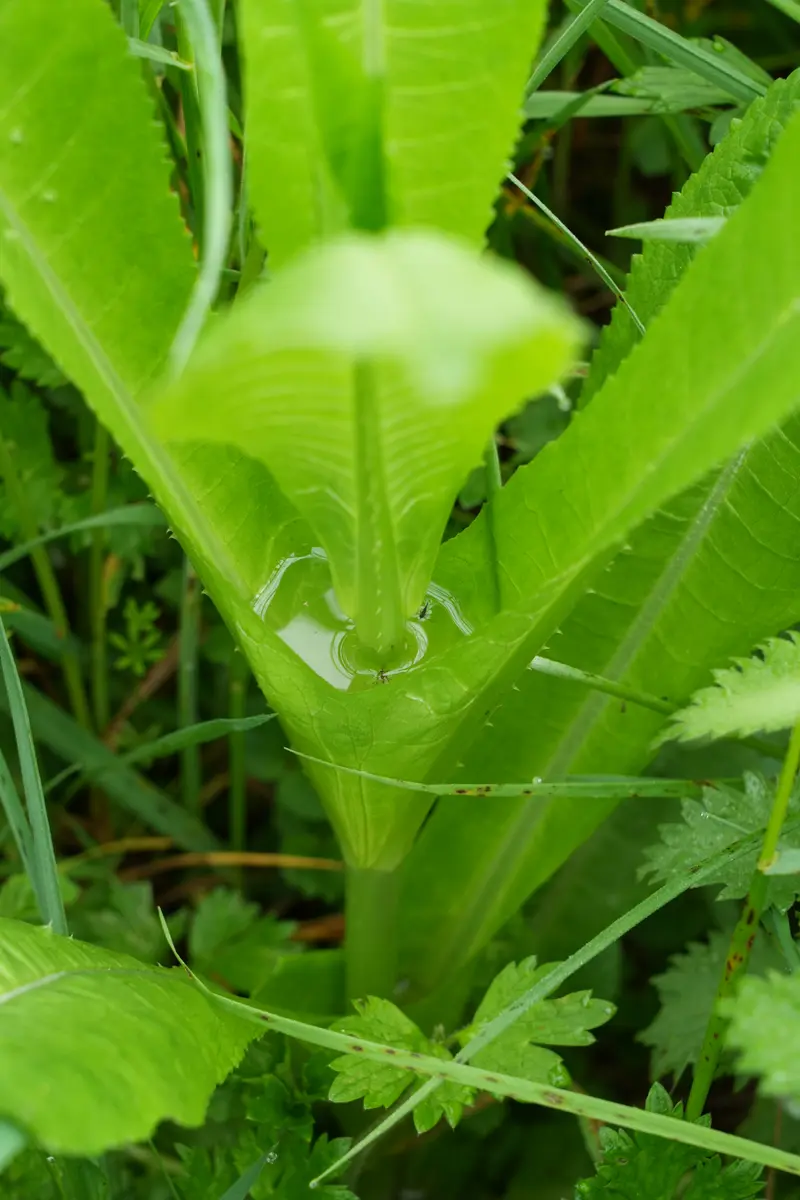
The bases of each pair of stem leaves are joined together, making a cup around the stem that can hold rainwater. The stems are ridged and lined with stiff prickles, as are the lower surfaces of the leaf midribs.
Some observers have suggested that water trapped in these cups might discourage climbing insects or provide nutrients when small insects decay there, but whether Teasel gains a significant nutritional benefit remains uncertain.
Habitat
Teasel occurs on field margins, roadsides, waste ground, riverbanks, open scrub edges and rough grassland. It often establishes itself on disturbed, relatively fertile soil, including damp sites, but can also thrive on drier banks.
It grows best in open or lightly shaded places, where its tall stems stand out above surrounding vegetation. The dried heads are conspicuous even in the middle of winter.
Flowering period
Teasel usually flowers in July and August in Britain, sometimes continuing into September. The heads become brown and rigid as the seeds ripen, and many remain standing until the following spring.
Similar species
- Small Teasel (Dipsacus pilosus) has smaller, more rounded heads with whitish flowers. It is typically found in moist, shaded places and is less robust than Common Teasel.
- Fuller’s Teasel (Dipsacus sativus) was cultivated for textile finishing. Its seed-head bracts have hooked tips that were particularly useful for raising the nap of woollen cloth, unlike the straighter bracts of wild Teasel.
- Thistles (various members of Asteraceae) may have similarly prickly heads, but their flower construction and leaf arrangements differ. Thistles do not have Teasel’s distinctive fused leaf-base cups.
Where the names come from
The English name Teasel is related to tease: the dried, bristly heads were associated with teasing or raising the surface fibres of cloth. The specially cultivated Fuller’s Teasel was particularly valued for this work.
The scientific name has an equally interesting meaning. Dipsacus comes from the Greek word dipsa, meaning “thirst”, a reference to the little pools of water held between the joined leaf bases. The species name fullonum comes from Latin fullo, a cloth fuller, reflecting the historical association of teasels with finishing woollen fabric.
Folklore & history
Teasel’s water-holding leaves gave it names such as Venus’s basin and Venus’s bath. The cups were sometimes associated in folklore with beauty and rainwater gathered for washing the face.
Dried teasel heads were long familiar in textile workshops. In particular, the hooked heads of cultivated Fuller’s Teasel were mounted in frames to raise a fine, even nap on woollen cloth. They were valued because the hooks could yield before causing the same damage that rigid metal teeth might inflict. Wild Teasel is closely related, but the cultivated form was especially suited to this work.
The dramatic dried heads have also been used in winter decorations and flower arrangements.
Wildlife
Bees, bumblebees, hoverflies and other insects visit the summer flowers for nectar and pollen. The heads can provide valuable food during the later part of summer when some meadow flowers have finished.
In autumn and winter the seeds are particularly attractive to goldfinches, whose fine beaks allow them to pick the seeds from between the bracts. Leaving the heads standing also provides structure and shelter for small invertebrates.