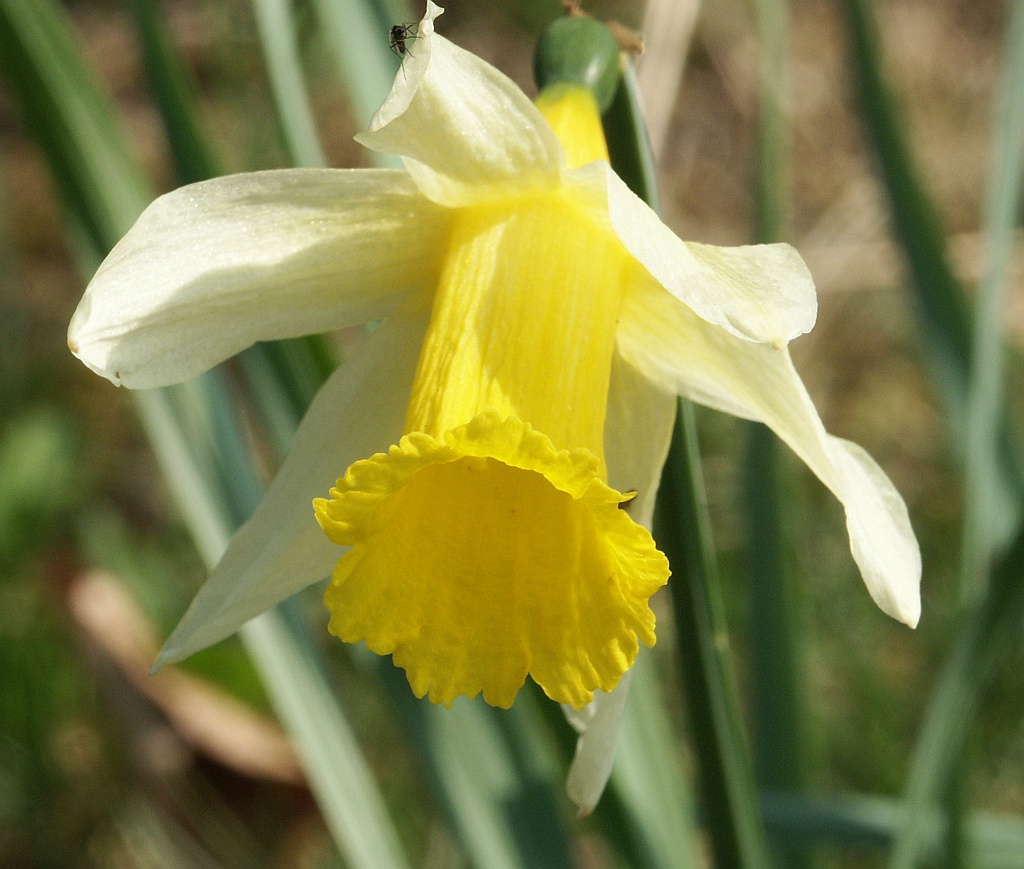
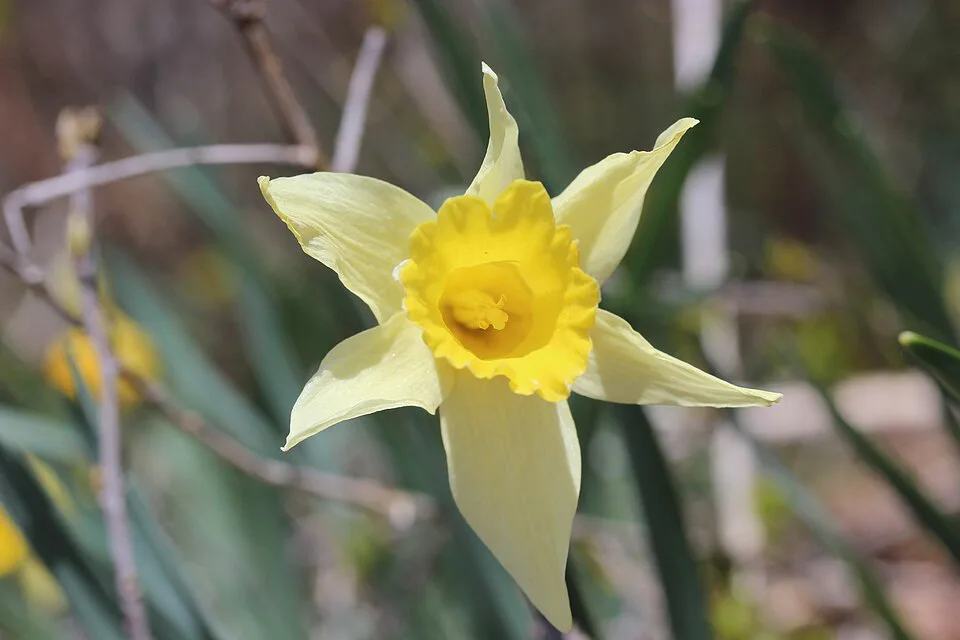
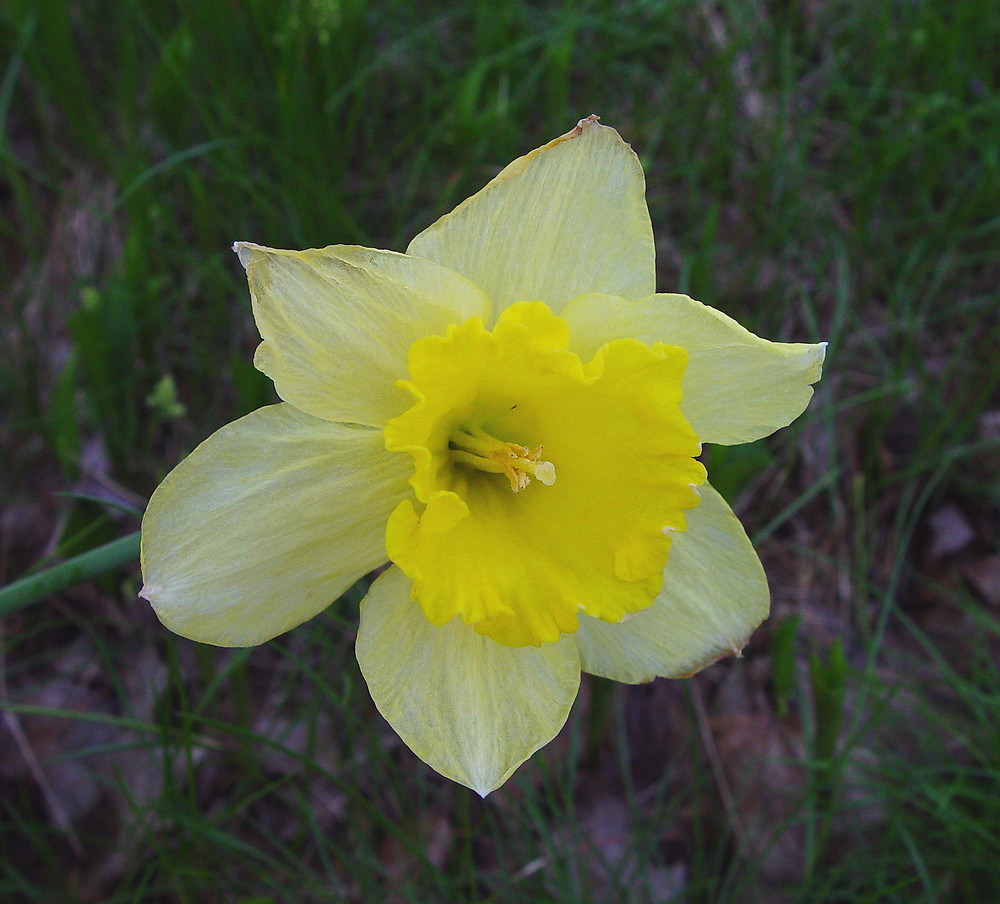
Wild Daffodil, sometimes called the Lent Lily, is the native daffodil of Britain. Smaller and more delicate than many garden varieties, it brings pale lemon-yellow flowers and deeper golden trumpets to damp woods, old meadows and grassy banks in early spring. Where conditions are suitable, its bulbs form great drifts of flowers beneath still-bare trees.
It belongs to Amaryllidaceae, the amaryllis family, alongside Snowdrop and Wild Garlic.
Identification
- A bulbous perennial, commonly about 15–35 cm tall.
- Usually a single, slightly nodding flower on each smooth, leafless flowering stem.
- Six pale yellow tepals surround a deeper yellow, trumpet-shaped corona.
- The corona is long and cylindrical, with a frilled or uneven rim.
- Narrow, flattened, grey-green leaves rise from the base in a loose cluster.
- The flower usually opens in March or April, occasionally earlier in mild weather.
- Plants often occur in clumps or extensive colonies in long-established habitats.
The contrasting pale tepals and rich yellow trumpet are particularly useful, although cultivated daffodils and hybrids may share some of these features.
Flower structure
What appear to be six petals are six tepals, arranged in two whorls of three. The outer and inner sets look similar, so they are described as tepals rather than as separate petals and sepals.
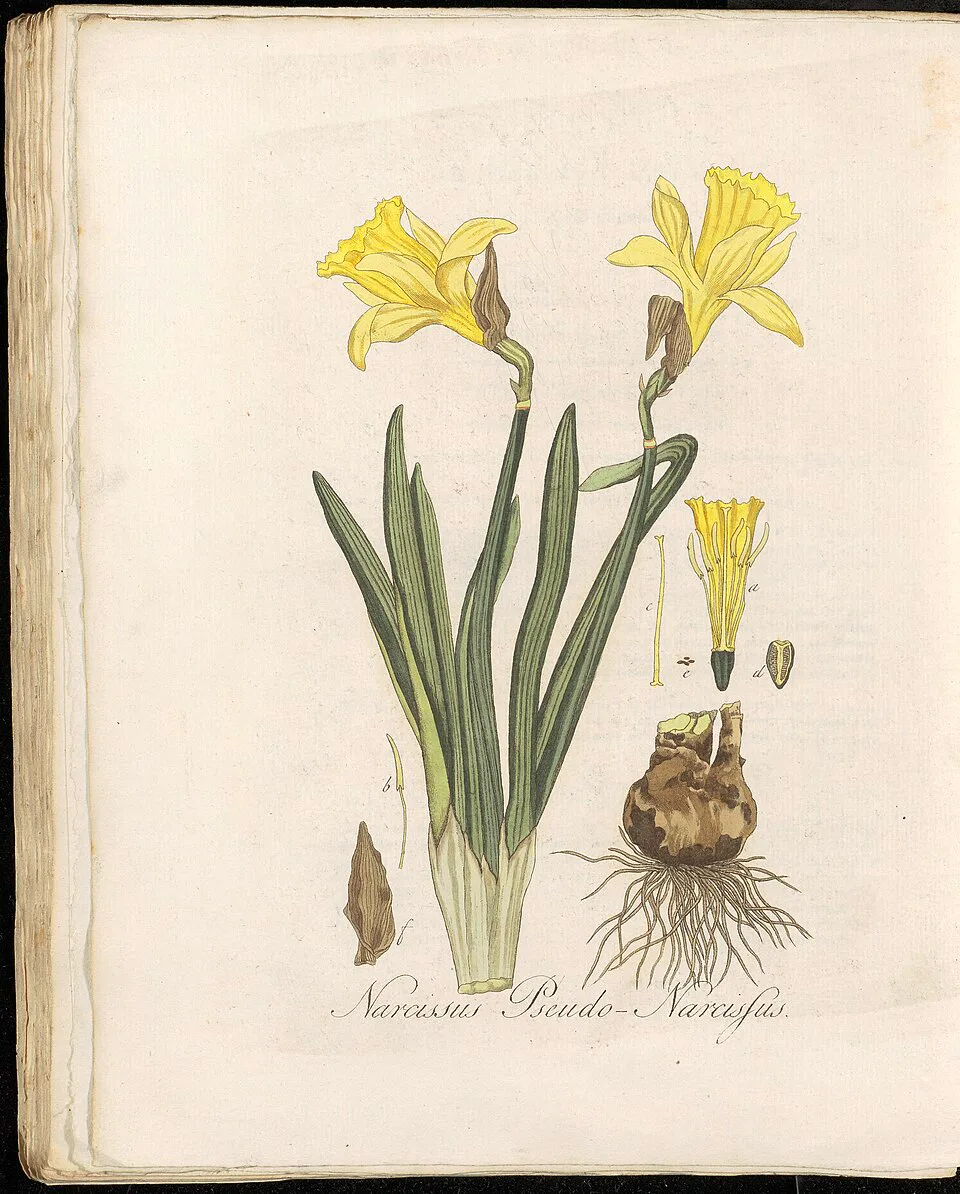
The golden trumpet is called the corona. It is an additional floral structure inside the ring of tepals, not a seventh petal. Its frilled opening surrounds six stamens and a central style with its stigma.
The ovary is inferior: it sits below the point where the tepals and the rest of the visible flower arise. Following fertilisation it may mature into a dry capsule containing seeds. The flower is carried on a leafless stalk called a scape, with a papery protective spathe around the developing bud.
Leaves and bulb
The leaves are long, narrow, flattened and often slightly grey-green, with parallel veins running along their length. They emerge directly from the base rather than being spaced along the flowering stalk.
An underground bulb stores reserves accumulated during the previous growing season. This allows the plant to push up leaves and flowers early in spring, before the woodland canopy becomes dense. Once the foliage has restored the bulb’s reserves, it dies back for the summer.
Habitat and distribution
Wild Daffodil favours damp deciduous woods, woodland edges, old meadows, orchards and grassy banks. It is native to Britain but has become much less widespread than garden daffodils. Some of the best-known colonies survive around the Gloucestershire villages of Newent, Dymock and Kempley, and in parts of western Britain and Wales.
Large colonies can persist for many decades. Because garden varieties are widely planted and can escape or hybridise, a daffodil growing beside a road or in woodland is not necessarily the native wild form.
Flowering period
Wild Daffodil is best seen in March and April, though flowering may begin in February during a mild spring. The flowers often appear when woodland is still open to the sunlight, with the foliage continuing to grow after the blooms have faded.
Similar species
- Garden Daffodils (Narcissus cultivars) are often taller, more robust or more intensely coloured, and may have multiple flowers or unusual trumpet and tepal shapes. Some cultivars closely resemble the wild plant.
- Tenby Daffodil (Narcissus pseudonarcissus subsp. obvallaris) is generally a brighter, more uniformly yellow form associated especially with Wales.
- Pheasant’s-eye Narcissus (Narcissus poeticus) has white tepals around a short yellow cup with a red-edged rim, rather than a long trumpet.
Where cultivated forms and hybrids occur nearby, identification from appearance alone can be difficult.
Where the names come from
The name Daffodil developed through forms such as affodill, historically associated with the name Asphodel. Wild Daffodil is also known as the Lent Lily because it commonly flowers during Lent, although it belongs to Amaryllidaceae rather than the true lily family.
Narcissus is the ancient Greek name connected with the myth of the beautiful youth Narcissus, who became captivated by his own reflection. Pseudonarcissus means ‘false narcissus’, a historical botanical distinction rather than a suggestion that the plant is not a true member of the genus.
Folklore & history
The Wild Daffodil has long been associated with spring, renewal and the return of light. In western Britain, its flowering drifts became a familiar feature of old woods and meadows, and flowers were once gathered and sold in towns and villages.
Its old name Lent Lily reflects the time of year, while daffodils more generally became symbols of Wales and of hope. The flower’s drooping head recalls the myth of Narcissus bending over a pool to admire his reflection.
William Wordsworth’s famous poem about daffodils helped make the flower one of Britain’s best-known signs of spring, although the flowers described in poetry should not automatically be assumed to be the native wild form.
Wildlife
The early flowers can provide pollen and nectar for bumblebees and other insects active on mild spring days. In established woodland and meadow colonies, Wild Daffodil forms part of a diverse seasonal ground flora alongside primroses, violets and other spring flowers.