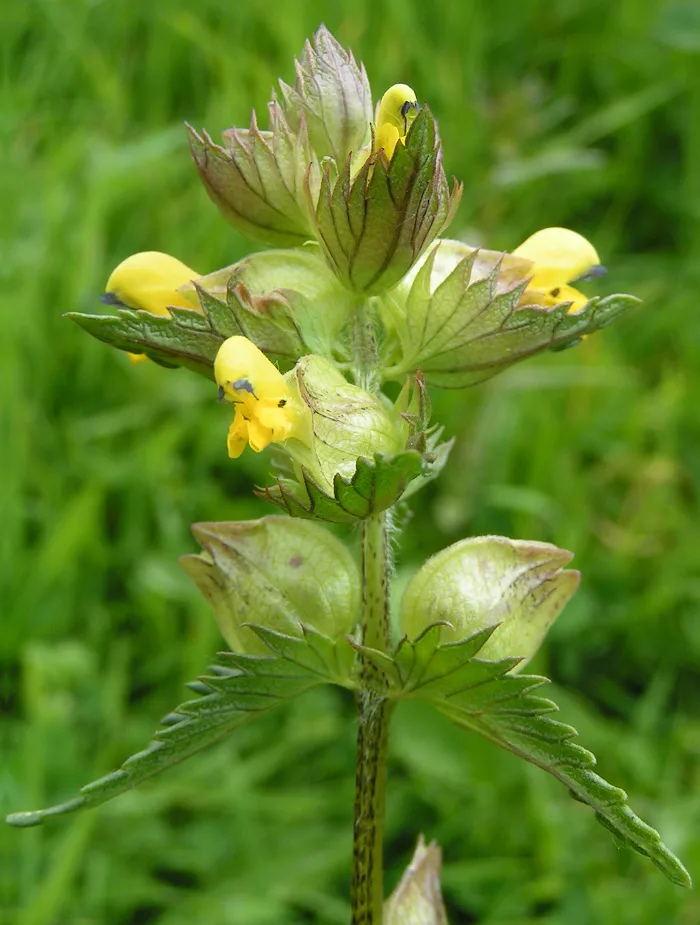
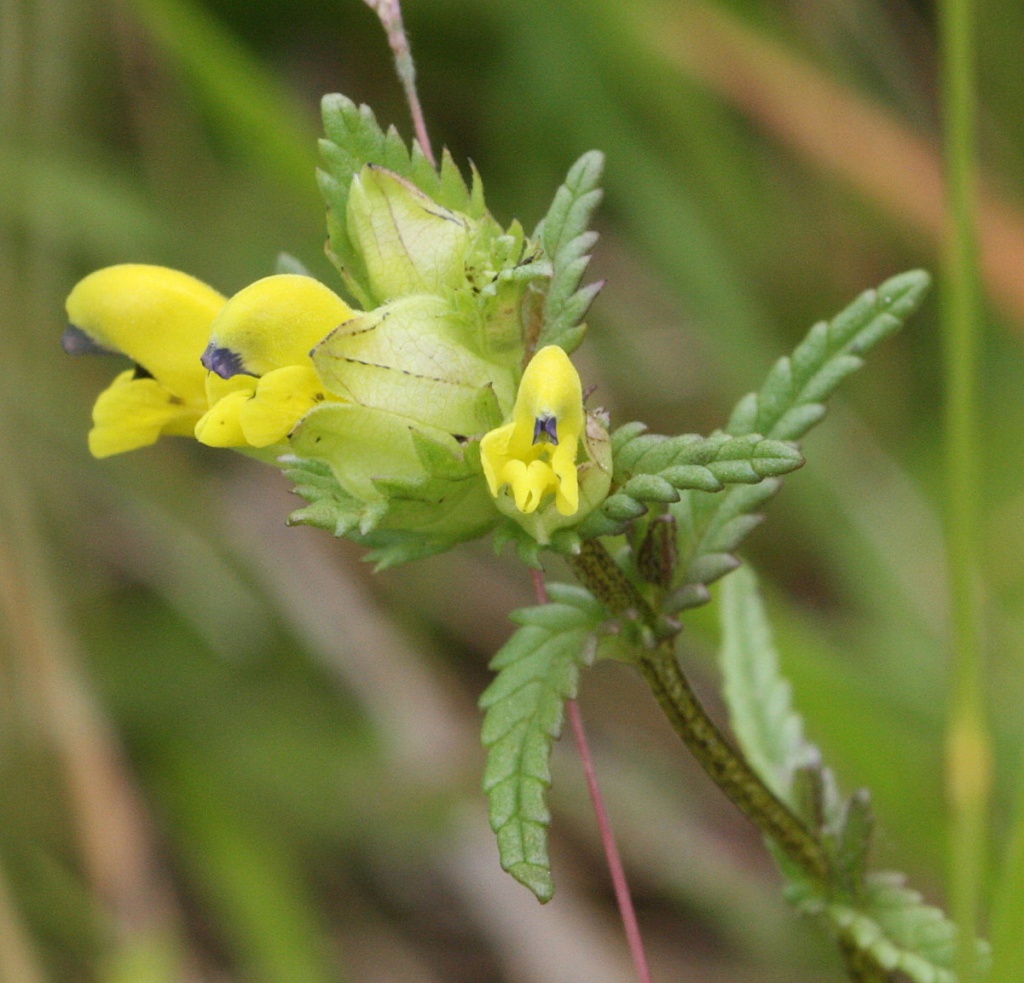
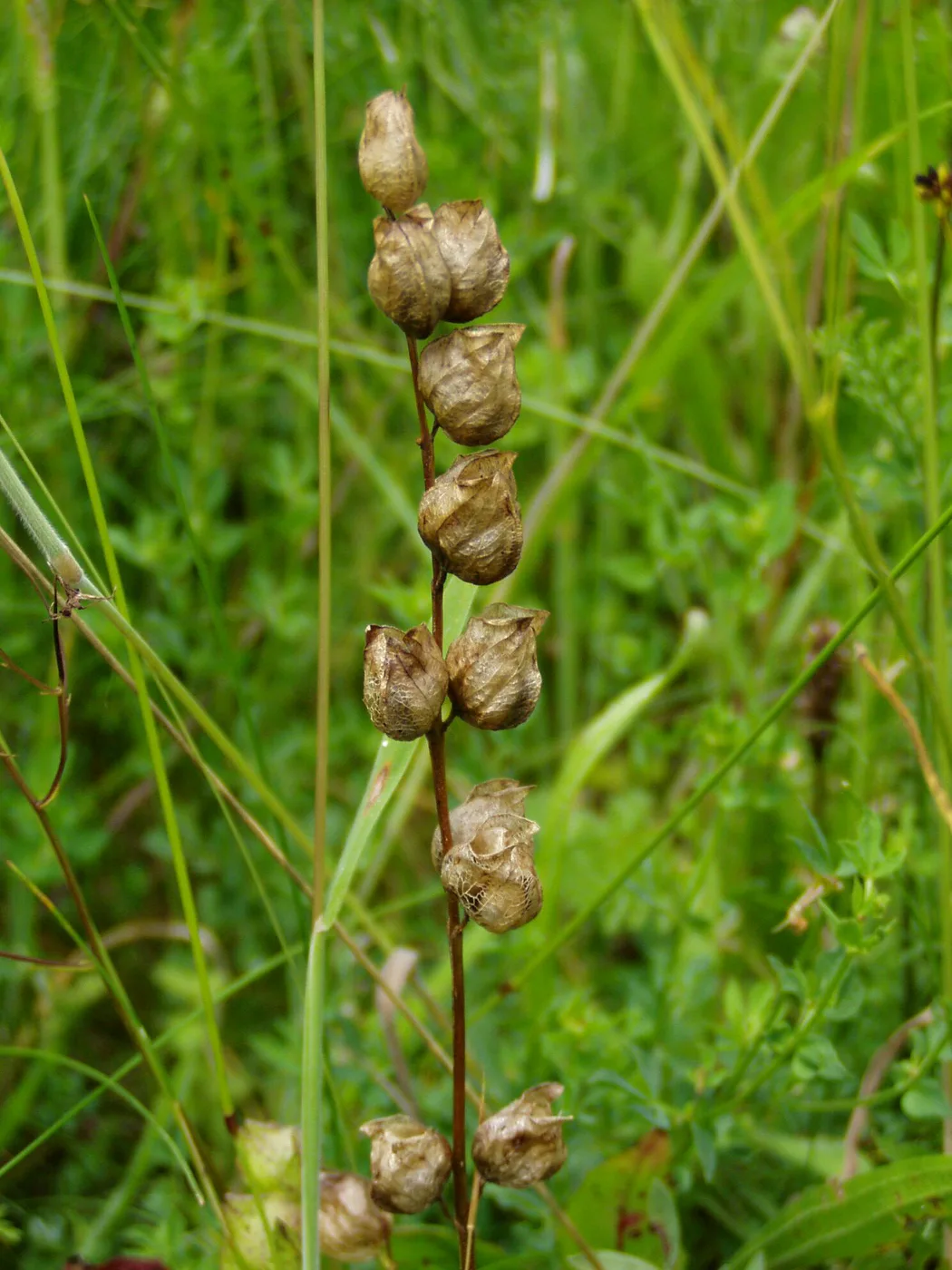
Yellow Rattle is a native annual wildflower of meadows and grassland, easily recognised by its yellow flowers, toothed leaves and inflated seed heads. It is sometimes called the meadow maker because it can weaken vigorous grasses and leave room for a greater variety of wildflowers. It belongs to Orobanchaceae, the broomrape family.
Its unusual way of life is part of what makes it so interesting: Yellow Rattle is a hemiparasite. It makes food using sunlight, but its roots also draw water and nutrients from neighbouring plants, especially grasses.
Identification
- Usually 10–50 cm tall, with an upright, sometimes branched stem, often marked by dark spots or streaks.
- Leaves grow in opposite pairs; they are narrow, pointed and noticeably serrate along the edges.
- A short, leafy inflorescence carries a succession of yellow, tubular flowers, each emerging from a large green calyx.
- Each flower has two lips: the upper lip forms a hood with two small teeth, sometimes tipped violet or whitish.
- The broad, veined calyx becomes inflated and papery around the developing seed capsule.
- When the fruits mature, the loose seeds rattle inside the dry capsules when the plant moves in the wind or is shaken.
The combination of toothed opposite leaves, yellow two-lipped flowers and swollen, bladder-like calyces makes this plant particularly distinctive, even after its flowers have finished.
Flower structure
The five petals are fused into an irregular, two-lipped corolla. The upper lip arches above the opening, and the lower lip provides a landing place for insects. Four fertile stamens lie inside the flower.
The green outer sepals are fused into a prominent, inflated calyx. Around the flowers are green, sharply toothed bracts, which can resemble small leaves. After pollination, a dry seed capsule develops within the calyx. As the capsule and calyx dry, the loose seeds produce the rattle that gives the plant its common name.
Leaves and stems
The leaves are simple and usually attached directly to the stem in opposite pairs. They are narrow to lance-shaped, with coarse teeth and conspicuous veins. The green bracts around the flowers are often broader and more strongly toothed than the lower leaves.
Stems are usually upright and can be branched. Unlike a creeping species, Yellow Rattle spreads between years by seed rather than runners. The entire plant dies after setting seed, since it is an annual.
A meadow plant that feeds on grasses
Yellow Rattle’s roots make specialised connections called haustoria with the roots of nearby host plants. Through these connections it draws water and dissolved nutrients, often weakening the surrounding grasses. It still has green leaves and carries out photosynthesis, which is why it is called a hemiparasite rather than a fully parasitic plant.
By reducing the dominance of vigorous grasses, it can open spaces in a meadow canopy for smaller flowering plants. This is why Yellow Rattle is so often used in meadow restoration. Its seeds generally need a spell of winter cold to germinate, and plants must be allowed to set seed to return the following year.
Habitat
It is most closely associated with traditionally managed hay meadows and other relatively open grassland. It can also grow in pastures, grassy banks and road verges where mowing or grazing allows plants to flower and set seed.
Yellow Rattle is native to Britain and widely distributed, although it is less likely to persist in heavily fertilised grassland dominated by very vigorous grasses.
Flowering period
The yellow flowers appear mainly from May to August, sometimes into September. Seed capsules follow during summer, turning from green to brown and papery as they ripen.
Similar species
- Greater Yellow Rattle (Rhinanthus angustifolius) is a related species with larger flowers; separating different Rhinanthus species and forms can require a close look at the calyx, bracts and flowers.
- Yellow Bartsia (Parentucellia viscosa) also has yellow flowers and toothed leaves, but is noticeably sticky or hairy and lacks Yellow Rattle’s characteristic large, papery, inflated calyces.
On a flowering Yellow Rattle plant, look especially at the two-lipped flowers and their swollen green calyces; later in the year, the brown rattling seed heads are an excellent clue.
Where the names come from
The common name Yellow Rattle refers to its yellow flowers and the sound made by loose seeds shaking inside the ripe, dry fruiting structures. It has also been called hay rattle and corn rattle because it was familiar in meadows and fields.
The scientific name comes from Greek and Latin. Rhinanthus combines the Greek rhis (genitive rhinos), meaning “nose”, and anthos, meaning “flower”, referring to the nose-like shape of the upper lip. Minor is Latin for “smaller” or “lesser”.
Folklore & history
In traditional haymaking, the sound of ripe Yellow Rattle was associated with the time to cut the meadow. Its dry, papery seed heads could be heard rustling and rattling as the grasses moved.
Farmers did not always welcome it. Because Yellow Rattle draws resources from grasses, a heavy growth of the plant could reduce the hay crop. Today, that same quality is valued when restoring flower-rich meadows where vigorous grass would otherwise overwhelm smaller plants.
Wildlife
The flowers are visited by bumblebees and other pollinating insects. Yellow Rattle is also a foodplant for the caterpillars of the Grass Rivulet moth (Perizoma albulata).
Its greatest contribution to meadow wildlife is often indirect: by weakening dominant grasses, it can help create a more varied habitat for other flowering plants and the insects that depend upon them.