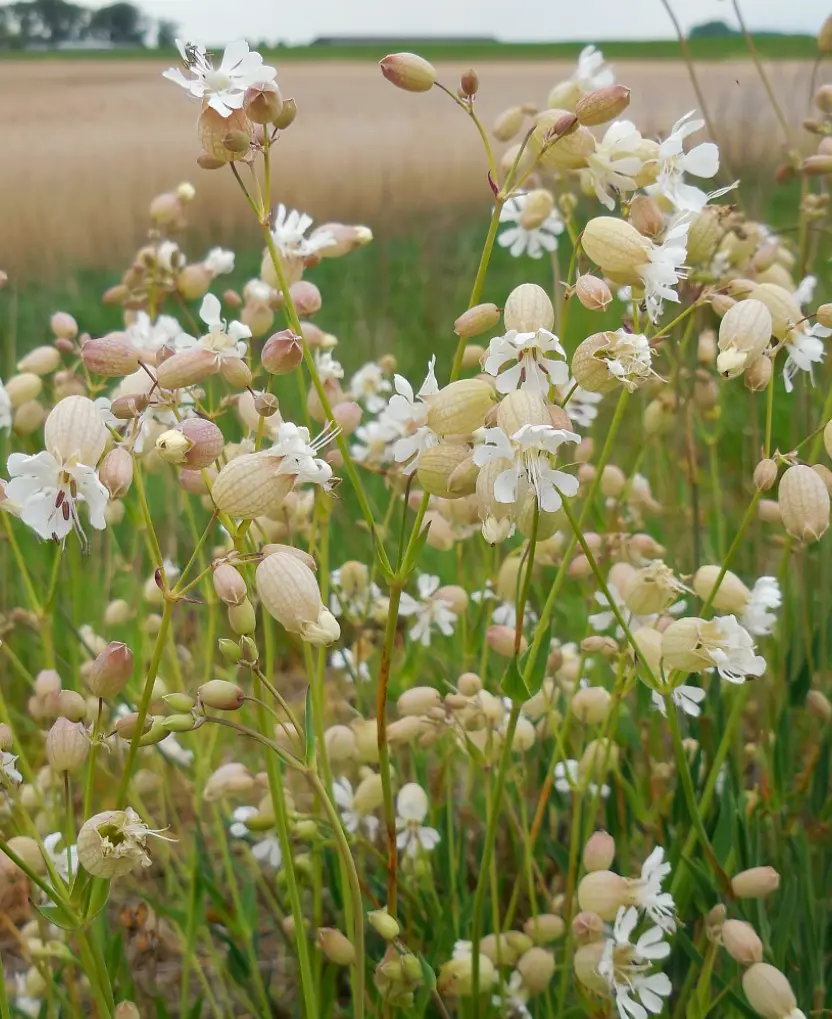
Bladder Campion is a native perennial wildflower of meadows, grassy banks, field edges and roadside verges. Its delicate white flowers are carried above a pale, balloon-like swelling that gives the plant its name. This unusual structure is the calyx, made from the flower’s fused sepals. Bladder Campion belongs to Caryophyllaceae, the pink family, alongside Red Campion, stitchworts and chickweeds.
Identification
- Usually 30–80 cm tall, with slender upright stems and a rather open, branching appearance.
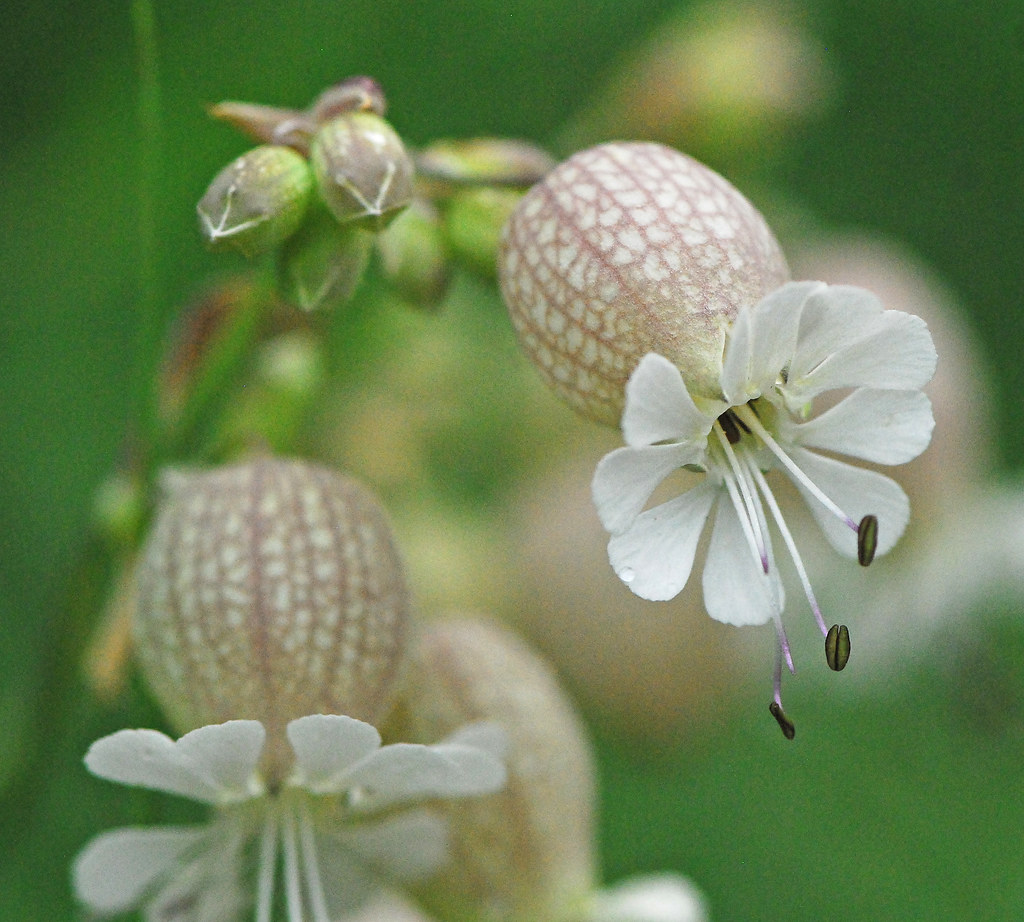
- Small white flowers with five deeply notched petals; the deep divisions can make them look as though they have ten petals.
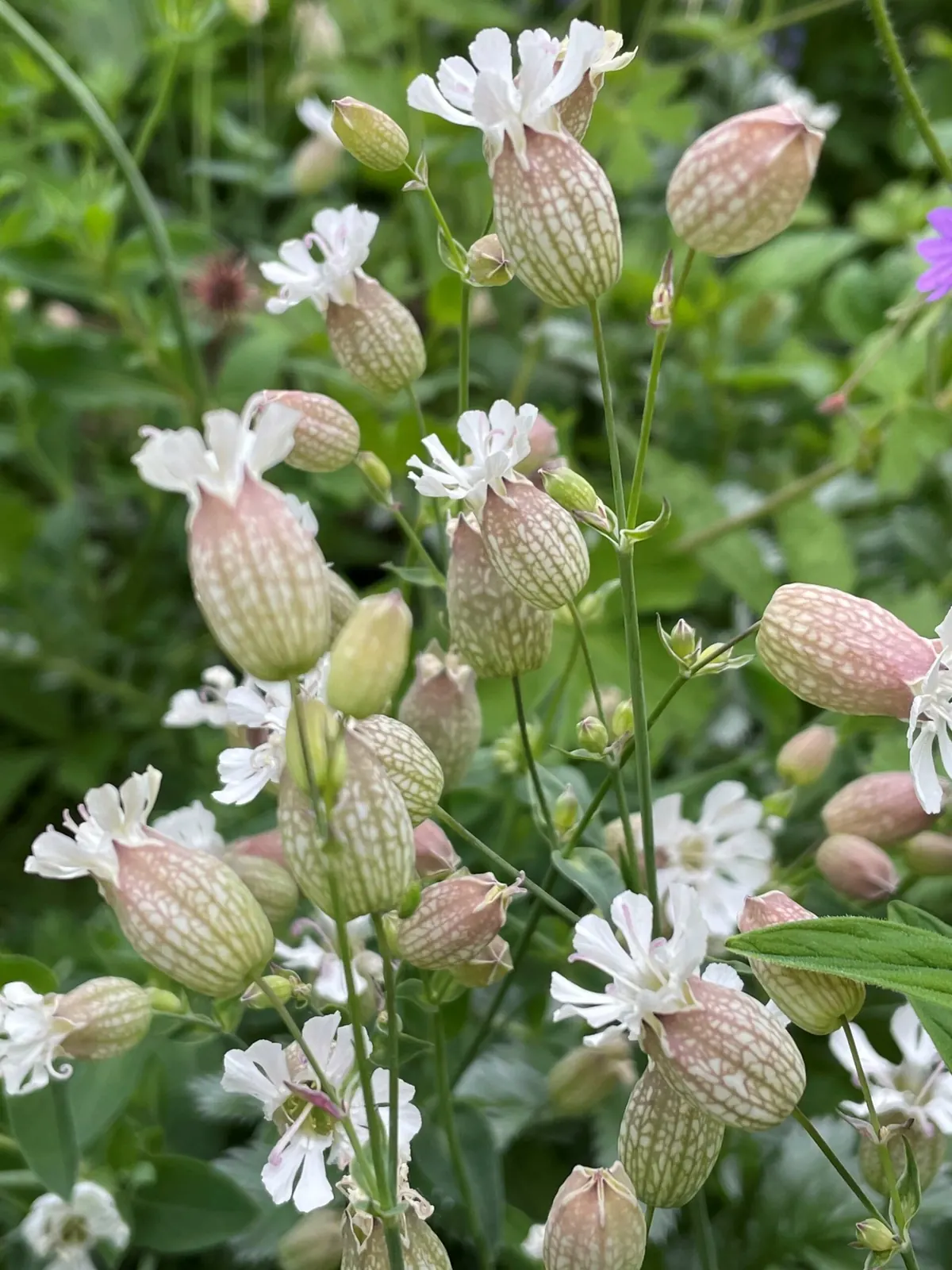
- A conspicuous, inflated, pale green or pinkish calyx sits behind each flower, often with a network of darker veins.
- The calyx is rounded or oval, narrowing slightly at its mouth, and remains conspicuous as the fruit develops.
- Narrow, greyish-green leaves grow in opposite pairs and usually have smooth, untoothed edges.
- Unlike Red Campion, the leaves and stems are usually hairless rather than softly hairy.
The combination of white, deeply notched petals and the large, net-veined, inflated calyx is particularly useful for recognising Bladder Campion.
Flower structure
Each flower has five white petals, each deeply divided into two lobes. The petals surround ten stamens and usually three styles. The flowers are carried in loose, branching groups rather than a dense spike.
Beneath the petals, the five sepals are fused into a single inflated calyx. Its papery surface is marked by branching veins, sometimes tinged purple or pink. It resembles a little balloon or lantern, but it is not a seed pod: it is part of the flower itself.
After pollination, a dry capsule forms inside the persistent calyx. When ripe, it opens to release numerous small seeds.
Leaves and stems
Bladder Campion has simple, oval to lanceolate leaves, often with a bluish or greyish-green cast. The leaves grow in opposite pairs along the stem and have entire, or untoothed, margins. The upper leaves are generally sessile, meaning they have little or no leaf stalk.
The stems are upright, branched towards the top and usually smooth rather than noticeably hairy. Compared with the soft-haired stems and leaves of Red Campion, the smooth, somewhat waxy appearance of Bladder Campion provides another helpful clue.
Habitat
Look for Bladder Campion in grassland, meadows, field margins, dry banks, hedgerows, waste ground and roadside verges. It often favours open, sunny places and can be especially frequent on lime-rich or chalky soils.
It occurs across much of Britain, particularly in England, although its abundance varies with local soil and habitat. It also appears in gardens and on disturbed ground.
Flowering period
Bladder Campion generally flowers from May to September. Individual flowers are fairly delicate, but the inflated calyces remain visible long after the petals have withered, so the plant can still be recognised later in the season.
Similar species
- Red Campion (Silene dioica) has pinkish-red flowers and softly hairy stems and leaves. Its calyx is not normally so round and inflated.
- White Campion (Silene latifolia) also has white, notched petals, but the plant is usually noticeably hairy. Its female flowers develop an enlarged calyx, so checking the hairs and overall flower shape is helpful.
- Sea Campion (Silene uniflora) has white, divided petals and a swollen calyx, but is a low-growing plant mostly found on rocky coasts and coastal grassland.
Where the names come from
Bladder Campion is named for its enlarged, bladder-like calyx, which looks as if it has been gently inflated. Traditional names such as Cowbell, Maiden’s Tears and White Bottle also reflect its dangling flowers and unusual shape.
The genus name Silene has several suggested origins, including a connection with Silenus of Greek mythology. The species name vulgaris is Latin for ‘common’ or ‘ordinary’.
Folklore & history
Bladder Campion has a collection of old country names, including Cowbell, Maiden’s Tears and Spatling Poppy. The last of these is associated with the frothy ‘cuckoo-spit’ left on its stems by young froghoppers. The English herbalist John Gerard used the name Spatling Poppie in his writings.
In parts of the Mediterranean, especially Italy, the young shoots and leaves have traditionally been gathered as a spring vegetable. Known by names including stridolo or sclopit, they have been eaten in cooked dishes, omelettes and fillings.
A tale associated with the name campion tells of a young boy whom the goddess Minerva changed into a plant after he fell asleep instead of catching flies for her owls. The swollen calyx was said to represent the bag he should have filled.
Wildlife
The flowers offer nectar and pollen to visiting insects, including moths and bees. Some moths can reach the nectar in these relatively deep flowers, and the pale blooms are noticeable in the evening.
Bladder Campion is also a food plant for froghoppers, including the striking red-and-black froghopper. Their nymphs shelter in the froth commonly called cuckoo-spit, which may be seen on the stems during spring and summer.