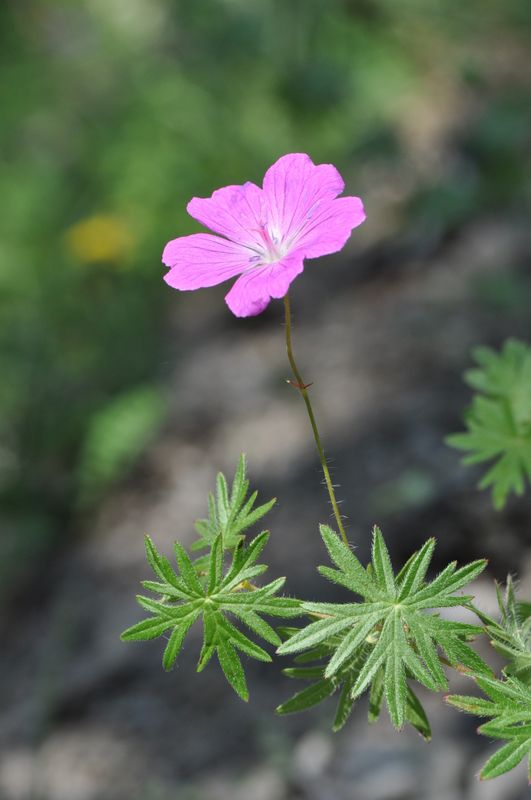
Bloody Crane’s-bill is one of the most colourful native members of the cranesbill family (Geraniaceae). Its vivid magenta-pink flowers stand out among finely divided leaves on dry limestone grassland, rocky slopes and coastal dunes. Although the flowers are striking, the plant is especially worth looking at after flowering, when the leaves and stems may develop the rich red colouring behind its name.
Identification
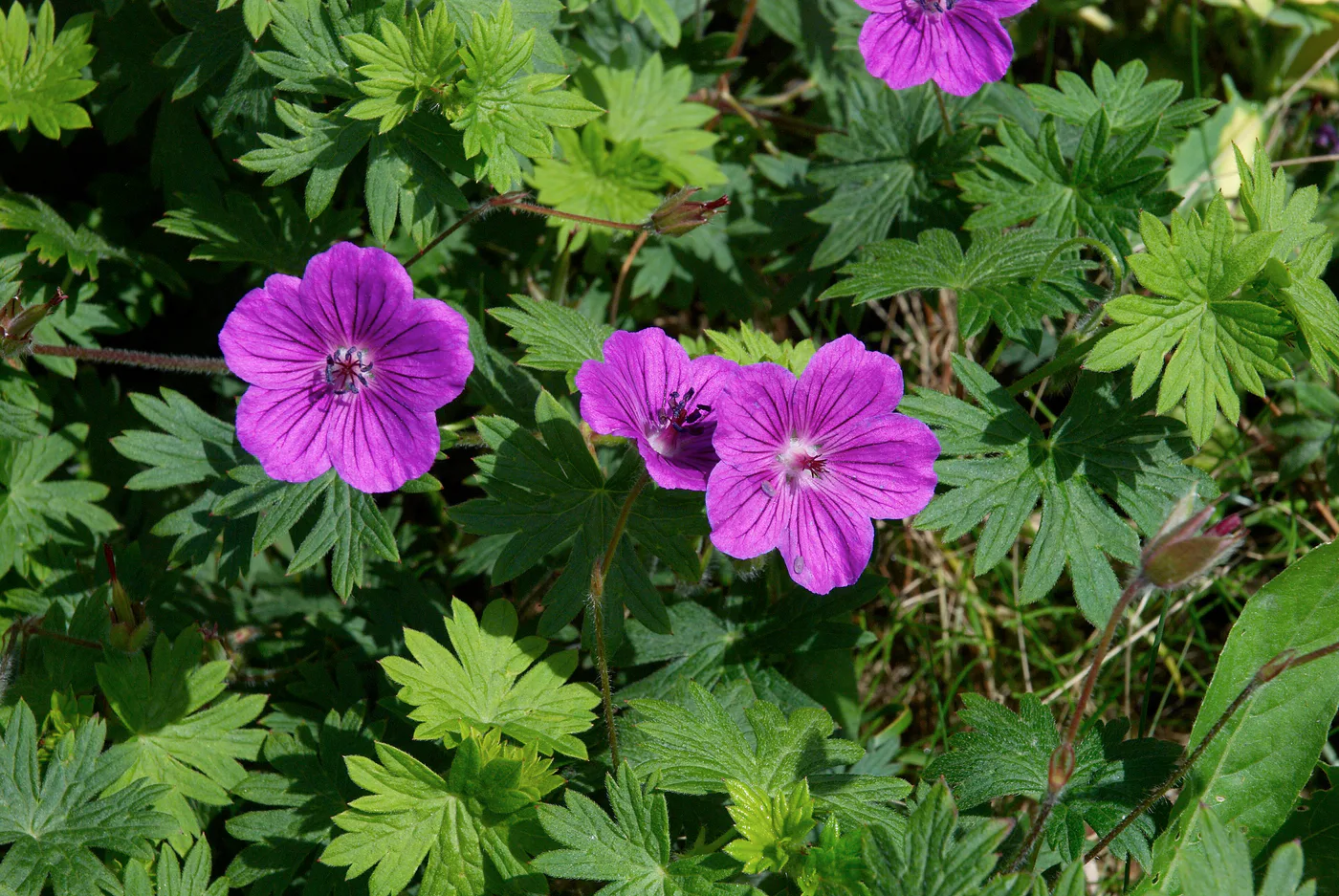
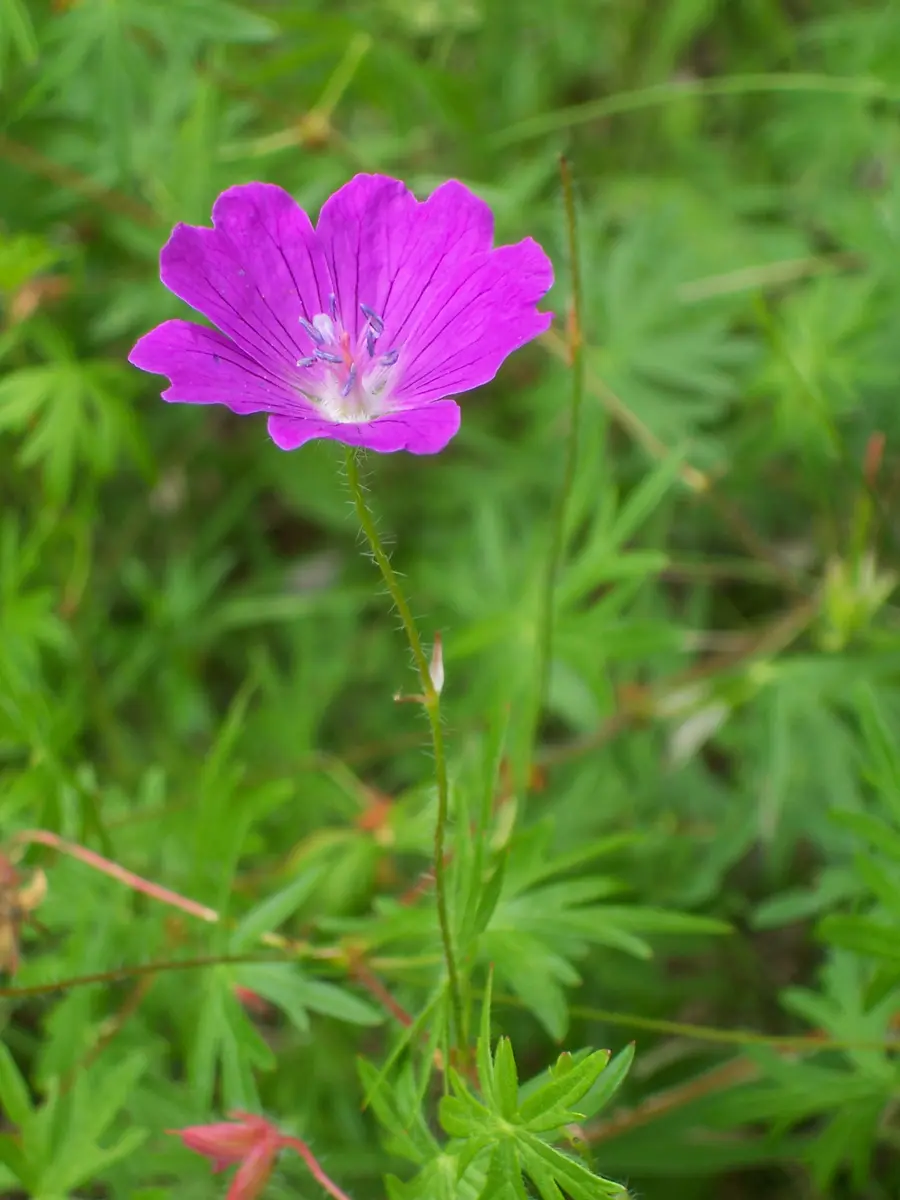
- Large, open flowers, usually about 2–4 cm across, with five vivid magenta-pink petals marked by darker veins.
- Flowers generally carried singly at the ends of long, slender stalks; the petals are broad and usually not noticeably notched.
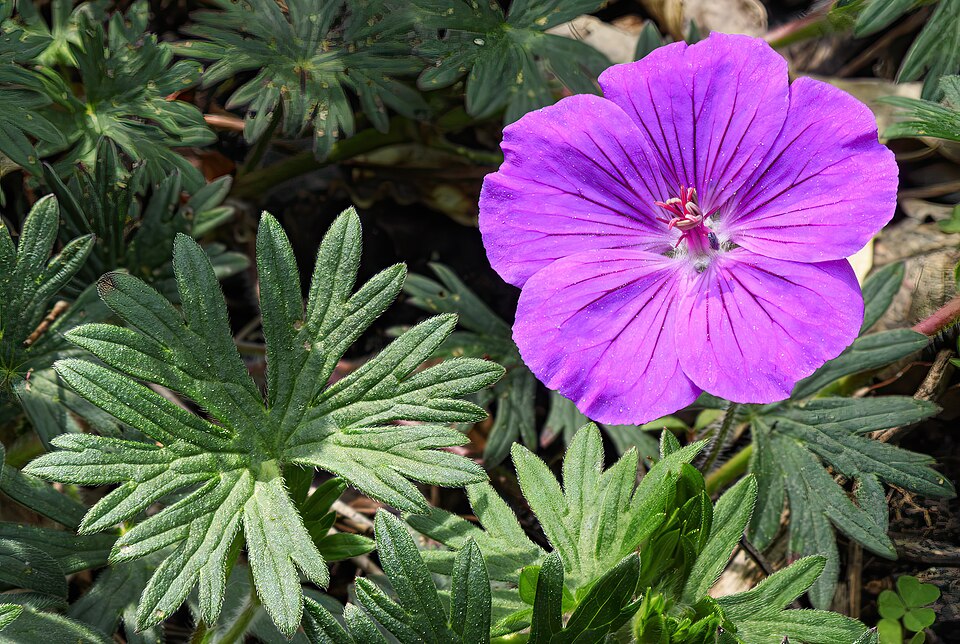
- Leaves deeply divided into five to seven main, narrow lobes, themselves often cut into smaller pointed segments.
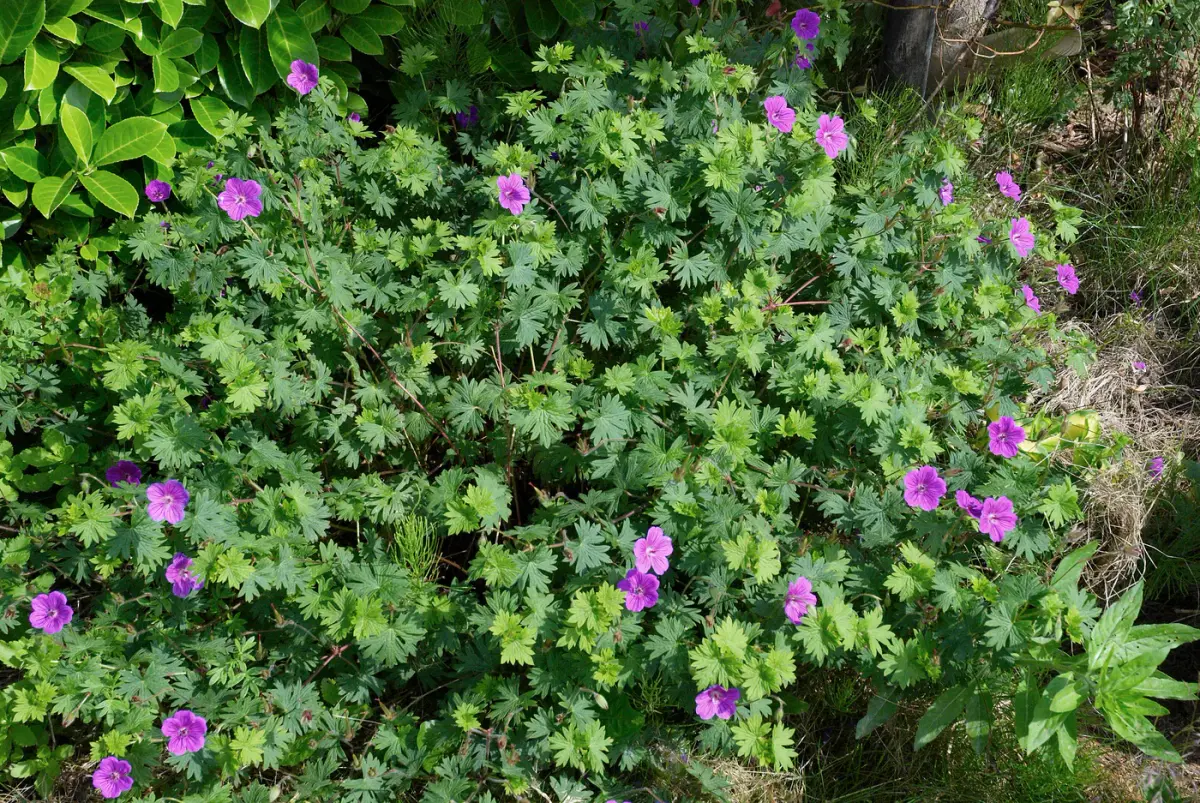
- Hairy, branching stems, often reddish at the joints, growing from a low, spreading perennial clump.
- Long, pointed fruits developing after the petals fall, resembling a bird’s slender beak.
- Often associated with open, sunny, well-drained limestone country or coastal grassland.
The combination of a large, usually solitary crimson-magenta flower and narrow, deeply cut leaf segments is particularly useful when distinguishing this species from other cranesbills.
Flower structure
A typical flower has five broad, separate petals, five pointed sepals and ten fertile stamens surrounding the central female parts. Each sepal ends in a small, narrow tip. The petals carry darker branching veins that are easy to see in a close photograph.
The ovary is formed from five joined carpels. After pollination, these develop into the characteristic long-beaked fruit of a true cranesbill. At maturity the five one-seeded portions, or mericarps, separate as their slender supporting strips curl upwards, flinging the seeds away from the parent plant. This spring-like movement is one of the most interesting features of the family.
Leaves and stems
The leaves are arranged in opposite pairs and have a palmate outline: their main divisions spread out from one point like fingers from a hand. Unlike the broad, rounded lobes of some other geraniums, the five to seven divisions here are cut very deeply and are comparatively narrow, giving the foliage a delicate, almost star-shaped appearance.
The leaves and stalks are usually hairy. Stems spread or rise gently from a perennial base and may be flushed red, particularly near the joints. As autumn approaches, the foliage often turns red or crimson, creating a second display of colour after the summer flowers have finished.
Habitat
In the wild, Bloody Crane’s-bill favours dry, open and well-drained places, especially limestone grassland, limestone pavement, rocky slopes, coastal dunes and cliffs. It can also occur at the edges of scrub or open woodland where enough sunlight reaches the ground.
Its natural distribution in the UK is rather local. It is particularly associated with northern limestone districts and parts of the coast, including sites in northern England and Wales. The species is also frequently grown in gardens, so a plant seen beside a road or near houses may be a garden escape rather than part of a long-established wild population.
Flowering period
Bloody Crane’s-bill usually flowers from June to August, sometimes starting in late May or continuing later in favourable conditions. The large, open flowers are attractive to visiting bees and other insects.
Similar species
- Meadow Crane’s-bill (Geranium pratense): has large blue to violet-blue flowers, usually in pairs, and broader, more widely spaced leaf divisions. Bloody Crane’s-bill is generally more crimson-magenta and has narrower leaf lobes.
- Herb-robert (Geranium robertianum): has much smaller pink flowers, usually in pairs, and finer, more intricately divided leaves. Its foliage often has a strong smell when rubbed.
- Dove’s-foot Crane’s-bill (Geranium molle): has smaller pink flowers and rounded, softly hairy leaves with broad lobes rather than narrow, deeply cut segments.
- Cut-leaved Crane’s-bill (Geranium dissectum): also has narrow leaf segments, but its flowers are much smaller and the petals are distinctly notched.
Where the names come from
The name crane’s-bill refers to the fruit, which develops a long, slender point resembling the beak of a crane. This resemblance was so striking to earlier botanists that the scientific genus name Geranium was formed from the Greek geranos, meaning ‘crane’.
The word bloody and the Latin species name sanguineum both evoke blood-red colouring. Despite the name, the flowers are usually magenta or crimson-pink rather than true blood-red. The deeper red is especially noticeable in the stems, joints and ageing seed structures, while the leaves can turn striking shades of red in autumn. The plant is also called Blood-red Crane’s-bill or Bloody Geranium.
Folklore & history
Bloody Crane’s-bill has long been familiar in the limestone landscapes and coastal grasslands of northern Britain. Its place in the identity of that region is reflected in its selection as the county flower of Northumberland, where its bright flowers can be seen among the dune grasslands and other open habitats of the coast.
The plant also belongs to a much older European herbal tradition surrounding cranesbills. In his English herbal of 1578, Henry Lyte described a plant called Sanguin geranium or Blood Roote, which has been tentatively associated with Bloody Crane’s-bill. Older herbals did not always divide cranesbills into the same species recognised today, so the identification cannot be treated as certain.
John Parkinson, writing in his Theatrum Botanicum of 1640, grouped cranesbills among herbs traditionally used to staunch bleeding and treat wounds. These associations help explain why several members of the group acquired names connected with blood, though the striking red autumn colour is an equally memorable feature of this particular plant.
Wildlife
The open, nectar-rich flowers attract bees, including bumblebees, as well as other visiting insects. In sunny grassland, the low foliage can provide shelter for smaller invertebrates. Once the seeds ripen, the beaked fruits release them with a sudden flick, helping the plant spread into nearby gaps in the vegetation.