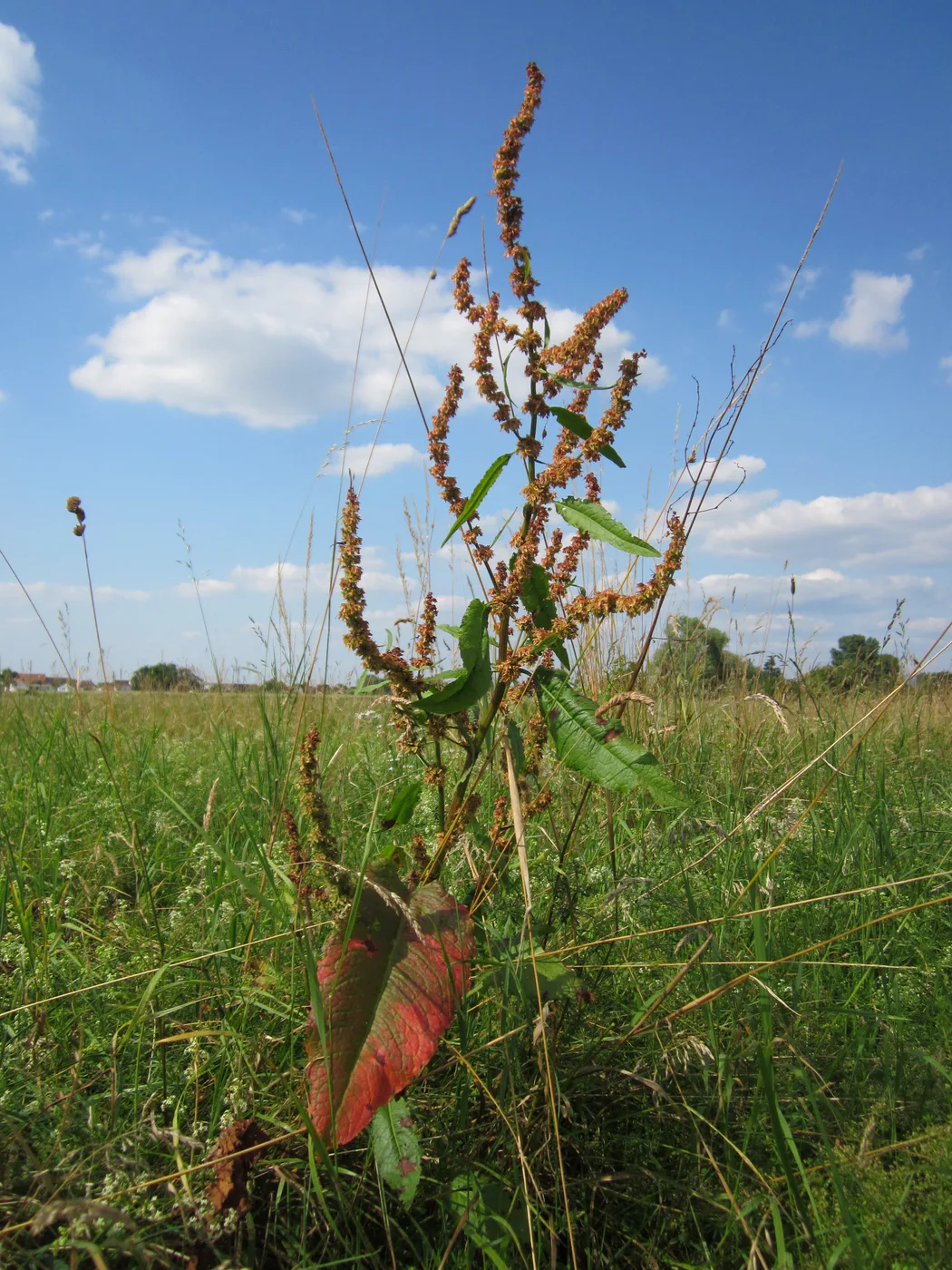
Broad-leaved Dock is one of the most familiar large-leaved plants of fields, pasture, roadsides and rough ground throughout the UK. Often dismissed as a weed, it is a robust perennial with broad leaves, a deep root and tall sprays of tiny greenish flowers that gradually become reddish-brown. It belongs to the dock and knotweed family (Polygonaceae), alongside Common Sorrel.
Anyone who has grown up in Britain is likely to know the tradition of rubbing a dock leaf on a nettle sting. The plant has a much richer story, however, from its unusual fruits to its old role as a natural wrapping for butter.
Identification
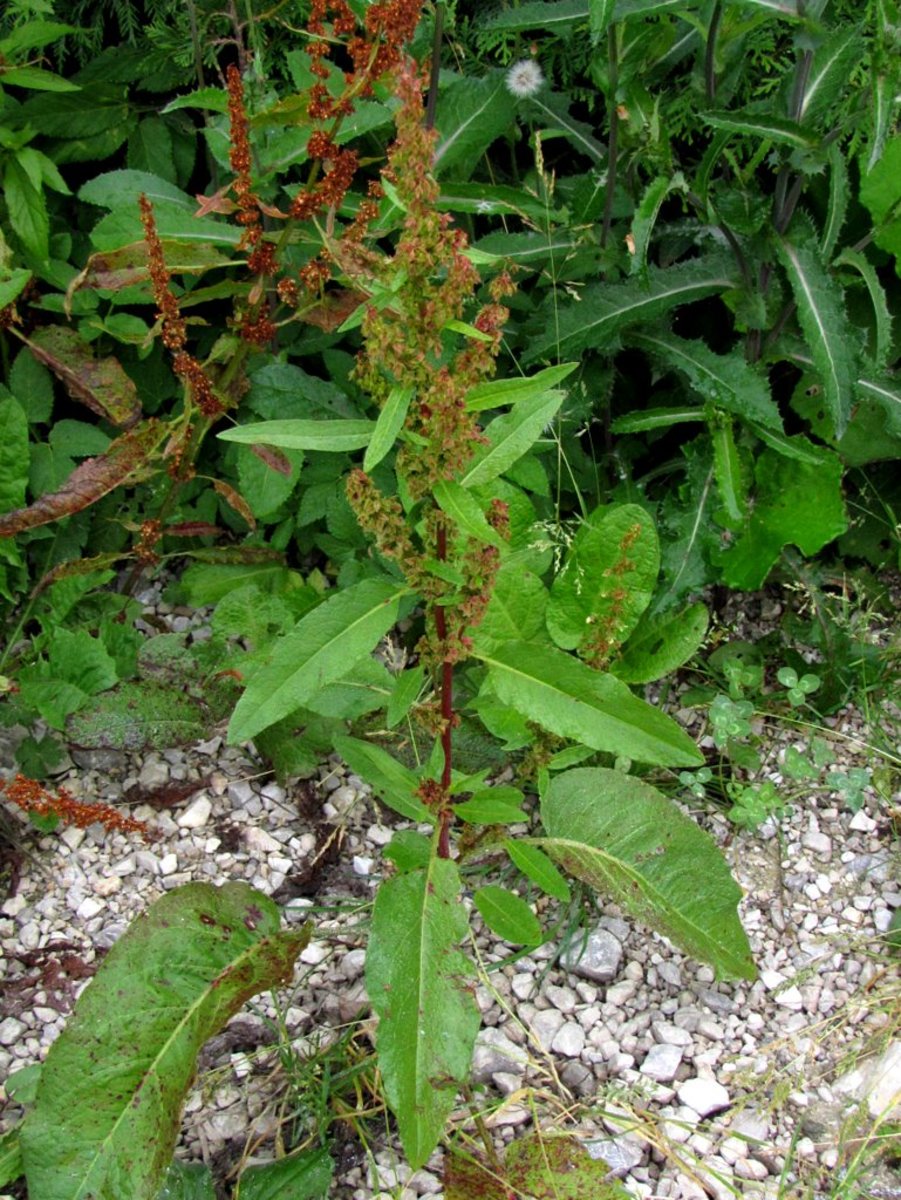
- A strong, upright perennial, typically 50–120 cm tall and sometimes reaching 150 cm, arising from a substantial, deeply penetrating root.
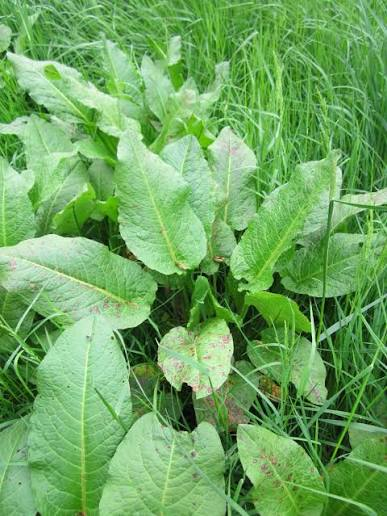
- Large, broad, oblong or oval lower leaves, often with a heart-shaped base, a relatively blunt tip and slightly wavy but not strongly curled margins.
- Long leaf stalks, especially on the lower leaves; the leaves become smaller and narrower higher on the flowering stems.
- Green or reddish-tinged, often ribbed stems that branch into long, open sprays of small, inconspicuous flowers.
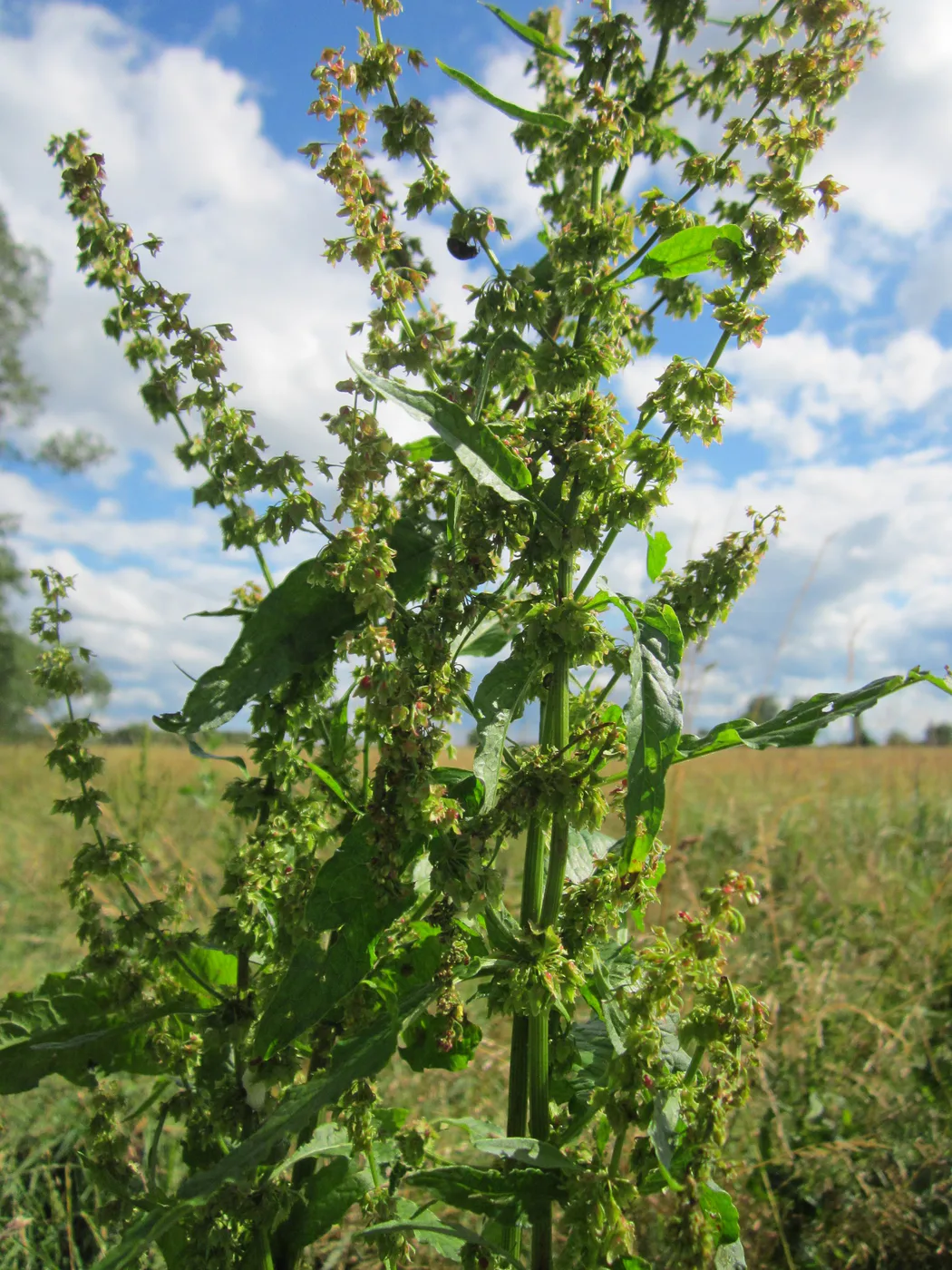
- Numerous tiny flowers grouped in clusters along the branches of a large panicle.
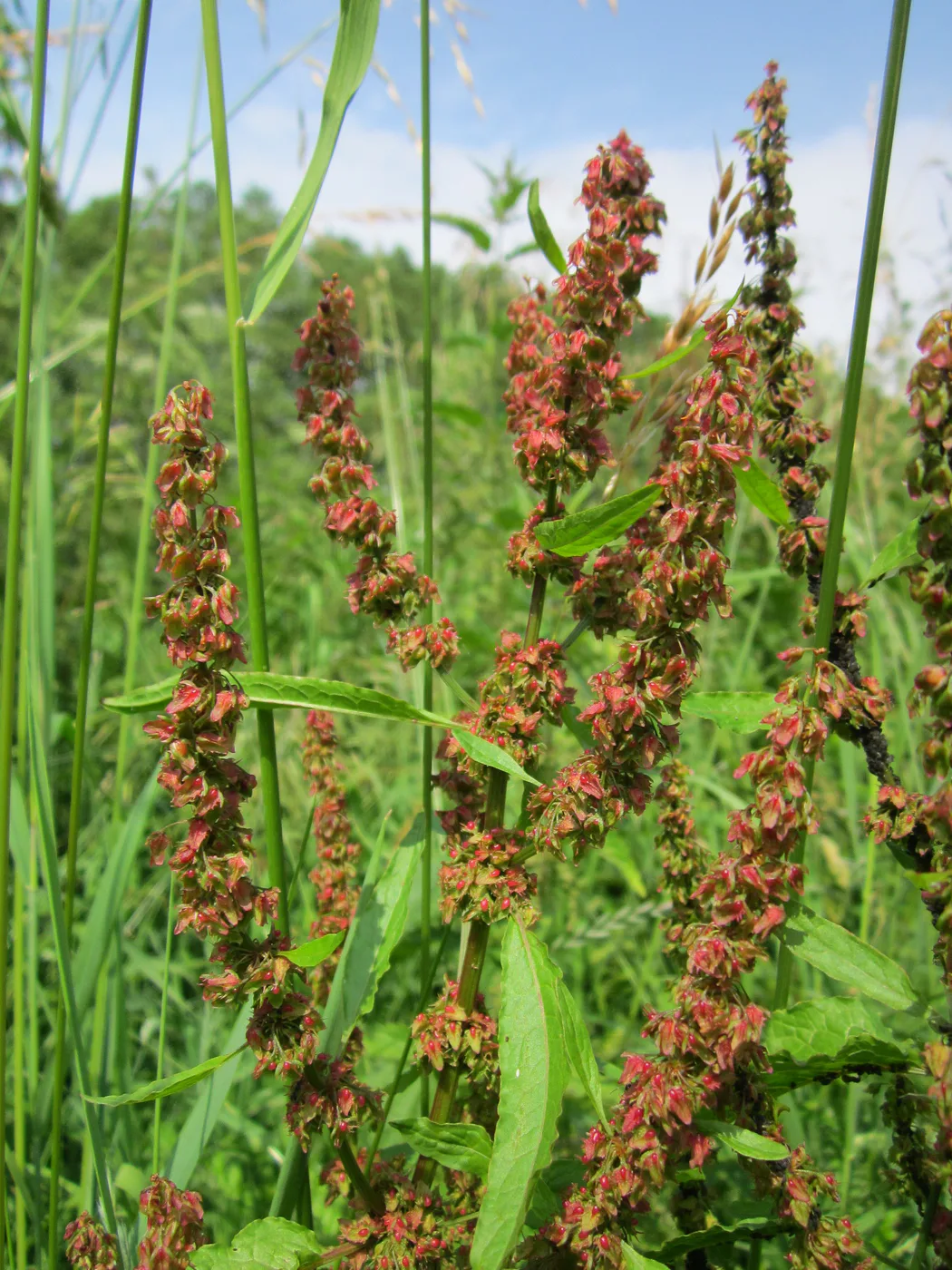
- Papery fruiting structures that become reddish then rusty brown; each has three roughly triangular wings, usually with irregular teeth along the sides.
- One of those wings commonly bears a conspicuous central swelling, called a tubercle, a useful feature for separating dock species.
The combination of broad, heart-based leaves and distinctly toothed fruiting wings is especially useful. Docks can be difficult to separate when they have leaves alone, so try to inspect a fruiting stem as well.
Flower structure
The tiny flowers are carried in repeated clusters along the many branches of an upright panicle. Each flower is only a few millimetres across and has no showy petals. Instead, it has six small tepals arranged in two groups of three. These may be green, greenish-pink or reddish.
Unlike Common Sorrel, which usually has male and female flowers on separate plants, Broad-leaved Dock generally bears flowers containing both male and female organs. Each flower has six stamens with anthers, and a central ovary with three styles ending in feathery stigmas. The feathery stigmas catch wind-blown pollen, while the exposed anthers release it into the air.
The flowers are easily overlooked when green, but the sprays become much more conspicuous as the enlarged floral parts turn reddish and later brown.
Leaves and stems
The large lower leaves arise on long stalks from a basal rosette. They are usually broadly oblong, with a rounded or distinctly heart-shaped base and an end that is often blunt rather than sharply pointed. Their edges may be wavy, but are generally less strongly curled than those of Curled Dock. A strong midrib and branching side veins give the blade a sometimes wrinkled appearance.
The upper leaves are smaller, narrower and shorter-stalked. Leaves occur alternately on the flowering stem. At the point where each leaf stalk joins the stem, a thin, papery sheath called an ochrea encircles the stem — a characteristic feature of Polygonaceae.
The stout flowering stems are often reddish, especially as they age. Below ground, a thick taproot stores reserves that allow the plant to survive winter and send up new leaves year after year.
Fruits and seed dispersal
After pollination, each flower produces a small, three-sided, single-seeded achene. It is enclosed by three enlarged inner tepals, often called fruiting valves, which act like papery wings around the true fruit. The term valve here refers to a modified flower part, not to a pod that splits open.
Look closely at a mature fruit: the three roughly triangular wings often have three to five projecting teeth along each margin. Usually one wing bears a prominent smooth, swollen knob, or tubercle, though some plants vary. These details are more dependable for identification than the overall colour of a dock’s fruiting stem.
The fruiting sprays change from green through red and finally to russet-brown. The light fruits can be scattered by wind and may also travel on muddy footwear, machinery or animal coats. A large dock can produce many thousands of seeds, some of which remain viable in the soil for years.
Habitat
Broad-leaved Dock thrives in nutrient-rich, disturbed ground: rough grassland, pasture, silage fields, farm gateways, road verges, hedgerows, gardens, woodland edges and watersides. It is particularly frequent where soil has been compacted or where vegetation has been broken, leaving gaps for seedlings to establish.
Once established, the thick root makes it persistent. Its large leaves can shade nearby grasses and smaller plants, but the dock itself also contributes food and shelter for insects.
Flowering period
The main flowering season is June to October, although the leaves may be present for much of the year. Some plants produce a second flush of flowers after cutting or grazing. Brown fruiting stems can remain conspicuous long after flowering has ended.
Similar species
- Curled Dock (Rumex crispus) has generally narrower, more elongated leaves with strongly crinkled or curled edges. Its mature fruiting wings are usually less deeply toothed than those of Broad-leaved Dock.
- Common Sorrel (Rumex acetosa) is usually more slender and has distinctive arrow-shaped leaves with two backward-pointing lobes at the base. Its male and female flowers are normally borne on separate plants.
- Water Dock (Rumex hydrolapathum) is an often much larger waterside species, with very long, tapering leaves and tall, dense branched flower spikes.
- Wood Dock (Rumex sanguineus) generally has narrower leaves and more slender, open inflorescences; the red-veined garden form is especially distinctive.
Where the names come from
Rumex is an ancient Latin name used for docks and sorrels. The species name obtusifolius combines Latin obtusus, meaning blunt, with folium, meaning leaf — a reference to the comparatively blunt tip of its broad leaves. Linnaeus published the scientific name Rumex obtusifolius in 1753.
The name Broad-leaved Dock describes its most immediately recognisable feature, although it does not distinguish it from every other broad-leaved member of the genus. Other traditional names include Bitter Dock, Docken, Kettle Dock and Butter Dock.
Butter Dock and Butter Docken have a particularly practical origin. Before greaseproof paper and other modern wrappings were common, people could wrap lumps of butter in the plant’s large, broad leaves. A related Scottish name, Smari Dock, is associated with the same custom. The leaves were useful not for a flower or fragrance, but simply because they made a convenient natural wrapping.
Folklore & history
For generations, dock leaves have been part of childhood life in the British countryside. After brushing against Stinging Nettle, children would look for a nearby dock and rub a leaf over the irritated skin, sometimes repeating little rhymes while they did so. The custom is old and widespread, although the name dock in such stories can refer to Broad-leaved Dock, Curled Dock or other related species rather than one particular plant.
Dock also appears in traditional herbal accounts. Leaves were laid on stings, rashes and minor burns, while preparations made from the roots were used in folk medicine for various skin complaints. The dark roots and bitter leaves gave docks a reputation as strong country herbs, and their persistence in farm fields made them both useful and troublesome to rural households.
The traditional butter-wrapping custom explains why Butter Dock is more than a whimsical country name. The large, flexible leaves served a practical purpose at a time when everyday materials were gathered from hedges, fields and waysides.
There is also an older food history. Young dock leaves were sometimes cooked as a bitter vegetable, though this was less appealing than the sharper, more tender leaves of Common Sorrel. Both contain oxalates, and dock leaves should not be treated as an ordinary salad green.
Wildlife
Docks support a surprising range of wildlife. The Small Copper butterfly uses docks and sorrels as caterpillar food plants, while the Green Dock Beetle (Gastrophysa viridula) is often found feeding on their leaves, sometimes leaving them riddled with holes.
Their tall stems and broad foliage also provide shelter for small insects. Later in the year, their seeds can be taken by seed-eating birds. Even in grassland where they are treated as weeds, docks play a role in the wider food web.