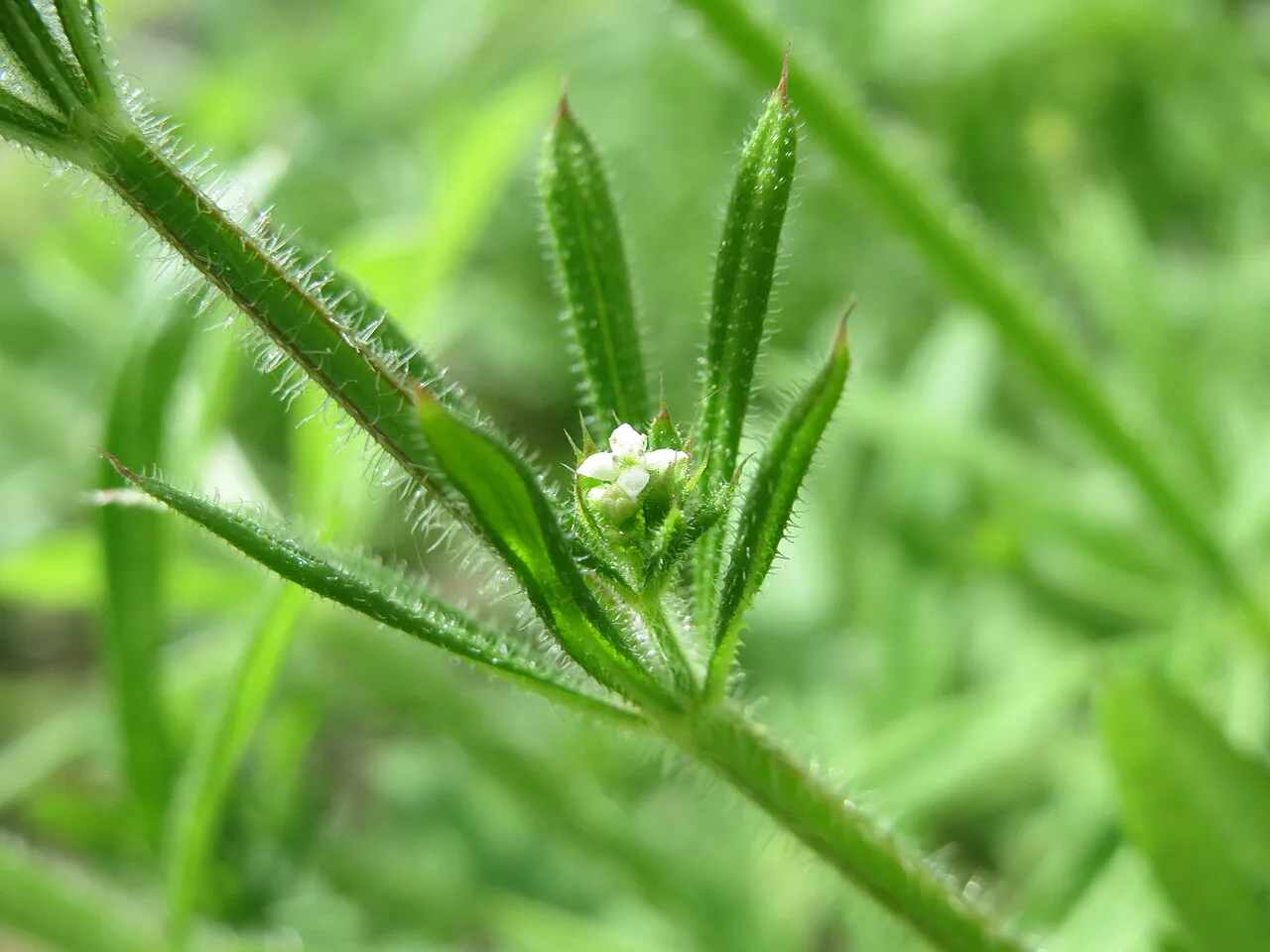
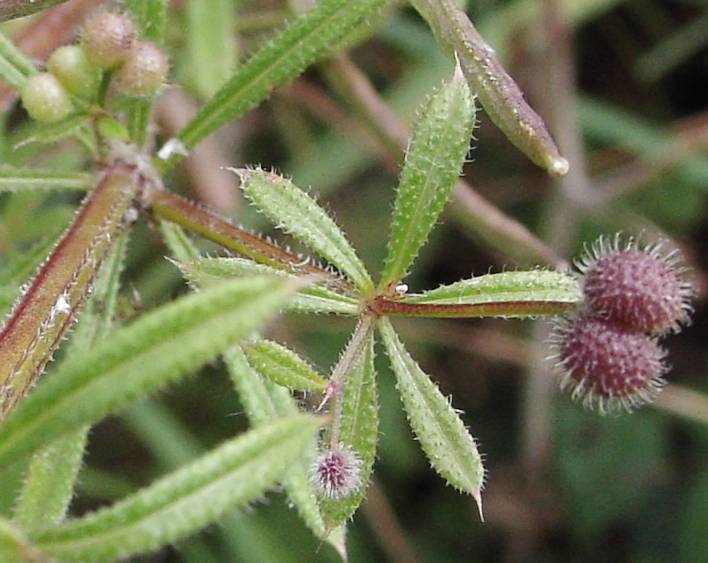
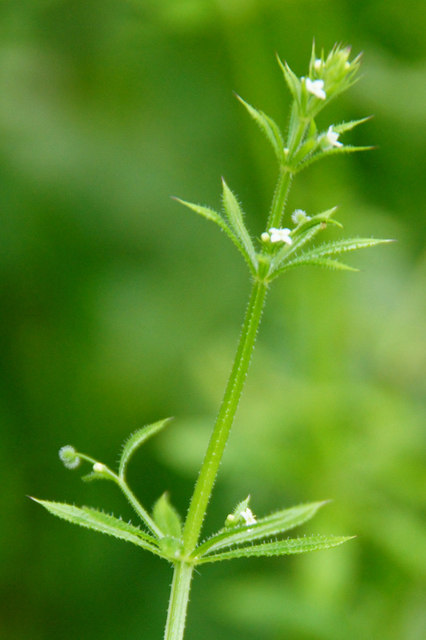
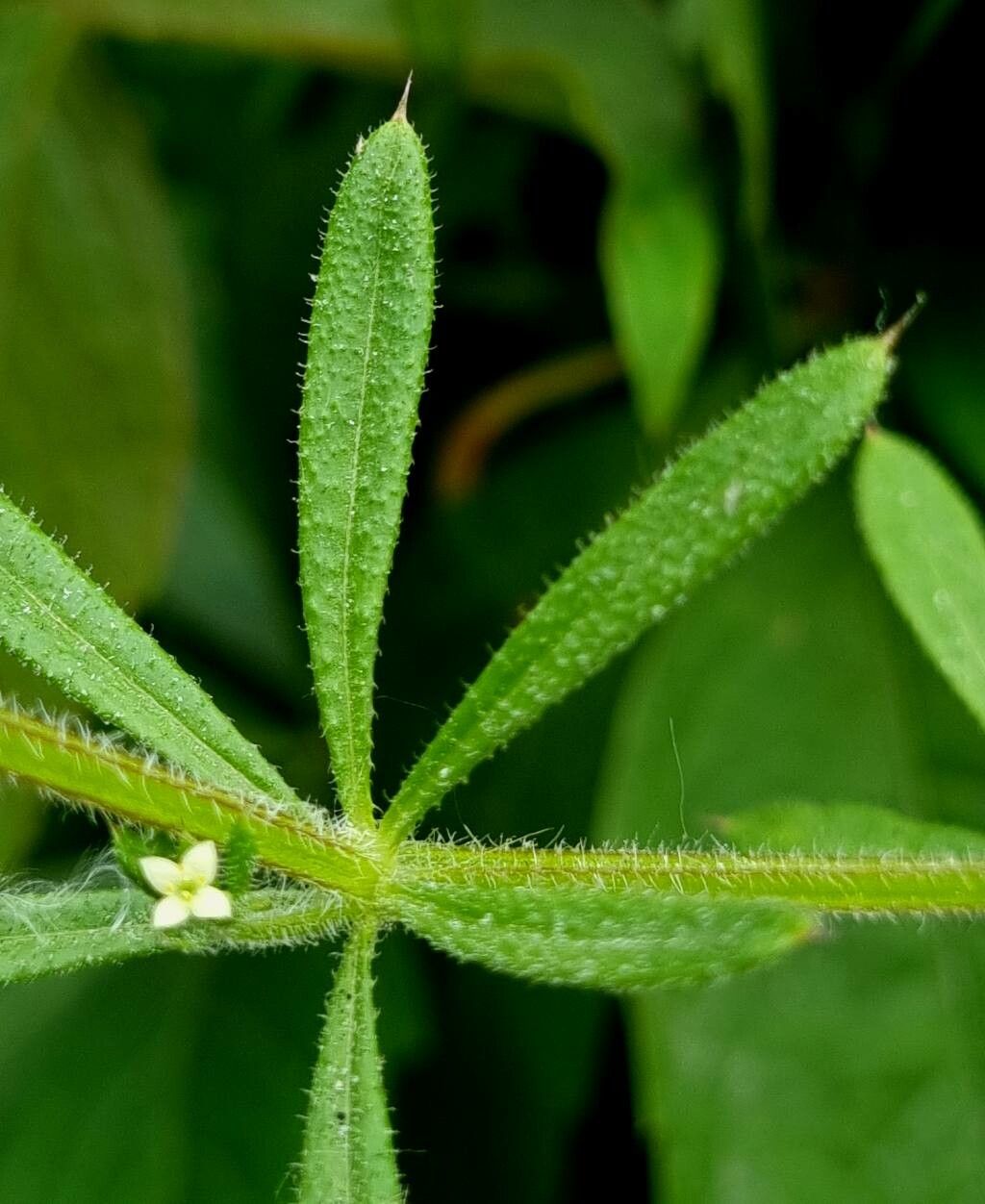
Cleavers is a familiar native annual of hedgerows, gardens and woodland edges. Its long, weak stems scramble through other plants, catching on foliage, clothes and animal fur with tiny hooks. Also known as Goosegrass or Sticky Willy, it belongs to Rubiaceae, the madder family, alongside Lady’s Bedstraw.
Identification
- Long, bright-green, sprawling stems that climb through neighbouring plants rather than supporting themselves upright.
- Narrow leaves in star-like apparent whorls of usually six to eight around the stem.
- Small, backward-pointing hooks along the four-angled stems and on the leaves, giving the plant its unmistakably clinging feel.
- Tiny white, four-lobed flowers in small groups beside the leaves.
- Paired, rounded fruits covered in hooked bristles; these may become tinged purple or brown as they mature.
The combination of narrow leaf whorls, rough stems and burr-like fruits makes Cleavers one of the easiest bedstraws to recognise, even when it is not flowering.
Flower structure
The flowers are very small, typically only about 1–2 mm across, with a white corolla divided into four spreading lobes. They usually arise on short branching stalks from the leaf axils, rather than forming a large, conspicuous flower head.
Each flower has four stamens and a tiny female structure with a two-part inferior ovary below the corolla. The flowers are easy to overlook among the mass of green leaves and stems.
Leaves and stems
The narrow, pointed blades form conspicuous rings, usually in groups of six to eight. Strictly speaking, there are two opposite true leaves at each node; the other leaf-like structures are enlarged stipules. Together they create the appearance of a whorl.
The stems are square or four-angled in cross-section, with short, backward-facing prickles along the ridges. Similar tiny hooks occur on the leaf margins and midribs. These catch on neighbouring vegetation, helping the plant climb without tendrils or a twining stem.
Fruits and dispersal
After flowering, the ovary develops into two small, rounded, one-seeded fruit segments, or mericarps, usually seen as a joined pair. Their surfaces are covered with curved bristles.
The hooks catch on passing animals and clothing, carrying the fruits away from the parent plant. This form of seed dispersal is called epizoochory. The fruits are often more noticeable than the flowers themselves.
Habitat
Cleavers thrives in fertile, often nitrogen-rich soils. Look for it in hedges, woodland edges, rough grass, gardens, arable margins and waste ground. It can form tangled masses as it scrambles over shrubs, nettles and other tall vegetation. It is widespread across the UK.
Flowering period
Usually May to August, although young plants may be visible much earlier in mild weather. The hooked fruits develop from late spring through summer.
Similar species
- Lady’s Bedstraw (Galium verum): a perennial with numerous golden-yellow flowers and fine leaves, but without Cleavers’ conspicuously clinging burrs.
- Hedge Bedstraw (Galium album): has small white flowers and broader leaves, but is not so densely covered in hooks.
- Marsh Bedstraw (Galium palustre): a more delicate white-flowered bedstraw of damp places, usually with fewer leaves in each apparent whorl.
Where the names come from
The name Cleavers refers to the plant’s habit of cleaving or clinging to anything it touches. Goosegrass recalls its traditional use as food for geese and other poultry; names such as Sticky Willy and Sticky Bobs refer to its hooked stems and fruits.
The genus name Galium is associated with the Greek gala, meaning ‘milk’, reflecting the traditional use of some bedstraws in cheese-making. Aparine has been linked to Greek words meaning ‘to seize’ or ‘take hold of’, a fitting description of the plant’s grasping habit.
Folklore & history
Cleavers has long been a favourite children’s plant. Its stems and fruits were playfully stuck to the backs of coats or thrown onto clothing, earning it an abundance of regional names such as Stick-a-back, Kisses and Robin-run-the-hedge.
It was traditionally gathered as feed for young geese and other poultry. Older herbals also describe Cleavers in preparations for the skin and as a diuretic. The seeds have sometimes been roasted as a coffee substitute, an intriguing connection with the coffee plants that share its family.
Wildlife
Cleavers provides food for caterpillars of several moth species, and its dense, trailing growth gives shelter to small invertebrates. Tiny insects visit the white flowers, while passing mammals and birds help carry the hooked fruits to new places.