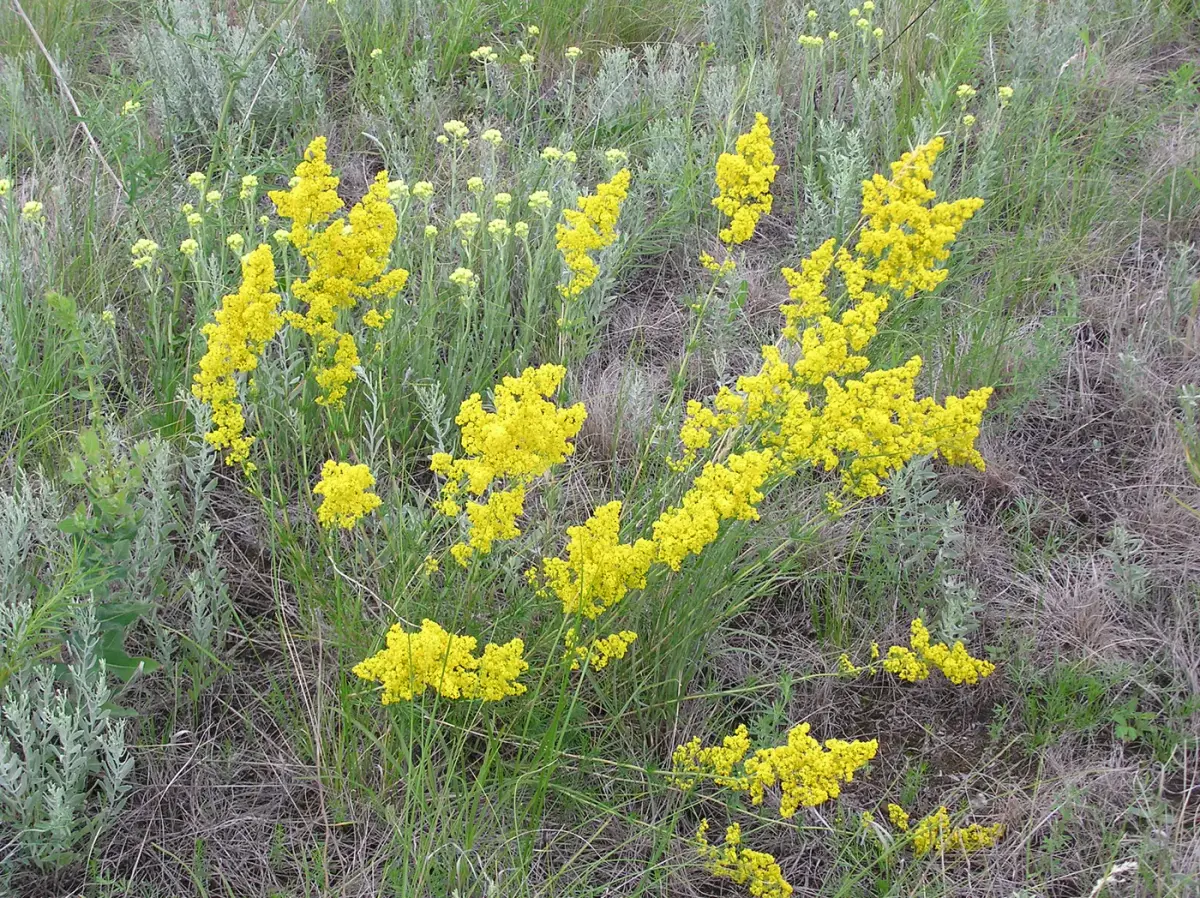
Lady’s Bedstraw is a native perennial of sunny grasslands, downland and coastal dunes. In summer its sprays of tiny golden flowers can turn patches of meadow yellow, while the flowering plant has a sweet, honey-like scent. The foliage becomes pleasantly hay-scented when dried. It belongs to Rubiaceae, the madder family.
Identification
- Masses of tiny, bright golden-yellow flowers in airy but dense, branching clusters.
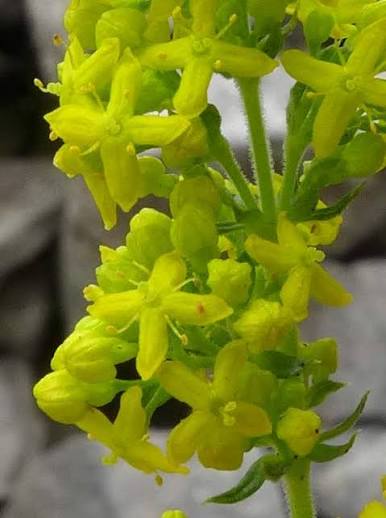
- Each individual flower is only about 2–3 mm wide, with four spreading lobes.
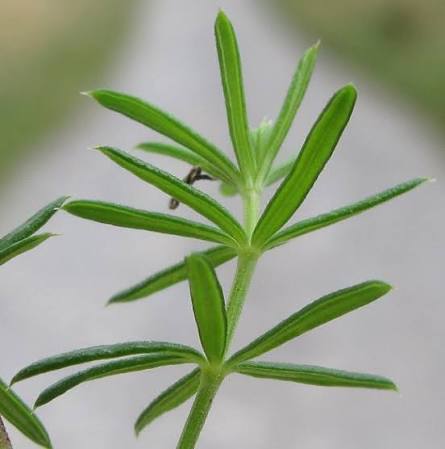
- Very narrow, pointed, dark-green leaves forming conspicuous star-like whorls around slender stems.
- Stems are thin and weakly upright or sprawling, sometimes supported by surrounding grasses.
- A perennial forming patches in meadows, sunny banks, chalk grassland and sand dunes.
- A sweet, honey-like fragrance when flowering; dried shoots are reminiscent of new-mown hay.
The combination of golden flowers and numerous narrow leaves apparently arranged in whorls is usually enough to recognise Lady’s Bedstraw. It differs from many other native bedstraws, which have white flowers.
Flower structure
Each tiny flower has a yellow corolla with four spreading lobes. Four stamens sit around the central style. The ovary is inferior, meaning it lies below the point where the other flower parts are attached; conspicuous separate sepals are absent.
Many flowers form little branched groups, which in turn make up the larger, frothy inflorescence. After pollination the ovary develops into a small dry fruit that divides into two one-seeded sections. Unlike Cleavers, these fruits are not covered in hooked bristles.
Leaves and stems
The narrow, pointed leaves are usually around 1–3 cm long, with edges that may roll under slightly. They appear in rings of roughly six to twelve around the stem. These are not all separate true leaves: as is characteristic of bedstraws, the pair of opposite true leaves is accompanied by enlarged, leaf-like stipules, creating the appearance of a whorl.
Stems may be somewhat four-angled and often weave through neighbouring vegetation. The plant can spread through underground stems and form broad, loose patches.
Habitat
Look for Lady’s Bedstraw in dry, open grassland, chalk and limestone downland, sandy coastal dunes, heaths and sunny roadside banks. It is widespread in Britain and Ireland, especially where grassland has not been heavily fertilised or disturbed. It is a characteristic flower of species-rich summer meadows.
Flowering period
Lady’s Bedstraw generally flowers from June to September, with the fullest display in July and August. Its fragrance is most noticeable on warm days when many stems are flowering together.
Similar species
- Hedge Bedstraw (Galium album): carries loose clusters of white flowers, with broader leaves and more vigorous growth.
- Marsh Bedstraw (Galium palustre): a delicate, white-flowered species of wet ground, with fewer and less tightly clustered flowers.
- Cleavers (Galium aparine): has white flowers and conspicuously rough, clinging stems and leaves, with hooked, burr-like fruits.
- Heath Bedstraw (Galium saxatile): a low-growing plant of acid heathland and grassland, with white flowers and shorter leaves.
Where the names come from
The name bedstraw comes from the old practice of using fragrant, dried plants as mattress stuffing. The Lady’s part has traditionally been connected with the Virgin Mary, giving rise to the alternative name Our Lady’s Bedstraw. How that association first arose is less certain.
The scientific name Galium comes from the Greek gala, meaning ‘milk’, referring to the traditional use of bedstraws to curdle milk in cheese-making. The Latin verum means ‘true’ or ‘genuine’. Together, Galium verum can be understood as ‘true bedstraw’.
Folklore & history
According to a Christian tradition, Lady’s Bedstraw was among the plants placed in the manger at Bethlehem. Another old association is with bedding for women in childbirth, when aromatic herbs were sometimes added to straw mattresses.
Lady’s Bedstraw was also valued for its sweet scent, which becomes more noticeable as the plant dries due to the presence of coumarin compounds. It was traditionally used in mattresses and bedding, where it was believed to help deter fleas, flies and lice. As a strewing herb, it was also scattered across the floors of homes and farm dwellings to freshen the air and discourage unwanted insects.
The plant was also known as cheese rennet or rennet weed. Its flowering tops were traditionally used to help set milk for cheese-making and to give some cheeses a yellow tint. Yellow dyes could be obtained from the flowers, while the roots provided red dyes, reflecting its kinship with the madder plants long used by dyers.
In older herbals, Lady’s Bedstraw also appears in accounts of preparations for the skin and for stopping bleeding.
Wildlife
The small yellow flowers attract bees, hoverflies, moths and other insects seeking nectar or pollen. Lady’s Bedstraw also supports the caterpillars of several moth species. In a wildflower meadow, its sprawling stems help create a varied structure among grasses and other flowering plants.