Common Honeysuckle, also known as Woodbine, is a native woody perennial climber whose sweetly scented flowers are a familiar feature of British hedgerows and woodland edges. Its long stems wind around trees and shrubs, sometimes twisting tightly around the branches that support them. It belongs to Caprifoliaceae, the honeysuckle family.
Identification
- A vigorous climber, reaching several metres by twining around other plants rather than using tendrils.
- Long, slender, woody stems; young growth may be reddish or softly hairy.
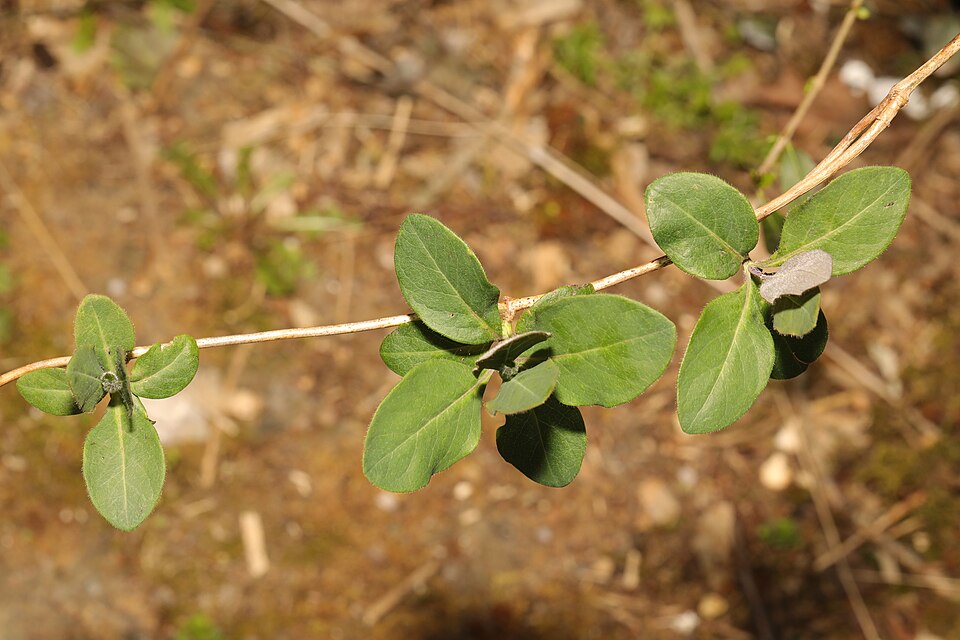
- Smooth-edged, oval leaves, arranged in opposite pairs, often paler underneath.
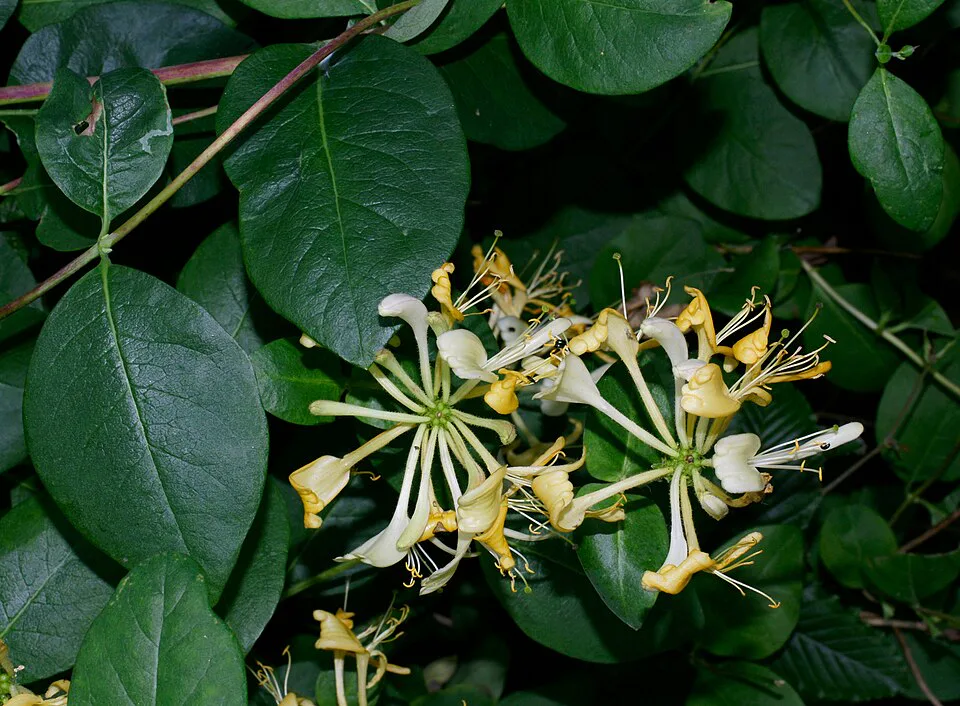
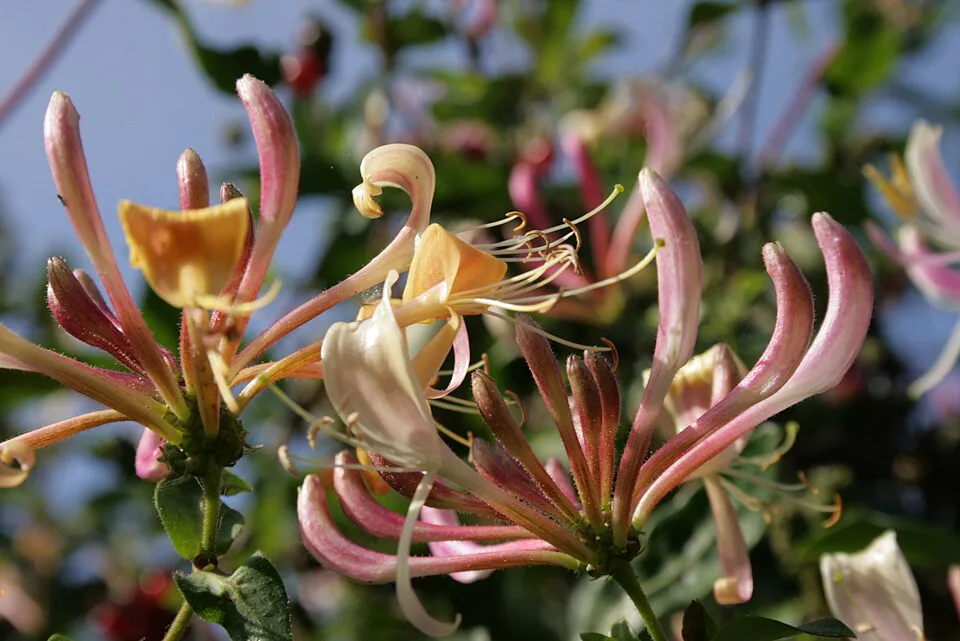
- Clusters of long, tubular flowers at the ends of shoots, usually cream or yellow with pinkish-red outer surfaces.
- A powerful, sweet fragrance, often strongest during warm evenings.
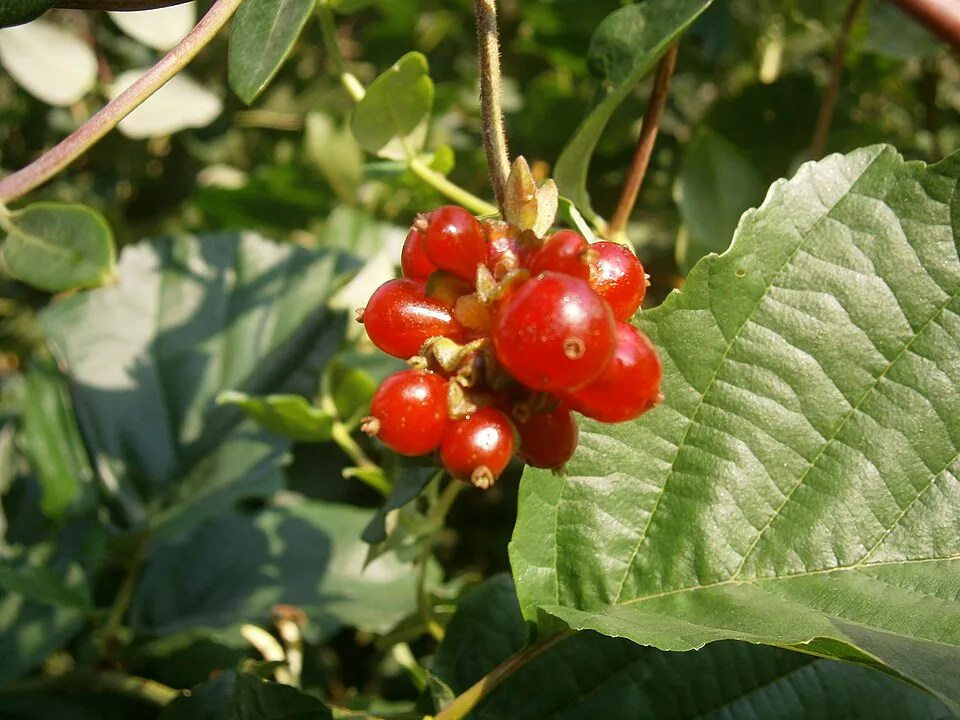
- Small clusters of glossy, bright red berries in late summer and autumn.
The combination of climbing stems, opposite leaves and sweetly scented, pink-flushed flowers is particularly distinctive.
Flower structure
The flowers are grouped in clusters near the ends of the stems. Each flower has a narrow tubular corolla, formed from five fused petals. At the mouth of the tube, the petals form two lips: an upper lip with four lobes and a lower lip with one lobe.
Five slender stamens and a single style project beyond the flower, where they can brush against visiting insects. The green calyx at the base has five small teeth. The ovary is inferior, sitting below the other flower parts; after pollination it develops into a berry.
Leaves and stems
The leaves grow in opposite pairs along the stem. They are broadly oval to elliptical, usually with smooth edges and very short stalks or none. Their upper surfaces are green, while the undersides can be grey-green.
Honeysuckle’s stems wind around neighbouring plants as they lengthen. Older stems become woody, and their tight spirals can leave host branches with a noticeably twisted appearance. Unlike ivy, Honeysuckle has no clinging roots to attach itself directly to a wall.
Habitat
Look for Common Honeysuckle in deciduous woodland, hedgerows, scrub, thickets and woodland margins. It is widespread across much of Britain, particularly where shrubs or trees provide support. It tolerates partial shade but flowers more freely where its stems reach the light.
Flowering period
Common Honeysuckle usually flowers from June to September, although timing varies with the weather and location. The pale flowers gradually become more yellow as they age. By late summer and autumn, the flower clusters are replaced by bright red berries.
Similar species
- Traveller’s Joy (Clematis vitalba) also climbs through hedges, but has small creamy-white flowers with four petal-like sepals and fluffy autumn seed heads, rather than tubular honeysuckle flowers. Its leaf stalks twist around supports instead of the stems twining.
- Japanese Honeysuckle (Lonicera japonica) is an introduced climber that may retain its leaves into winter. Its fragrant flowers are usually borne in pairs rather than the terminal clusters typical of Common Honeysuckle.
- Perfoliate Honeysuckle (Lonicera caprifolium) has upper leaf pairs that are joined around the stem, unlike the separate leaves of Common Honeysuckle.
- Cultivated honeysuckle varieties may have more intensely coloured flowers, but often retain the same tubular form and sweet scent.
Where the names come from
The name Honeysuckle refers to the sweet nectar held within its long flower tubes. Woodbine is an old English name describing the way its woody stems bind and twist around other plants.
Lonicera commemorates the sixteenth-century German botanist Adam Lonicer. The name periclymenum comes from an ancient Greek plant name associated with climbing or twining plants.
Folklore & history
Honeysuckle has long symbolised affection, devotion and fidelity, its entwining stems providing a natural image of enduring attachment. In traditional folklore it was sometimes planted near doorways to bring good fortune and keep unwanted influences away.
Its evening fragrance made it a favourite around cottages and gardens. Twisted branches shaped by growing honeysuckle were sometimes selected for distinctive walking sticks, while the flowers and leaves also appeared in older herbal traditions.
Wildlife
Honeysuckle is especially valuable to night-flying moths. Its rich scent becomes stronger towards evening, attracting insects such as hawk-moths, which can reach the nectar deep in the long flower tubes.
The leaves are an important foodplant for White Admiral butterfly caterpillars. Birds including thrushes eat the red berries, while tangled stems provide cover and nesting places. Dormice may use strips of Honeysuckle bark to build their summer nests.