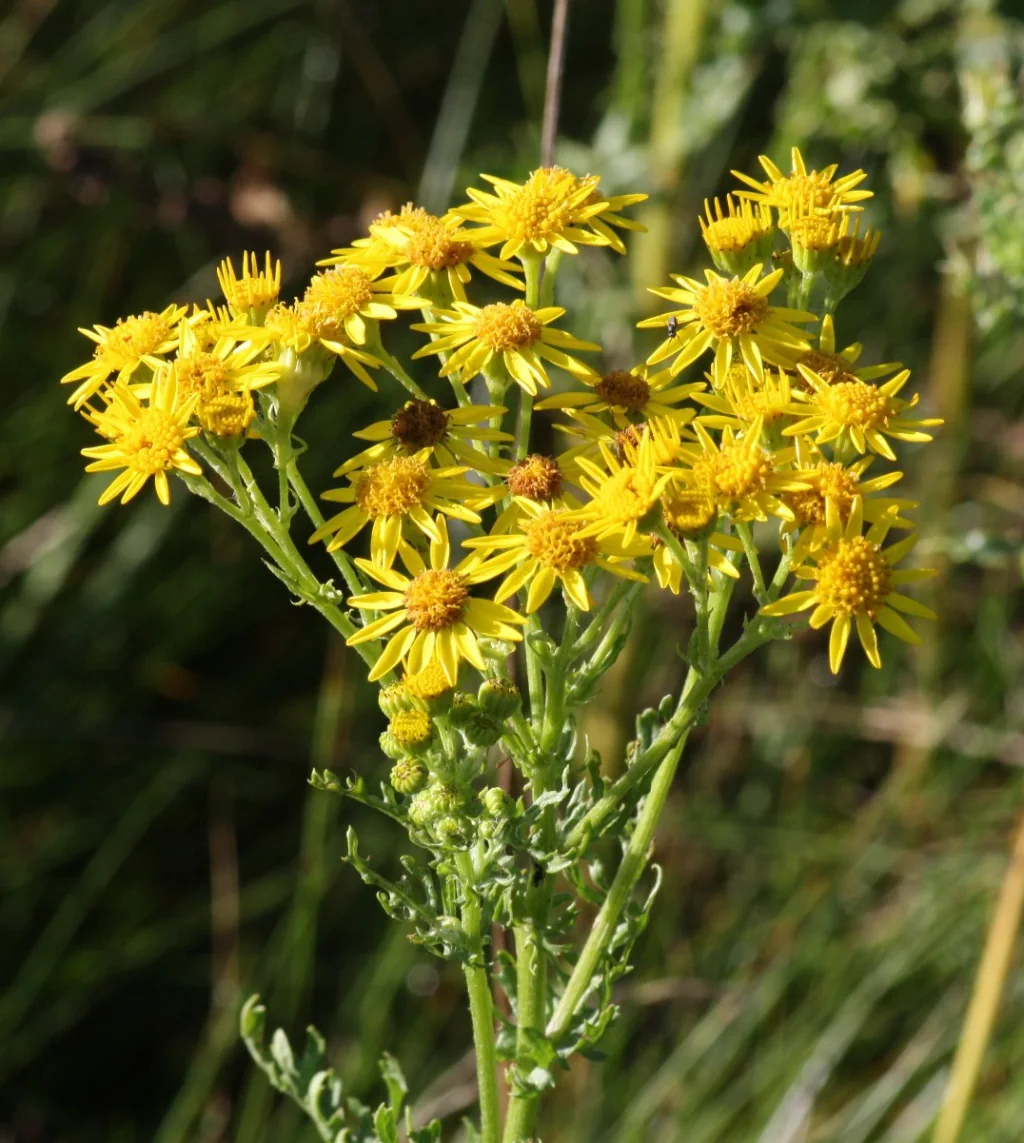
Common Ragwort is a familiar native wildflower of grassland, roadside verges, waste ground and other open places. In summer its branched stems carry conspicuous flat-topped clusters of bright yellow flower heads.
It belongs to the daisy family, Asteraceae. Each apparent flower is actually a capitulum made up of many individual florets.
Identification
- Usually an upright biennial, although damaged plants can sometimes persist for longer.
- Commonly reaches around 30–100 cm, but vigorous plants may grow taller.
- Bright yellow daisy-like flower heads are carried in broad, flat-topped clusters.
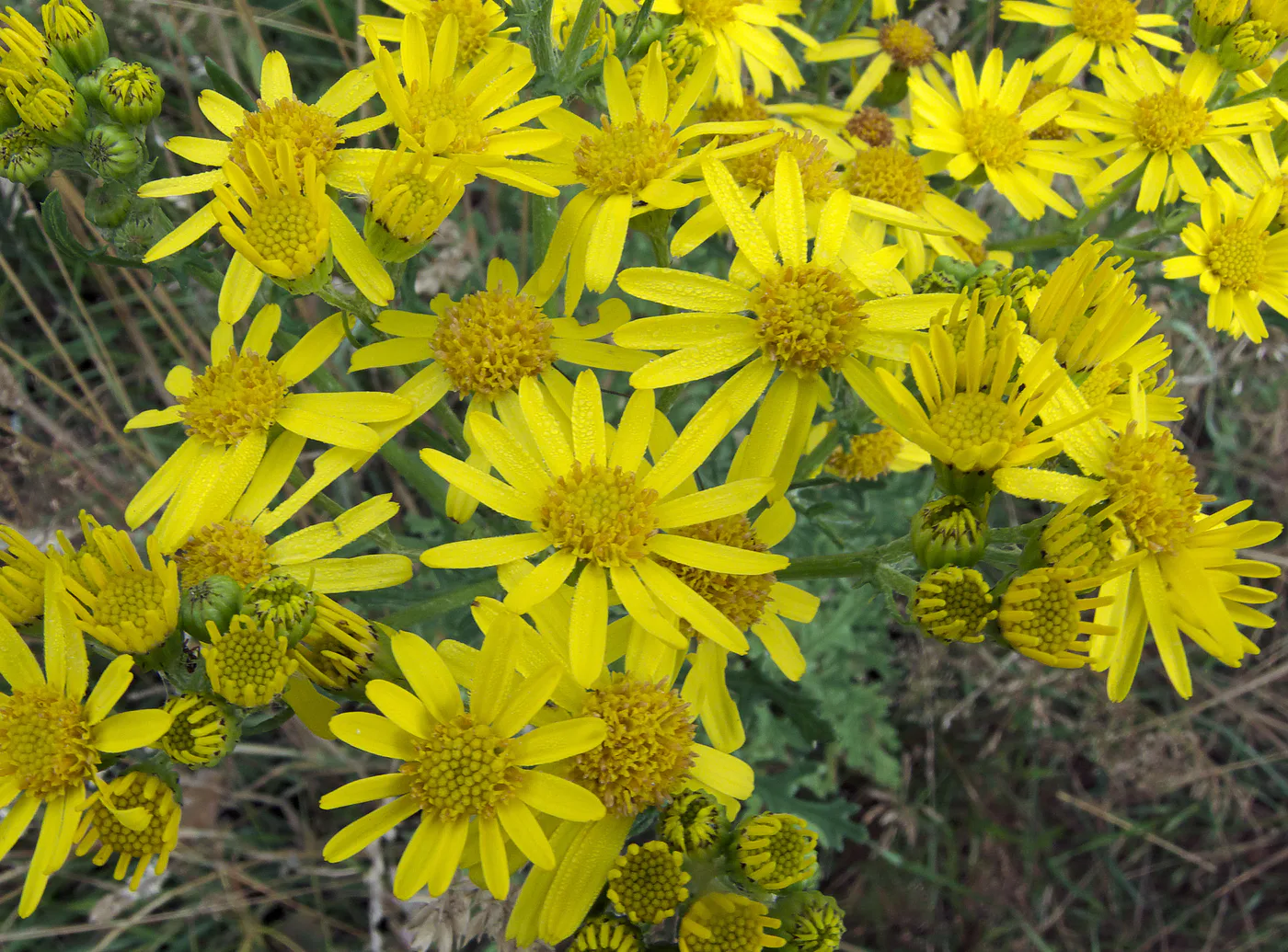
- Each head has yellow outer ray florets surrounding a central disc of tubular florets.
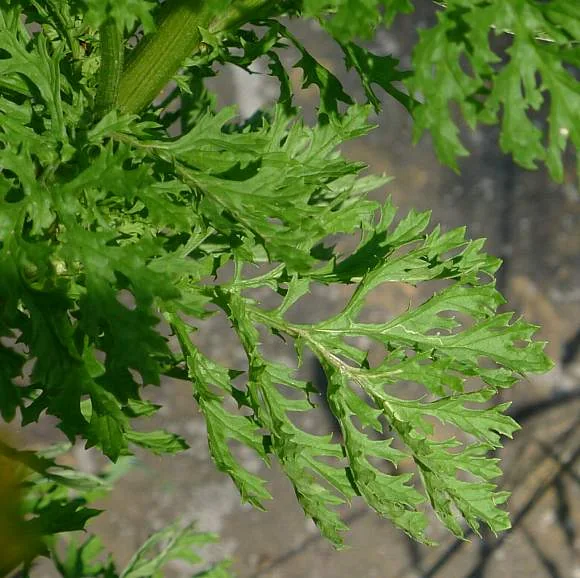
- Leaves are dark green and very deeply divided into irregular lobes, giving them a ragged or feathery appearance.
- First-year plants usually form a low rosette of leaves before producing a flowering stem in the following year.
- Mature flower heads eventually produce small fruits with a tuft of pale hairs that helps them disperse on the wind.
The combination of deeply divided leaves and large clusters of yellow daisy-like heads is a useful first clue to Common Ragwort.
Flower structure
Like other members of the Asteraceae, Common Ragwort does not have a single simple flower.
Each yellow head is a capitulum containing many individual florets:
- narrow yellow ray florets form the outer ring
- small tubular disc florets fill the centre
- green bracts surround the base of the head
Many flower heads are grouped together on branched stems, creating the broad yellow flowering display visible from a distance.
Leaves and stems
The leaves are one of the most useful identification features.
They are:
- dark green
- alternate on the flowering stem
- deeply pinnately divided
- irregularly lobed
- often described as ragged or feathery in appearance
Young plants begin as a basal rosette. In the flowering year, an upright leafy stem develops and branches strongly towards the top.
Habitat
Common Ragwort grows in a wide variety of open habitats, including:
- grassland and pasture
- roadside verges
- waste ground
- railway banks
- field margins
- sand dunes and other coastal grassland
- disturbed ground around towns and villages
It is widespread across Britain.
Flowering period
Common Ragwort can flower from June to November, although the main display is usually during summer and early autumn.
The yellow heads are particularly noticeable in July and August.
Similar species
- Hoary Ragwort (Jacobaea erucifolia) can look very similar, but its leaves and stems are usually greyer or more woolly, especially on their undersides.
- Marsh Ragwort (Jacobaea aquatica) favours wetter habitats and generally has less deeply divided upper leaves.
- Oxford Ragwort (Senecio squalidus) also has yellow daisy-like flower heads but is usually more slender, with narrower lobed leaves and looser flowering clusters. It is strongly associated with walls, railway land and urban ground.
- Tansy (Tanacetum vulgare) produces yellow flower heads without the obvious outer ray florets, giving its heads a button-like appearance.
Wildlife
Common Ragwort is exceptionally valuable to insects.
Its open yellow flower heads attract bees, hoverflies, butterflies and many other flower-visiting insects. The Wildlife Trusts notes that more than 200 species of invertebrate have been recorded using ragwort and describes it as one of the most frequently visited flowers by butterflies in the UK.
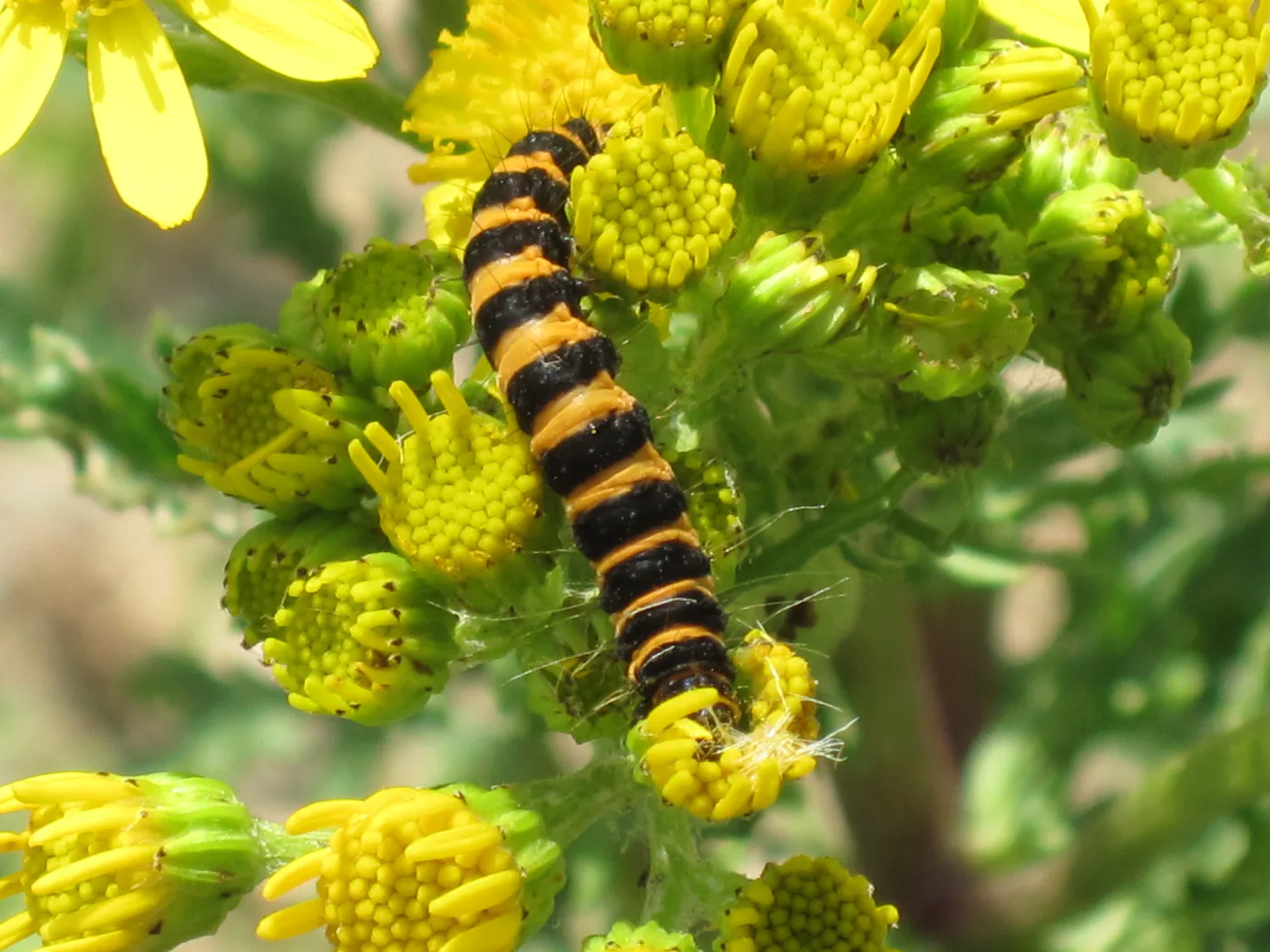
It is particularly important as the principal food plant of the Cinnabar moth (Tyria jacobaeae). Its distinctive caterpillars are boldly striped black and yellow and may occur in large numbers, sometimes stripping much of the foliage from a plant.
Toxicity and livestock
Common Ragwort contains toxic compounds and can be harmful to horses, cattle and other livestock if eaten. The danger remains when the plant has been cut and dried, which makes contamination of hay or forage particularly important.
This does not make ragwort an undesirable plant everywhere. Away from grazing land and forage production it can be an extremely valuable wildlife plant, so management should take account of both livestock risk and conservation value.
Ragwort and the law
Common Ragwort is one of the species covered by the Weeds Act 1959. Its presence on land is not automatically illegal, but landowners can be required to prevent it spreading where it presents a risk to grazing animals or land used to produce forage.
Defra’s ragwort code of practice recommends assessing the actual risk and prioritising control where plants could spread onto grazing or forage land.
Where the names come from
Ragwort most likely refers to the ragged, deeply cut outline of its leaves. The extra word ‘Common’ distinguishes this familiar species from several other ragworts.
Jacobaea is traditionally connected with St James (Jacobus in Latin), whose feast day falls in the ragwort flowering season. Vulgaris means ‘common’. Older books often place it in the genus Senecio, as Senecio jacobaea.
Folklore & history
Common Ragwort has accumulated a remarkable number of traditional names. Recorded names include St James’ wort, staggerwort, yellow tops, cankerweed and Stinking Willie.