Tansy is a strongly aromatic perennial of riverbanks, roadside verges, rough grassland and other open places. From midsummer onwards it produces striking clusters of bright yellow, button-shaped flower heads above finely divided, fern-like leaves.
It belongs to the daisy family, Asteraceae. As in the other members of this family, each yellow button is actually a capitulum — a compact head containing many individual florets.
Identification
- Usually around 50–100 cm tall, with sturdy upright stems that may be reddish or brownish.
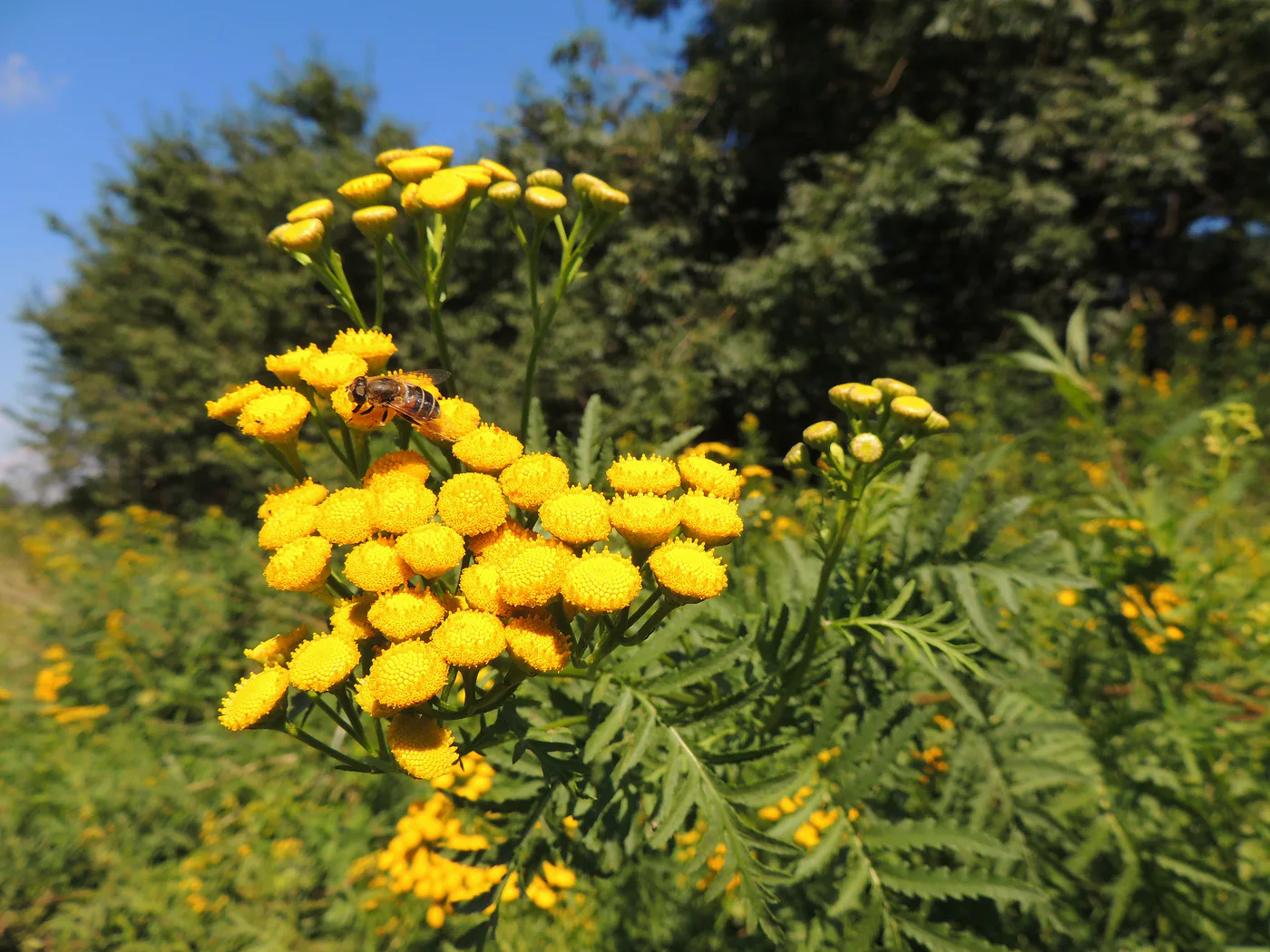
- Many small golden-yellow flower heads form broad, fairly flat-topped clusters at the ends of the stems.
- Each head is rounded or button-shaped, without the obvious outer ‘petals’ seen in daisies.
- Leaves are arranged alternately along the stems.
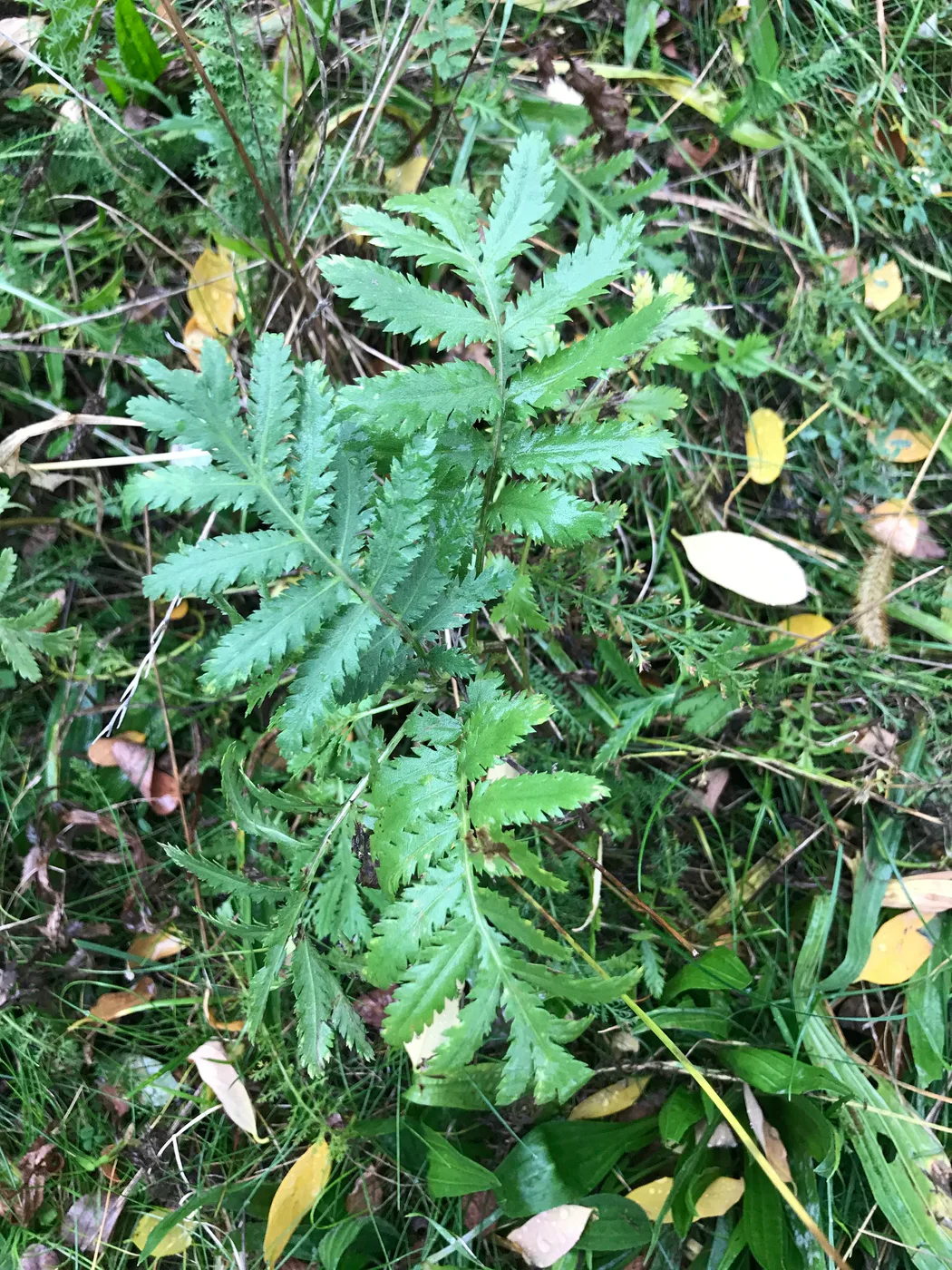
- The leaves are deeply divided into many narrow, sharply toothed leaflets, giving a feathery or fern-like appearance.
- Crushed foliage has a strong, distinctive, bitter aromatic smell.
- Plants are perennial and often spread into patches through underground rhizomes.
The combination of yellow button-like heads, fern-like leaves and a strong scent is especially useful for recognition.
Flower structure
Each individual yellow button is a capitulum made up of many densely packed tubular disc florets.
Unlike an Oxeye Daisy or Common Ragwort, Tansy has no conspicuous ray florets around the outside of the head. Instead, the surface of each small yellow disc is covered by tightly crowded tubular flowers. This gives the heads their rounded, button-like appearance.
A set of small overlapping bracts forms an involucre beneath each head. Numerous heads are borne together on branched stalks, making a broad, nearly flat-topped flowering cluster.
Leaves and stems
Tansy leaves are one of its most distinctive features. Each leaf is pinnately divided into multiple narrow segments, with each segment having sharply toothed edges.
They are:
- alternately arranged on the stem
- bright green to dark green
- fern-like in outline
- strongly aromatic when crushed
- sometimes slightly glandular in appearance
The stems are usually upright, firm and branched near the top. Established plants can spread by underground rhizomes and create sizable clumps.
Habitat
Tansy is widespread in Britain and particularly associated with sunny, open or disturbed places. Look for it in:
- rough grassland and field margins
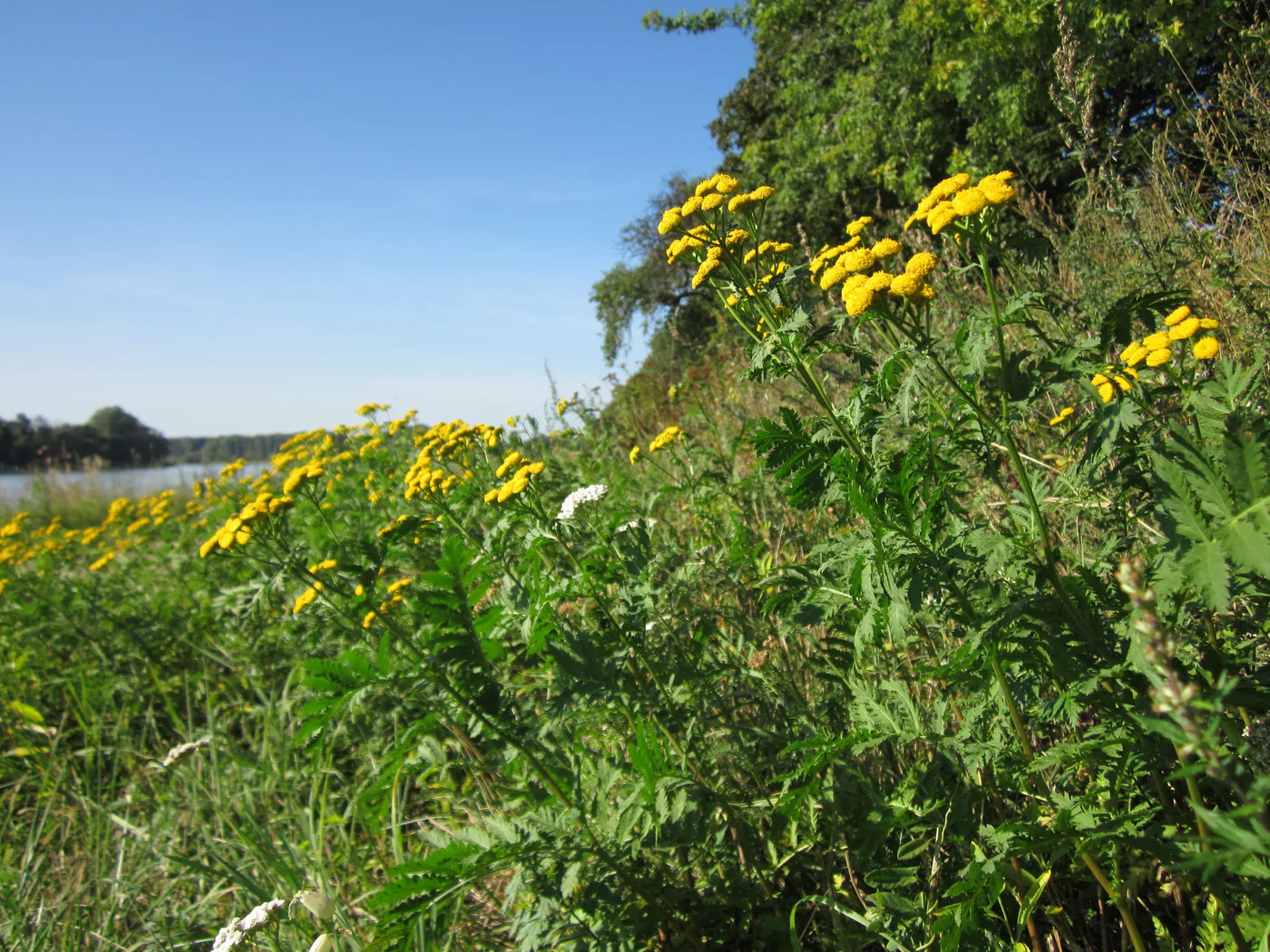
- riverbanks, ditches and floodplain edges
- roadside verges and railway banks
- waste ground and disturbed soil
- hedgerow margins and open scrub edges
It often grows in sizeable colonies along riverbanks, where the bright yellow clusters stand out against surrounding vegetation.
Flowering period
Tansy generally flowers from July to October in Britain. The bright yellow heads are often most noticeable during late summer and can remain visible into early autumn.
Similar species
- Common Ragwort (Jacobaea vulgaris) also carries broad clusters of yellow flower heads and deeply divided leaves. However, its heads normally have an obvious outer ring of yellow ray florets, giving them a small daisy-like appearance. Tansy has rounded button-like heads without those outer rays.
- Pineappleweed (Matricaria discoidea) also lacks ray florets, but it is much smaller and low-growing. Its heads are greenish-yellow and often conical, rather than the broader golden-yellow buttons of Tansy. Its crushed foliage has a characteristic pineapple-like scent.
- Yarrow (Achillea millefolium) can also have very finely divided leaves and flat-topped flowering clusters, but its heads are typically white or pinkish and each has small outer ray florets.
- Feverfew (Tanacetum parthenium), a relative of Tansy, has yellow centres surrounded by conspicuous white ray florets. Its leaves are divided, but they are broader and less uniformly feathery than those of Tansy.
Where the names come from
Tansy is an old name that reached English through French and Latin. It is often traced ultimately to Greek athanasia, ‘immortality’, although the historical development of the word is not entirely straightforward.
Tanacetum preserves that older plant name in botanical Latin. Vulgare means ‘common’, distinguishing this widespread species from other members of the genus.
Folklore & history
Tansy has a long history as an aromatic herb in European households. Its strongly scented leaves were used in traditional herbal preparations and placed around homes in attempts to discourage insects.
It was also associated with old Easter food traditions. Tansy cakes, often rather like herb-flavoured pancakes or omelettes, were made using small amounts of the plant’s bitter leaves.
Old names include Golden Buttons and Bitter Buttons, both referring to its distinctive flowers and strong bitter flavour.
Wildlife
Tansy’s late-summer flower heads attract a range of insects, including small bees, hoverflies and other nectar- and pollen-feeding species.
It is particularly important to the rare Tansy Beetle (Chrysolina graminis), a striking metallic green beetle that depends heavily on Tansy along the River Ouse near York. Separate populations in the East Anglian fens also use other wetland plants, including Water Mint.
The beetle has declined because suitable riverside habitat and stands of its food plants have become fragmented. Protecting established patches of Tansy is consequently an important part of conservation work around York.