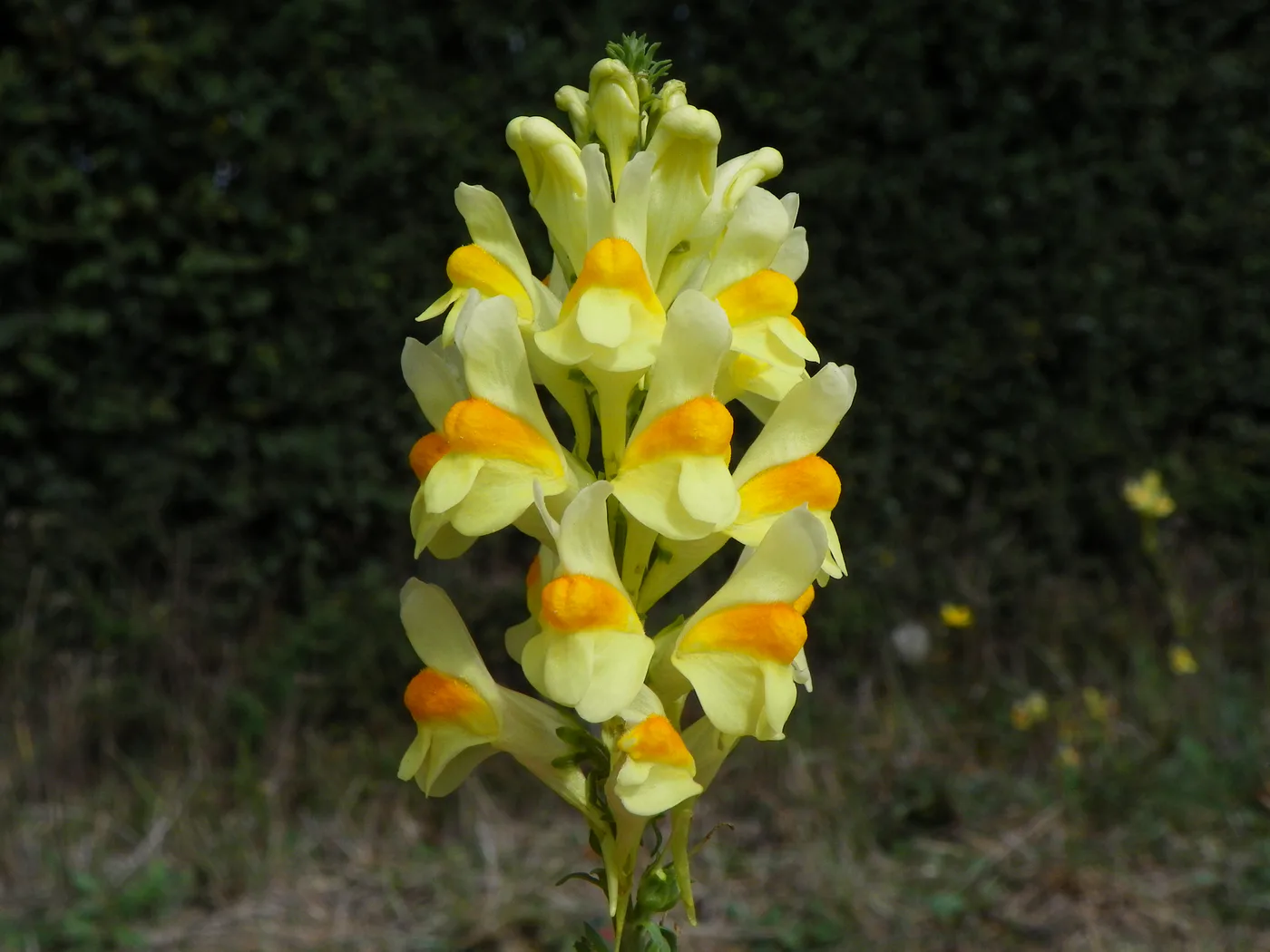
Common Toadflax is a distinctive perennial of grassy and disturbed places, with narrow leaves and dense spikes of yellow-and-orange flowers. It is widespread in Britain and can remain in flower well into autumn.
It belongs to the plantain family, Plantaginaceae. Its strongly two-lipped flowers and long nectar spur make it a useful species for learning the characteristic flower shape seen in Linaria.
Identification
- Upright perennial, usually up to about 75 cm tall.
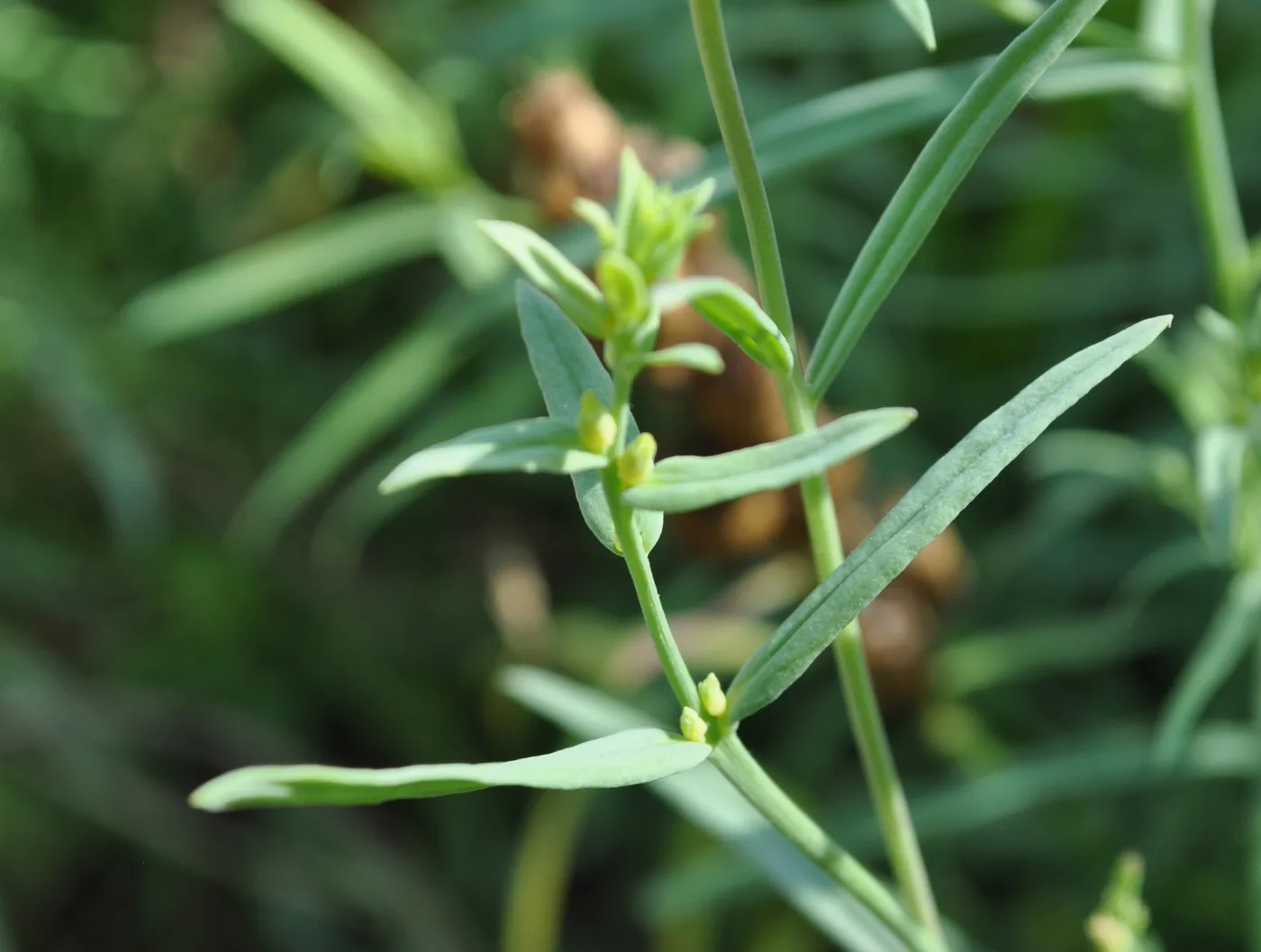
- Stems are slender and carry many narrow, pale green leaves.
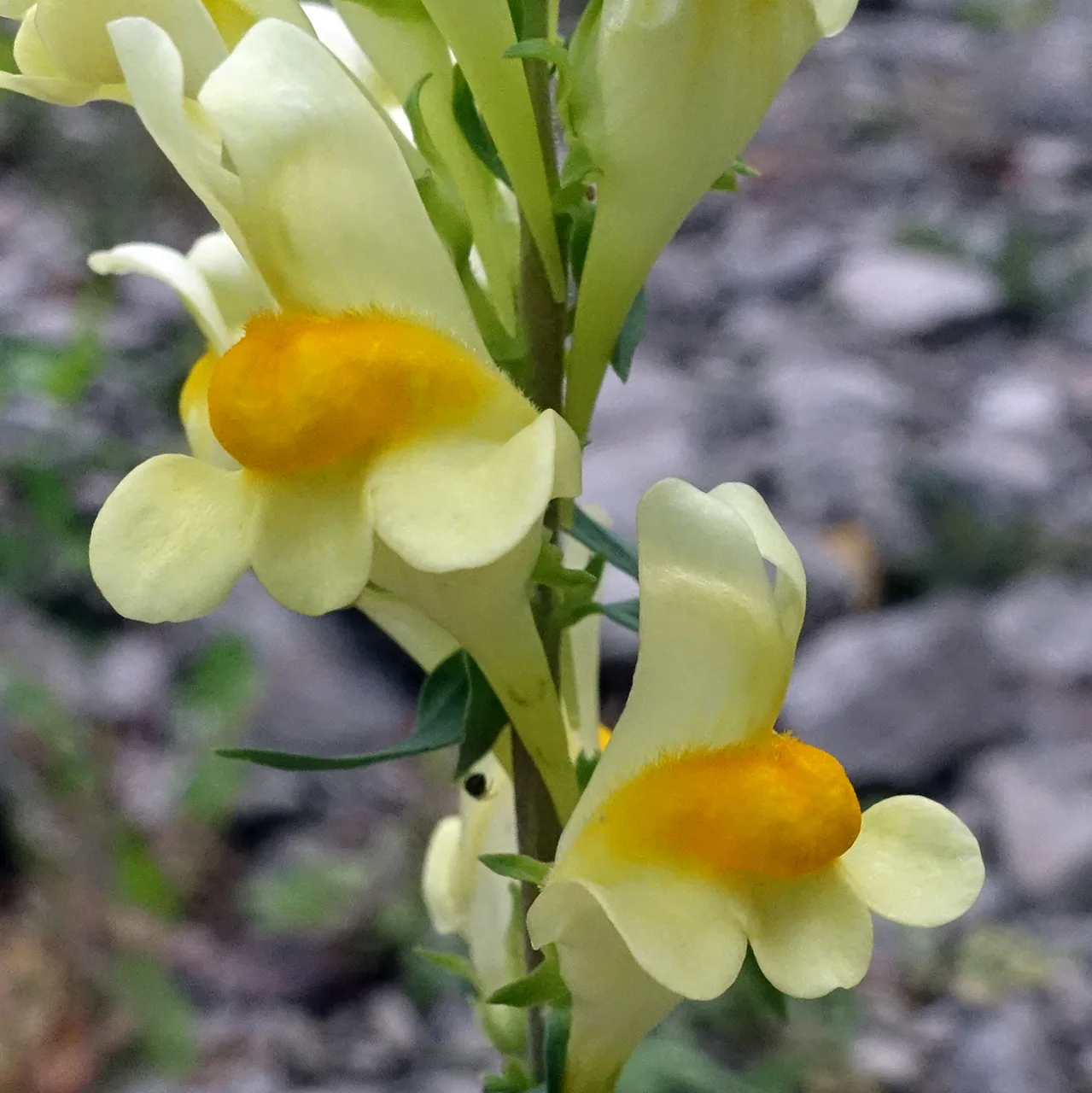
- Flowers are creamy to lemon-yellow with a deeper orange patch on the lower lip.
- Each flower is strongly two-lipped and resembles a small snapdragon.
- A long, narrow spur projects backwards from the base of the flower.
- Flowers are crowded into a dense terminal raceme.
- Leaves are narrow and untoothed, giving the plant a fine, almost flax-like appearance.
- It often forms patches on verges, banks and other open disturbed ground.
The combination of narrow leaves, yellow-and-orange snapdragon-like flowers and a conspicuous rear spur makes Common Toadflax quite distinctive when in flower.
Flower structure
The flowers are bilaterally symmetrical and have a fused corolla divided into an upper and lower lip.
The lower lip has a swollen orange centre, often called the palate, which partly closes the mouth of the flower. Behind the corolla, a long narrow spur contains nectar.
There are four stamens within the corolla tube. Visiting insects push into the closed flower to reach the nectar, brushing against the reproductive parts as they do so.
Leaves and stems
The leaves are:
- narrow and linear to narrowly lance-shaped
- simple and without obvious teeth
- pale to medium green
- closely spaced along the stem
- arranged alternately or in a spiral
Their shape is one reason the plant has long been compared with flax.
The stems are upright and may arise in groups because Common Toadflax can spread vegetatively as well as by seed.
Habitat
Common Toadflax is found in a wide range of open habitats, especially:
- grassland
- roadside verges
- hedgerows
- waste ground
- railway banks and cuttings
- other disturbed sunny places
It does particularly well on open ground where competition from taller vegetation is limited.
Flowering period
Common Toadflax usually flowers from June to November.
Its long flowering season means plants can still be conspicuous late in the year, when many summer wildflowers have already finished.
Similar species
- Purple Toadflax (Linaria purpurea) has the same narrow leaves, two-lipped flowers and long spur, but its flowers are violet-purple rather than yellow and orange.
- Pale Toadflax (Linaria repens) has pale lilac to whitish flowers, often marked with darker purple veins. It is less strongly yellow than Common Toadflax and generally has a paler overall appearance.
- Garden snapdragons (Antirrhinum) have similarly closed, two-lipped flowers, but they usually have broader leaves and larger, showier flowers in a wider range of colours.
Where the names come from
Toadflax is an old English name with several proposed explanations, so the ‘toad’ part should not be treated as a proven reference to a particular feature. Another familiar name, Butter-and-eggs, describes the yellow and orange colours of the flower.
Linaria comes from Latin linum, meaning ‘flax’, because the narrow leaves resemble those of flax. Vulgaris means ‘common’.
Folklore & history
Alongside Butter-and-eggs, other recorded names include eggs and bacon, wild snapdragon, false flax and yellow toadflax.
The species was formally published as Linaria vulgaris by Philip Miller in 1768.
Wildlife
The flowers provide nectar for a range of insects.
Common Toadflax is visited by bumblebees including Buff-tailed, White-tailed and Common Carder Bees, as well as Honeybees and several kinds of fly.
The closed flower shape favours insects strong enough to push against the lower lip and reach the nectar stored in the spur.