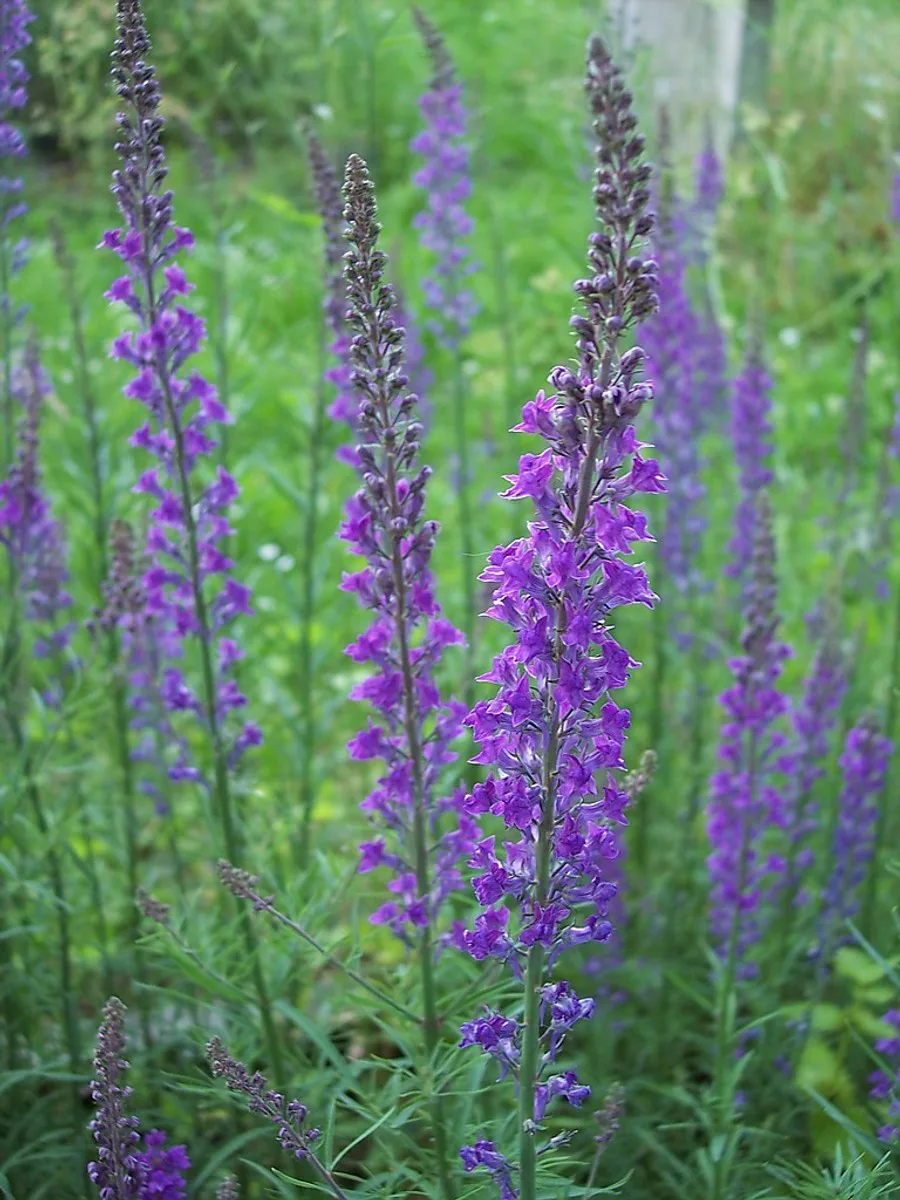
Purple Toadflax is a tall, elegant perennial with narrow grey-green leaves and slender spikes of small violet-purple flowers. Although it is now a familiar sight on walls, waste ground and roadsides in much of Britain, it is not native: it originated in Italy and Sicily and escaped from cultivation.
It belongs to the plantain family, Plantaginaceae. Its two-lipped flowers and long nectar spurs are particularly useful identification features.
Identification
- Usually around 60–90 cm tall, though some plants can grow taller.
- Stems are upright, slender, smooth and often branch toward the top.
- Flowers are violet-purple and arranged in long, narrow terminal racemes.
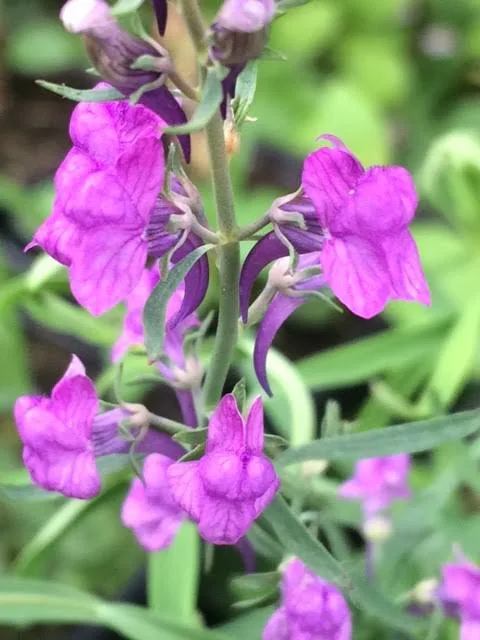
- Individual flowers are small, strongly two-lipped and snapdragon-like.
- A long, curved spur projects backwards from the base of each flower.
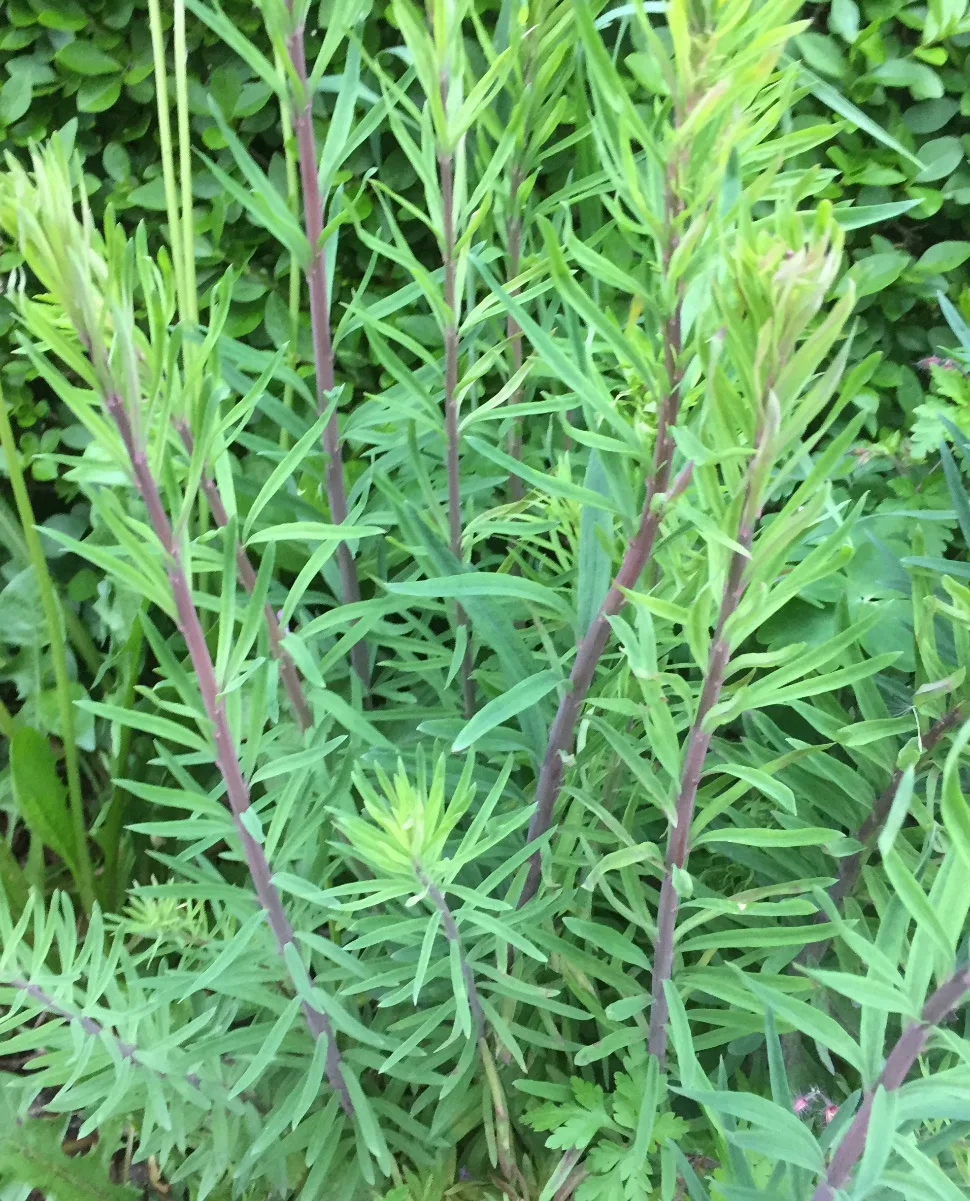
- Leaves are very narrow, linear to linear-lanceolate and grey-green.
- Lower leaves may be arranged in whorls, while upper leaves are more scattered or alternate.
- The plant often grows from cracks in walls, paving and other dry disturbed places.
- It can self-seed freely and may form conspicuous colonies.
The combination of very narrow leaves, tall slender stems and narrow spikes of purple spurred flowers makes Purple Toadflax distinctive.
Flower structure
The flowers are carried in a long raceme at the top of the stem.
Each flower has a fused corolla forming two lips. The upper lip is divided into two lobes, while the lower lip has three lobes and a raised, hairy centre.
Behind the flower, the corolla extends into a long narrow spur. Nectar is held within this spur, so visiting insects must reach deep into the flower to feed.
There are four stamens enclosed within the corolla tube.
Leaves and stems
Purple Toadflax has numerous narrow leaves closely spaced along its upright stems.
The leaves are:
- linear or narrowly lance-shaped
- usually grey-green
- smooth and without obvious teeth
- up to several centimetres long
- often whorled near the base of the plant
- more scattered or alternate higher up the stem
The very narrow leaves can make the plant look almost grass-like before the flower spikes develop.
Habitat
Purple Toadflax is a garden escape that has become widely naturalised in Britain.
Typical habitats include:
- old walls
- pavement and concrete cracks
- waste ground
- railway banks
- roadside verges
- dry banks
- quarries and rocky ground
- disturbed places around towns and villages
It prefers open, sunny, well-drained sites and is particularly successful in dry stony ground.
Flowering period
Purple Toadflax flowers mainly from June to September.
Individual plants can remain in flower for a long period, and colonies may be especially conspicuous in mid-summer.
Similar species
- Common Toadflax (Linaria vulgaris) has the same characteristic two-lipped, spurred flower shape, but its flowers are yellow with an orange centre rather than purple.
- Pale Toadflax (Linaria repens) has paler lilac to whitish flowers, often with darker purple veins or stripes. It is generally less uniformly deep purple than Purple Toadflax.
- Purple Toadflax also occurs in cultivated pale pink and white forms. These retain the same tall habit, narrow leaves and slender racemes.
Where the names come from
Purple Toadflax gets its colour name from the tall spikes of violet-purple flowers. Toadflax is an old name shared with its yellow-flowered relatives, though the exact origin of that English word is uncertain.
Linaria refers to the slender, flax-like leaves, from Latin linum (‘flax’). Purpurea is Latin for ‘purple’.
Folklore & history
Purple Toadflax is native to central and southern Italy and Sicily. It had been grown in British gardens by the seventeenth century and was first recorded naturalised outside cultivation in the nineteenth century.
Its ability to produce large numbers of seeds has allowed it to spread readily from gardens into walls, paving, railways and other disturbed habitats.
Despite being introduced, it has become such a familiar member of the British urban and wayside flora that it can easily be mistaken for a native wildflower.
Wildlife
The flowers are attractive to bees and other pollinating insects.
Their shape is specialised: insects must push into the two-lipped flower to reach the nectar held in the long spur, brushing against the reproductive parts as they feed.
Purple Toadflax can therefore provide a useful nectar source over its long summer flowering period.