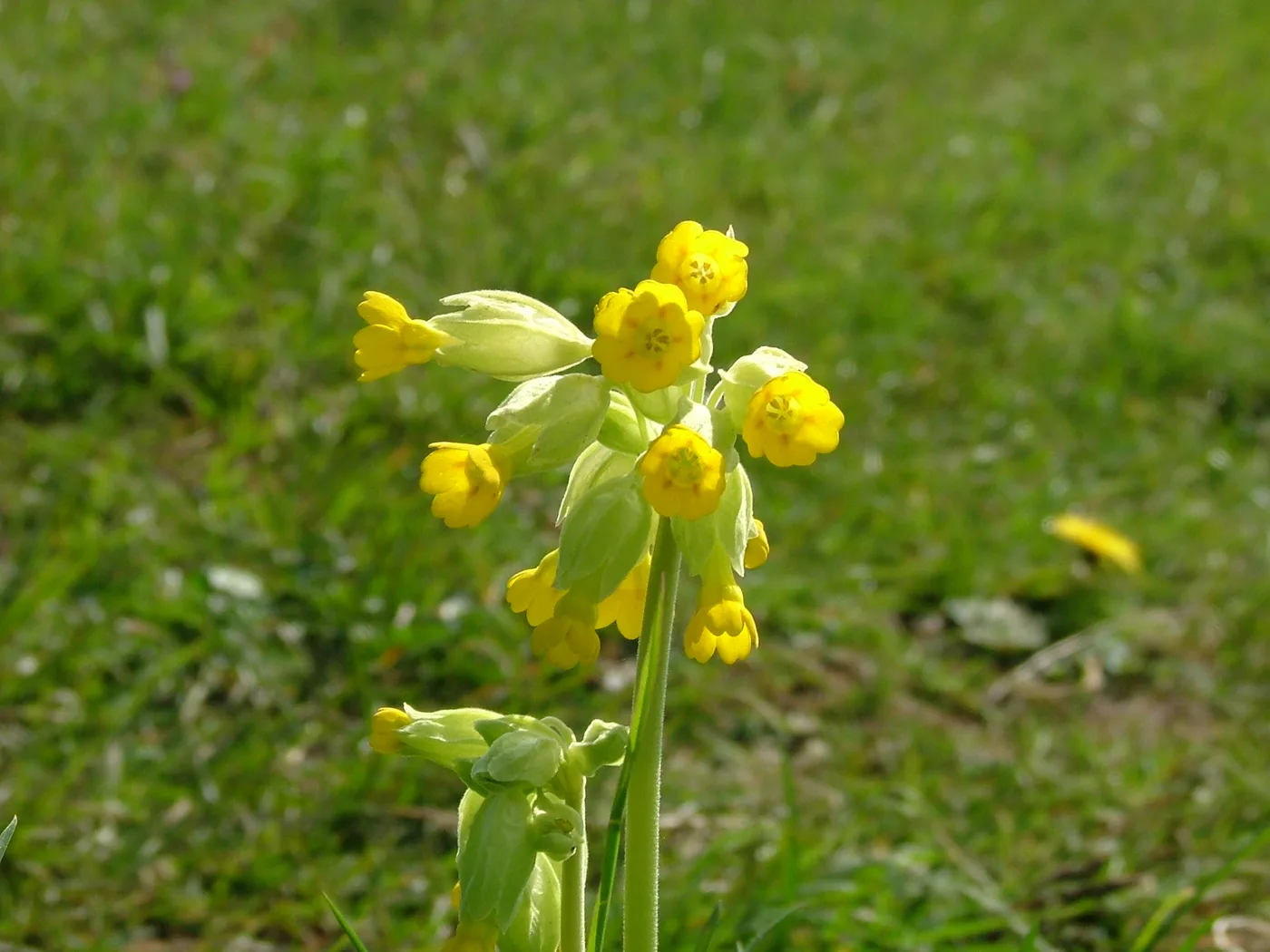
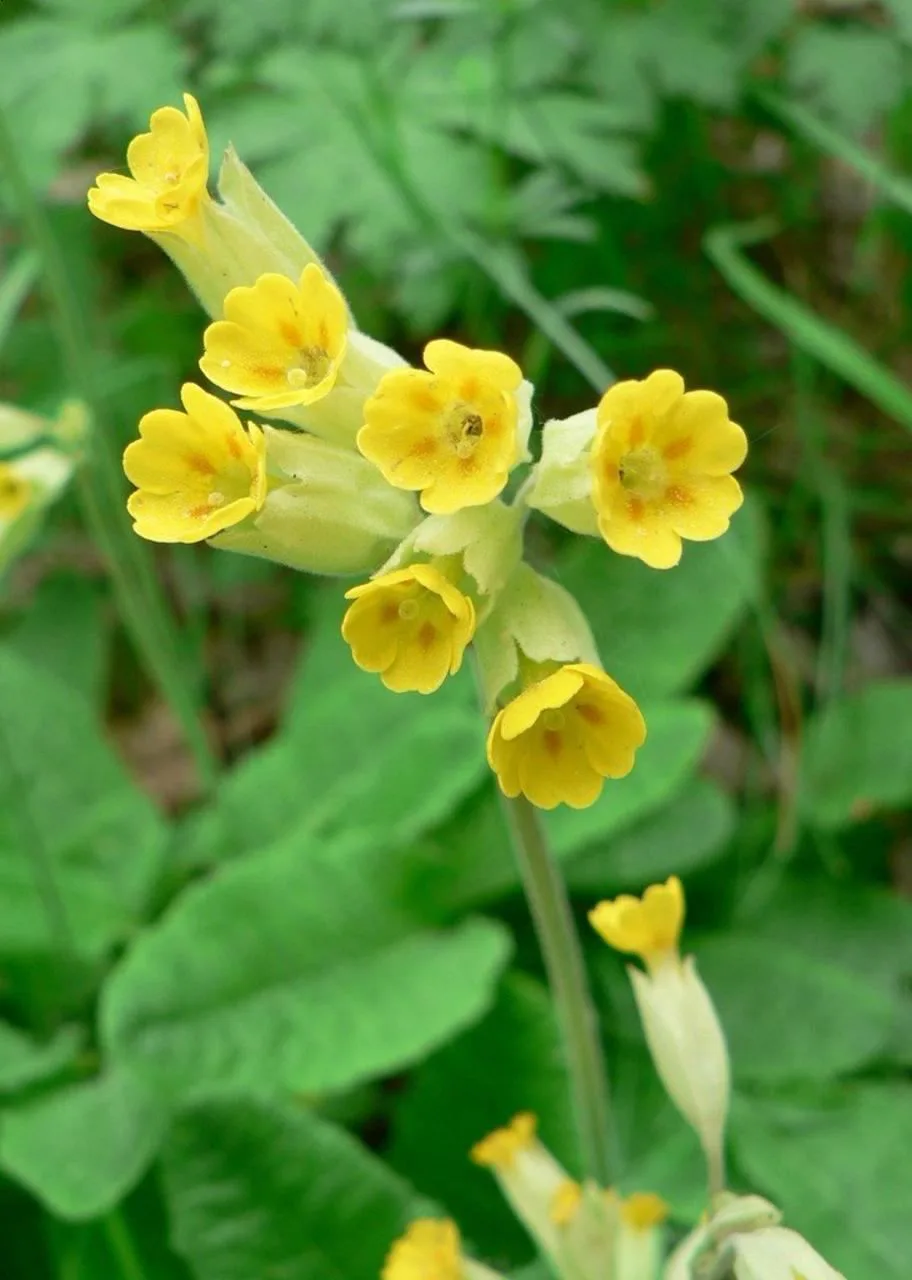
Cowslip is a native perennial of grassy places, loved for its clusters of nodding, golden-yellow flowers in spring. It is closely related to Primrose, but its flowers are smaller, more cup-shaped and carried together at the top of a taller stalk. Cowslip belongs to Primulaceae, the primrose family.
Identification
- Several small, deep yellow, bell-like flowers hang from the top of one upright, leafless stalk, usually 10–30 cm tall.
- Each flower has five shallowly notched lobes, often with orange marks towards its centre.
- The flowers face downwards or outwards rather than spreading flat, and the flower head may resemble a little bunch of keys.
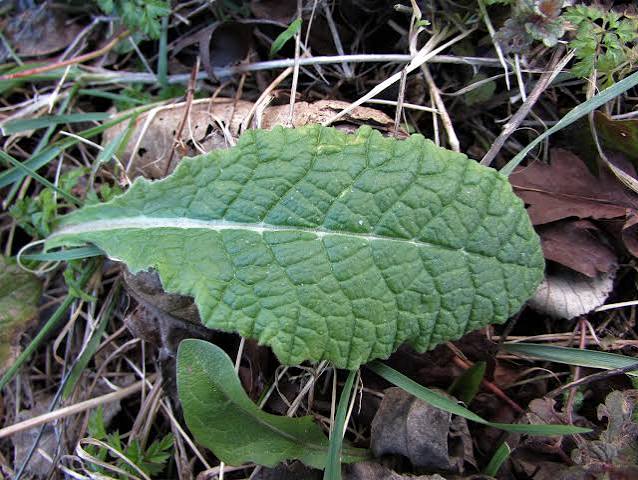
- A rosette of wrinkled, oval to tongue-shaped leaves grows at ground level.
- The leaves have a prominent midrib, branching veins and a rounded blade that narrows towards its stalk.
The easiest field clue is the arrangement of the flowers. A Primrose normally has one flower on each stalk from the base; Cowslip has a bunch of flowers on a single stalk.
Flower structure
The five petals join below to form a narrow tube, opening into a cup-shaped corolla with five lobes. Small orange markings are often visible inside the yellow flower. Five green sepals are joined to form an elongated calyx around much of the corolla tube.
The flowers form an umbel: their small individual stalks arise close together at the top of the main flowering stalk. Because the flowers droop, the cluster can look more one-sided than a typical open umbrella shape. After flowering, a dry capsule develops and releases the seeds.
Pin and thrum flowers
Like Primrose, Cowslip has two flower forms. In a pin flower, the stigma sits near the mouth of the corolla tube and the anthers sit lower down. In a thrum flower, their positions are reversed.
This arrangement is called heterostyly. It encourages visiting insects to transfer pollen between plants with different flower forms. Both pin and thrum flowers have male and female reproductive parts; they are not separate sexes.
Leaves
The leaves are gathered at the base in a low rosette. They are soft, slightly hairy and distinctly crinkled, with a network of sunken veins. Their broad, rounded blades narrow quite abruptly into the leaf stalk, giving the plant a different outline from many narrow-leaved meadow flowers.
Compare both the leaves and the flowers when identifying a Cowslip: Primrose and Oxlip can have rather similar foliage.
Habitat
Cowslip favours grassland, old hay meadows, sunny banks, open woodland and hedgerows. It is especially associated with well-drained, often calcareous soils and is sometimes abundant on roadside verges where grass is not heavily improved or frequently cut.
It was once a very familiar sight in traditional meadows. Agricultural intensification and the loss of unimproved grassland caused a substantial decline during the twentieth century, although Cowslips have returned to some verges and restored grasslands.
Flowering period
Cowslip flowers chiefly in April and May, occasionally a little earlier or later depending on the season and location. Its fragrant flowers are among the distinctive sights and scents of a British spring meadow.
Similar species
- Primrose (Primula vulgaris): has larger, paler, more open flowers, usually borne singly on separate stalks arising from the base.
- Oxlip (Primula elatior): has pale yellow flowers clustered on a shared stalk, often facing to one side; the flowers are more open and less deeply golden than those of Cowslip.
- False oxlip (Primula × polyantha): a hybrid between Primrose and Cowslip, often combining a clustered flowering stalk with relatively large, open flowers.
Where the names come from
Cowslip is an old countryside name commonly associated with cow pastures and dung, sometimes explained through the older form ‘cow-slop’. Its exact history is not perfectly settled.
Primula means ‘little first one’ or ‘early one’, from Latin primus (‘first’), reflecting early spring flowering. Veris is Latin for ‘of spring’.
Folklore & history
Cowslip has gathered a remarkable collection of old names, including Paigle, Bunch of Keys, Fairy Cups and St Peter’s Keys. In one legend, Cowslips sprang up where St Peter dropped the keys to heaven. The drooping flowers make the connection easy to imagine.
In rural celebrations, the flowers were woven into May Day garlands and scattered along paths for weddings. Shakespeare also mentioned the Cowslip in his plays, reflecting how familiar it was in the English countryside.
The fragrant flowers were used to make country wine and to flavour drinks, while herbal traditions associated Cowslip preparations with sleep, coughs and headaches. These uses form part of the plant’s long history in British folk culture.
Wildlife
The flowers offer nectar to spring insects, including bees, butterflies and beetles. Cowslip is also one of the larval foodplants of the Duke of Burgundy butterfly, whose caterpillars feed on its leaves and those of Primrose.