Primrose is a native perennial whose pale yellow flowers brighten woodland floors and hedge banks in spring. Each flower grows on its own slender stalk from a cluster of wrinkled leaves close to the ground. It belongs to Primulaceae, the primrose family.
Identification
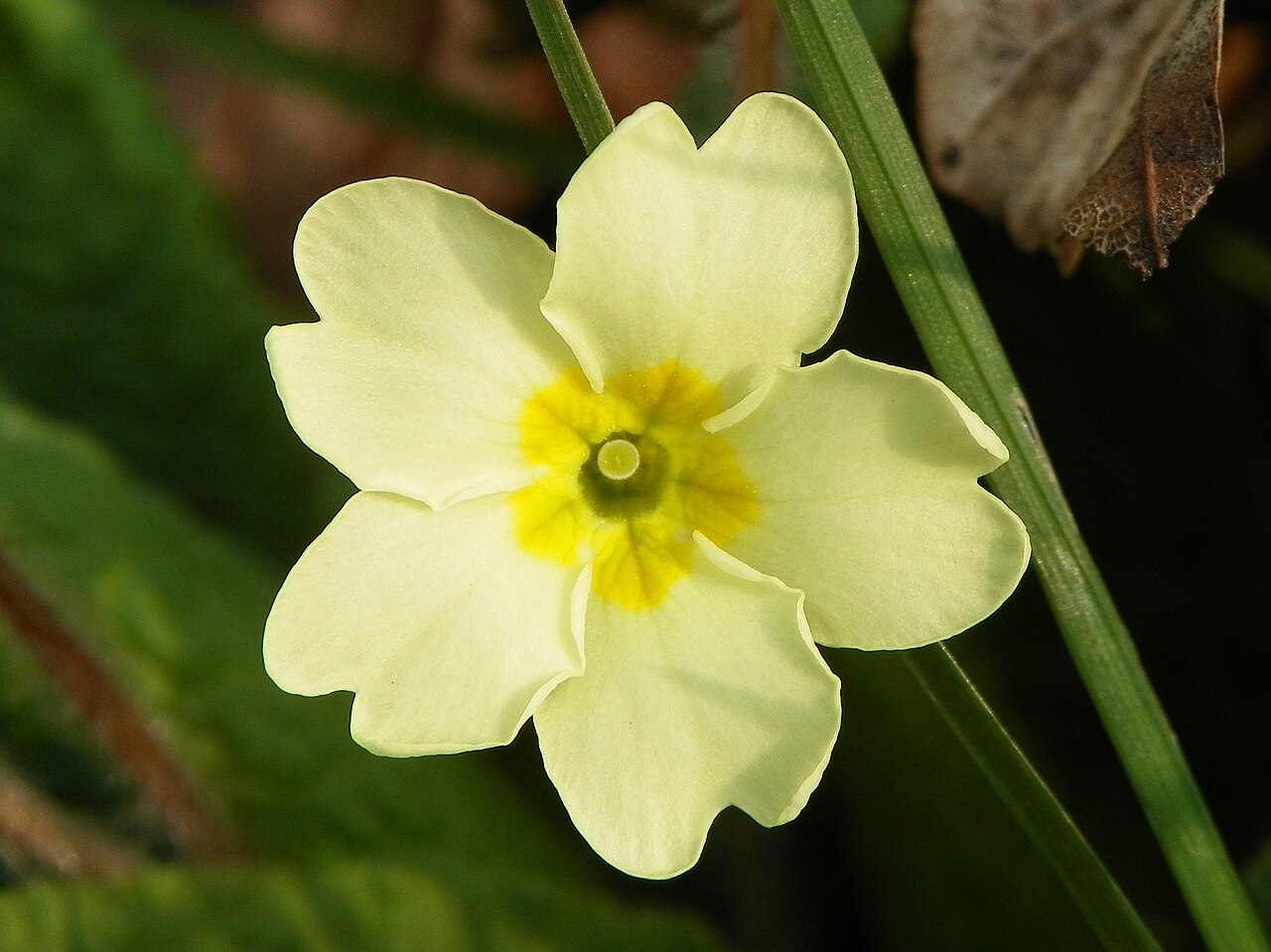
- Pale yellow flowers, usually about 2.5–4 cm across, with a deeper yellow centre.
- Five broad, shallowly notched lobes give each flower its familiar outline.
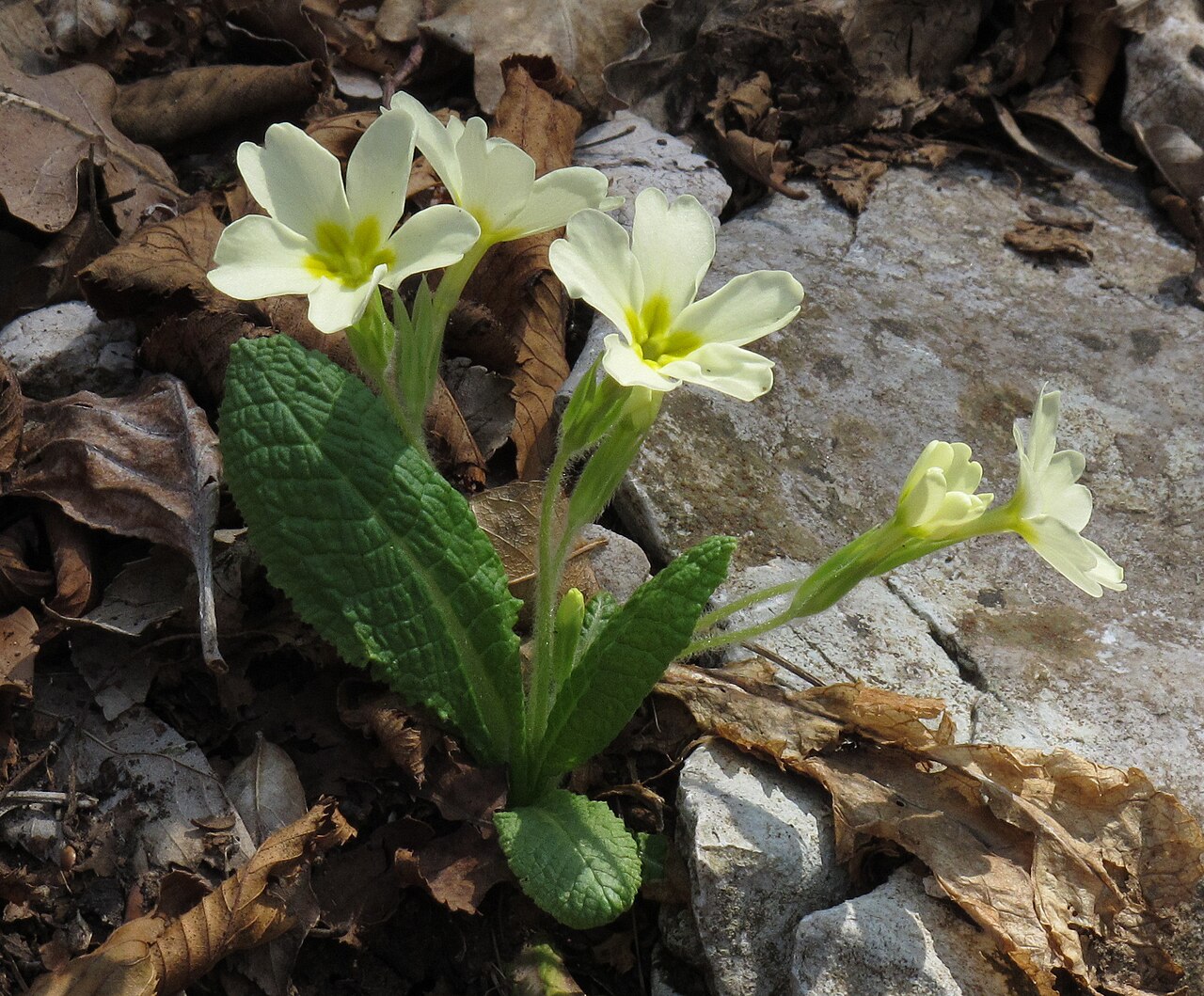
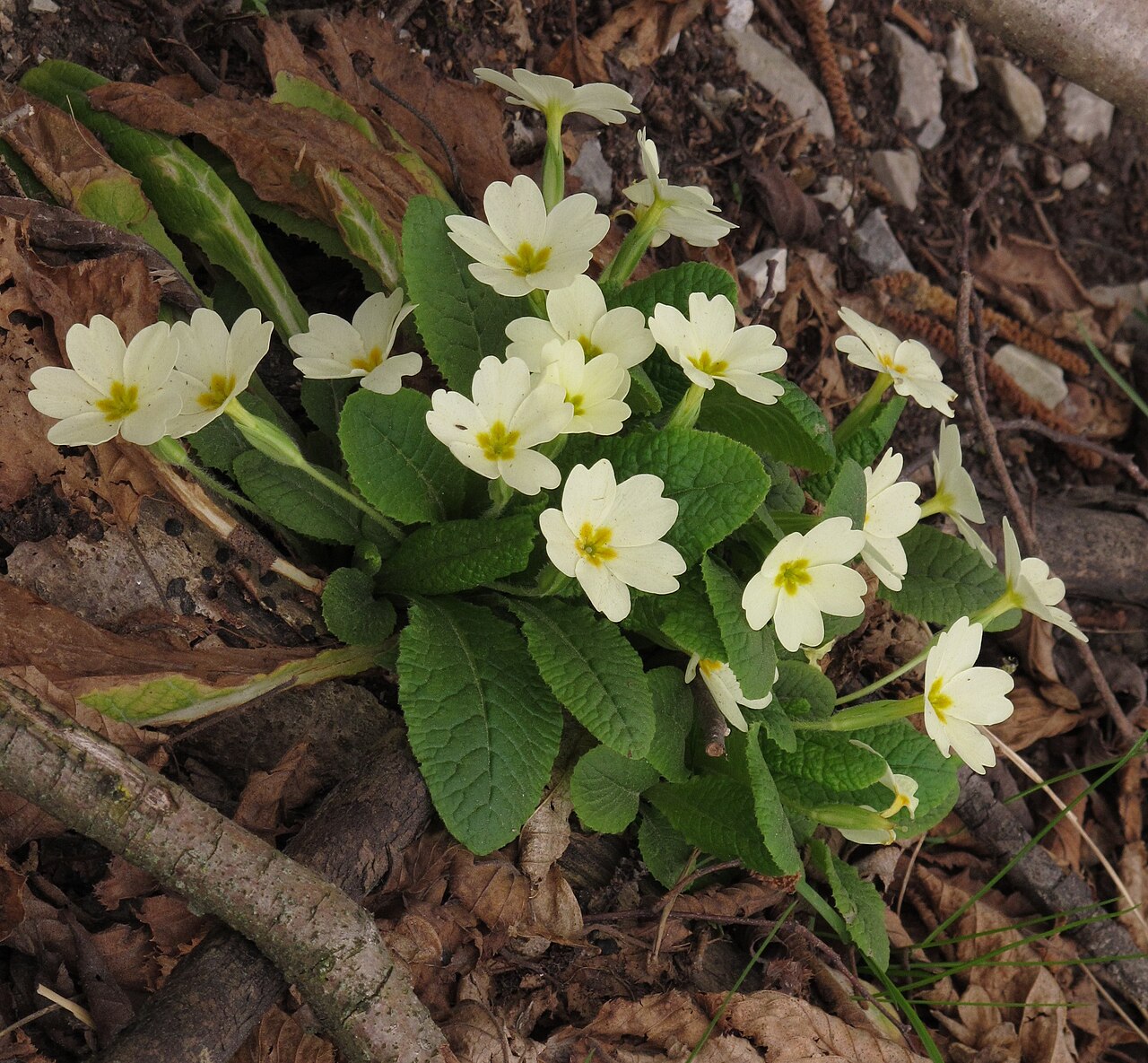
- Individual flower stalks rise from the base of the plant.
- Tongue-shaped, strongly veined leaves form a low rosette.
A flowering clump can look like a bunch of flowers, but follow the stalks down: they arise separately from the base. This is a useful distinction from cowslip and oxlip, which usually carry several flowers together at the top of a taller stalk.
Flower structure
The five petals are joined at their bases into a tube, opening out into the flat face of the flower. Together they form the corolla. The green calyx surrounds the base of this tube.
The flowers are often lightly scented. Unlike the flower heads of daisies, each Primrose bloom is one flower.
Pin and thrum flowers
Primrose has two flower forms, called pin and thrum. Both forms contain stamens and a stigma; the difference is the height at which these parts sit inside the corolla tube.
- Pin flower (long-styled form): the stigma is near the mouth of the tube, while the anthers are lower down.
- Thrum flower (short-styled form): the anthers are near the mouth of the tube, while the stigma is lower down.
This arrangement is called heterostyly. The matching heights encourage an insect to carry pollen from a pin flower to a thrum flower, and vice versa, promoting cross-pollination. Pin and thrum are not separate male and female flowers: each flower contains both sets of reproductive parts.
Look into open flowers on different plants without picking them. With a close view, you may be able to spot the rounded stigma or the ring of anthers at the entrance of the flower tube.
Leaves
The leaves are oblong to tongue-shaped, with a broad rounded tip and a narrower base. Their network of veins gives the surface a crinkled appearance, and the undersides are hairy. Look for the leaves spreading out from the base of the plant, rather than along an upright leafy stem.
Habitat
Primrose is widespread in Britain and Ireland. Look in open woodland, woodland edges, the bottoms of hedgerows and grassy banks. It favours moist soil and can grow in partial shade, with spring flowers appearing before the woodland canopy becomes dense.
Flowering period
Primrose is best known as a spring flower, but the season can extend from December to May. Winter flowers are especially likely in mild, sheltered places; the months listed above include these early blooms. Timing varies with weather and location.
Similar species
- Cowslip (Primula veris): usually has smaller, deeper yellow, cup-shaped flowers hanging in a cluster at the top of a shared stalk.
- Oxlip (Primula elatior): has pale yellow flowers grouped at the top of a taller stalk, often facing to one side.
- Garden primulas and hybrids: may have brighter colours or a different flower arrangement. Primrose can hybridise with cowslip, so some plants combine features of both.
Wildlife
The flowers provide nectar for early pollinators, including brimstone and small tortoiseshell butterflies. Primrose leaves are also a foodplant for the caterpillars of the Duke of Burgundy butterfly.