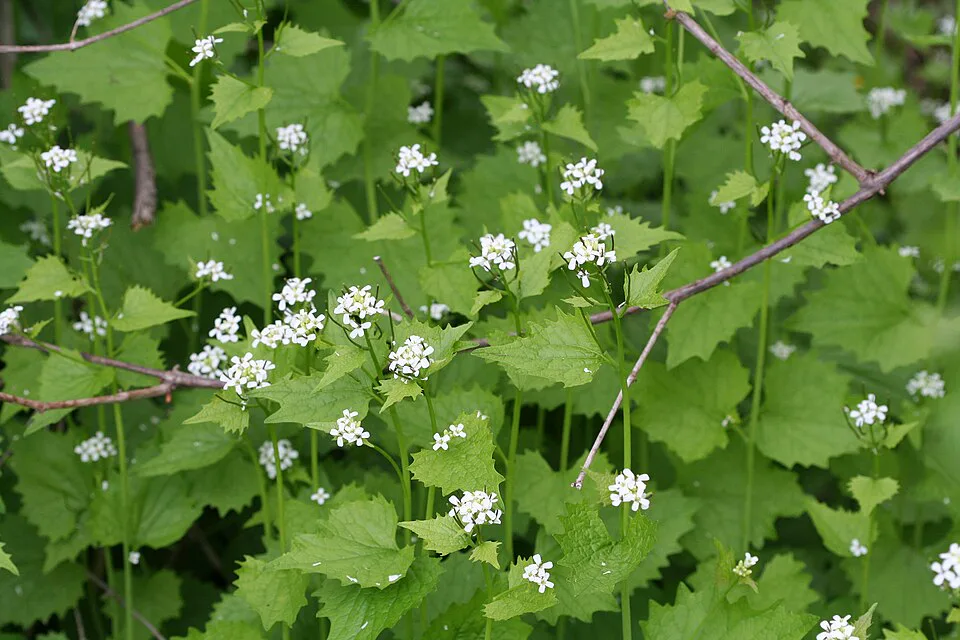
Garlic Mustard is a familiar spring plant of hedgerows, shady lanes and woodland edges. Also called Jack-by-the-hedge or Sauce-alone, it has small white flowers and sharply toothed leaves which release a distinctive garlic smell when crushed. Although its name suggests a connection with Wild Garlic, it belongs to Brassicaceae, the cabbage family, rather than the onion and garlic family.
Identification
- An upright biennial, usually around 20–120 cm tall when flowering.
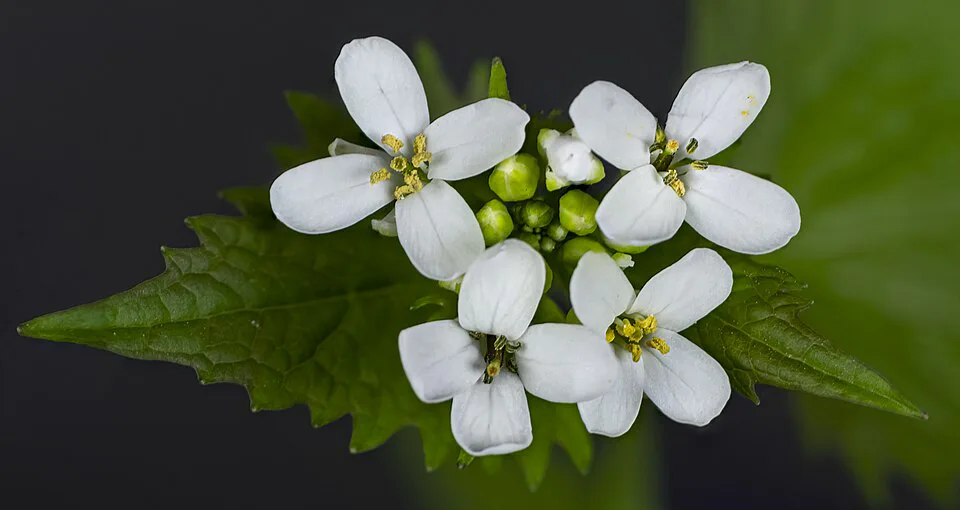
- Small white flowers, each with four petals arranged in a cross, grouped at the tips of the stems.
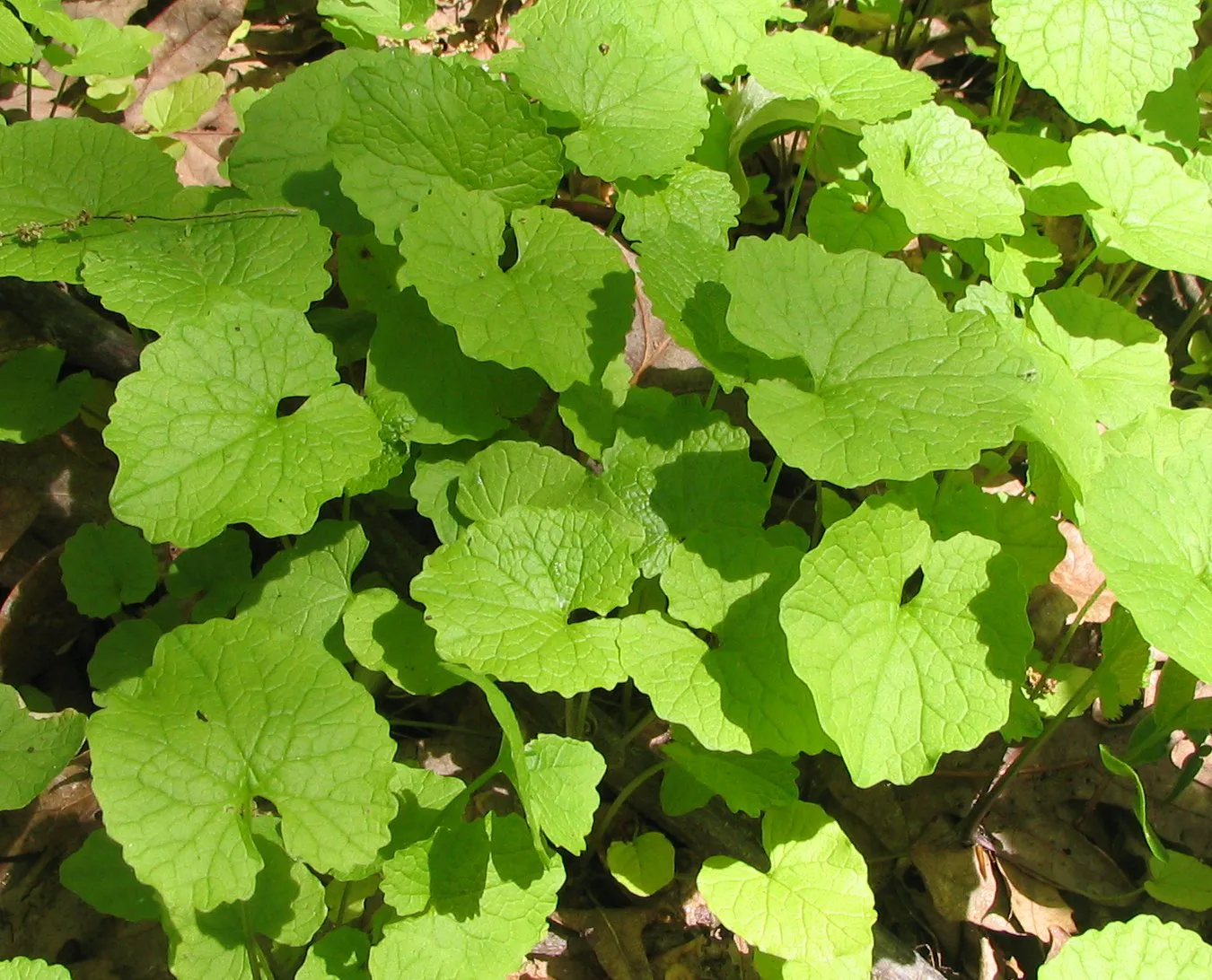
- The first-year plant forms a low rosette of rounded or kidney-shaped leaves with broad scalloped teeth.
- Flowering plants have larger, more triangular or heart-shaped stem leaves, with pronounced veins and coarser teeth.
- The stem leaves are alternate, rather than paired opposite each other.
- Crushed leaves give off a garlic smell; unbruised plants may have little noticeable scent.
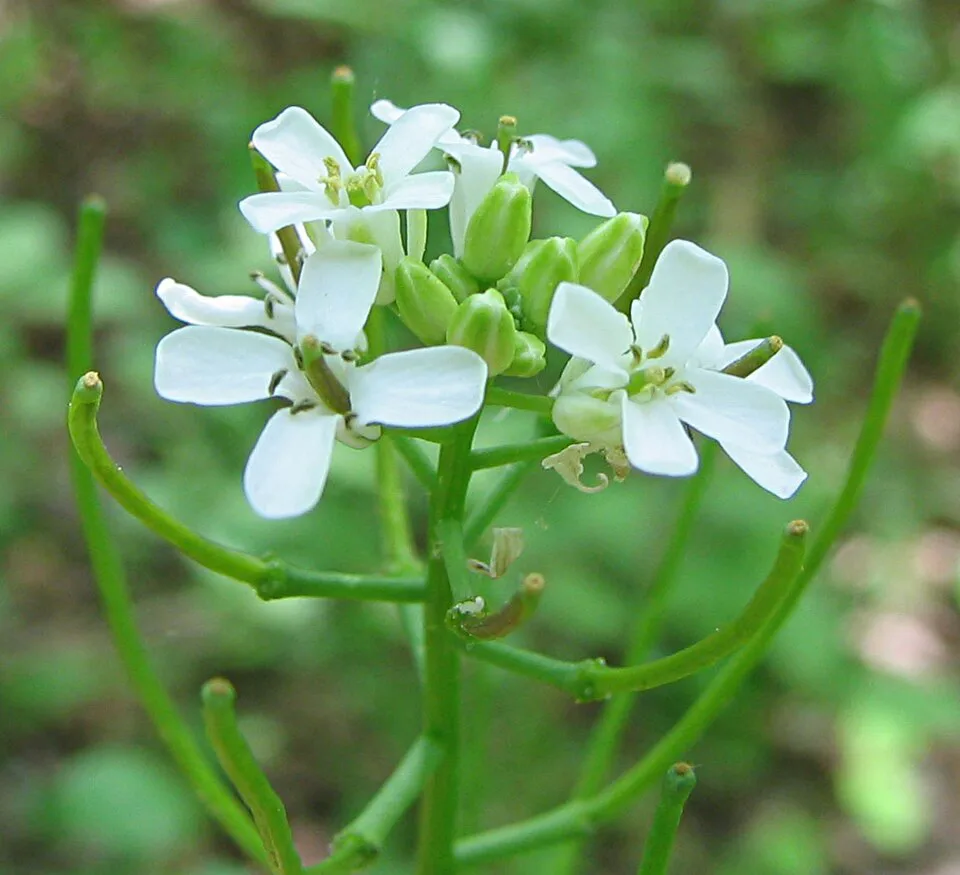
- After flowering, long, slender seed pods stand out from the stem.
The combination of toothed leaves, garlic scent, four-petalled white flowers and narrow upright seed pods makes this plant quite distinctive.
Flower structure
Each tiny flower has four white petals arranged crosswise, a pattern known as cruciform. Below them sit four sepals. Inside are six stamens, usually with four longer and two shorter, surrounding the central ovary. This unequal arrangement of stamens is called tetradynamous.
The flowers grow in racemes at the ends of the stems. As flowering progresses, the cluster lengthens, and the lower flowers give way to narrow green fruits. These are called siliques: pods which usually split along two sides when ripe to release their seeds.
Leaves and life cycle
Garlic Mustard changes appearance considerably between its first and second years.
In its first year, it develops a low basal rosette of fairly round, kidney-shaped or heart-shaped leaves. Their edges are broadly scalloped, and the rosette can remain green through winter.
In the second spring, a tall flowering stem grows from the rosette. Its leaves are generally more pointed and triangular, with conspicuous veins and irregular, sharp teeth. The leaves become smaller towards the top of the stem. Bruising a leaf releases the characteristic garlic scent.
After the plant flowers and sets seed, it usually dies. The ripe seed pods become dry and pale, and the seeds are released into the surrounding soil.
Habitat
Look for Garlic Mustard along hedgebanks, woodland paths, shaded roadside verges, field margins and the edges of gardens. It particularly favours fertile, fairly moist soil in partial shade, although it can also grow in more open places.
It is widespread in Britain and is especially conspicuous in spring, when its fresh green leaves and small white flowers appear beside paths and hedges.
Flowering period
Garlic Mustard mainly flowers from April to June, with the earliest plants sometimes flowering in late March and flowers occasionally persisting later in the season. By early summer, many flowering stems carry long, narrow seed pods.
Similar species
- Young stinging nettles (Urtica dioica) can have similarly toothed, pointed leaves, but their leaves grow in opposite pairs and they lack Garlic Mustard’s white, four-petalled flowers. Nettles also have stinging hairs.
- Hedge Mustard (Sisymbrium officinale) is another member of Brassicaceae, but has tiny yellow flowers and pods which stay close to the flowering stem.
- Wild Garlic (Allium ursinum) also smells of garlic, but has smooth-edged leaves with parallel veins and white flowers with six tepals rather than four petals.
The garlic smell is a useful clue, but the leaves and flowers should be checked as well.
Where the names come from
Garlic Mustard describes the plant’s garlicky scent and its membership of the mustard family. Jack-by-the-hedge refers to its familiar habit of growing beside hedges, while Sauce-alone recalls its old use as a ready-made flavouring.
The genus name Alliaria comes from Allium, the Latin name associated with garlic and onions, referring to the plant’s smell. The species name petiolata means ‘stalked’ or ‘provided with leaf stalks’, from Latin petiolus, a small stalk.
Folklore & history
Garlic Mustard was once a useful spring herb in country kitchens. Its young leaves were added to salads and sauces, and the pungent flavour was particularly associated with sauces served alongside fish or meat. The name Sauce-alone hints at how a handful of the leaves could provide a seasoning without many other ingredients.
Older herbals also mention the plant in remedies and household preparations. It has been known by a surprisingly large number of local names, including Jack-by-the-hedge, Garlicwort and Poor Man’s Mustard, reflecting how familiar it was to people gathering plants along lanes and hedgerows.
Wildlife
Garlic Mustard is an important caterpillar foodplant for the Orange-tip butterfly (Anthocharis cardamines). Female Orange-tips lay eggs on suitable flower stalks, and the caterpillars feed on the developing flowers and seed pods. The Green-veined White (Pieris napi) also uses the plant.
The small white flowers provide nectar and pollen to spring-flying insects, including bees and hoverflies.