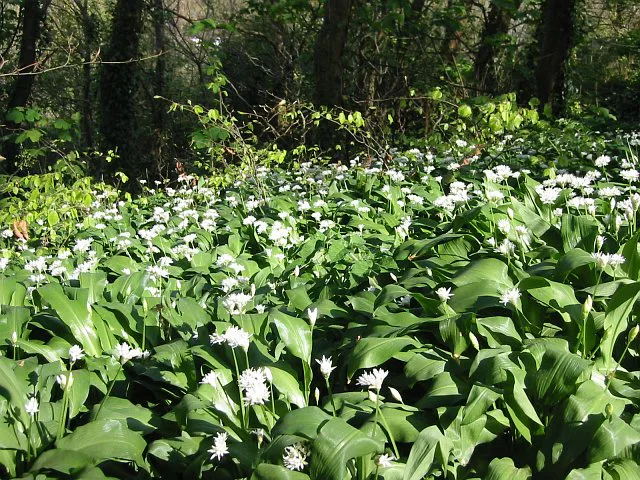
Wild Garlic, also known as Ramsons, is a familiar spring wildflower of damp deciduous woods and shaded hedgebanks. Large colonies can cover the woodland floor, and the plant is often noticed first by its distinctive garlic scent.
It belongs to Amaryllidaceae, the amaryllis family. Modern classifications place the onion and garlic genus Allium within this family, in the subfamily Allioideae; older books may therefore place Wild Garlic in Alliaceae or Liliaceae.
Identification
- A bulbous perennial, usually around 15–50 cm tall when flowering.
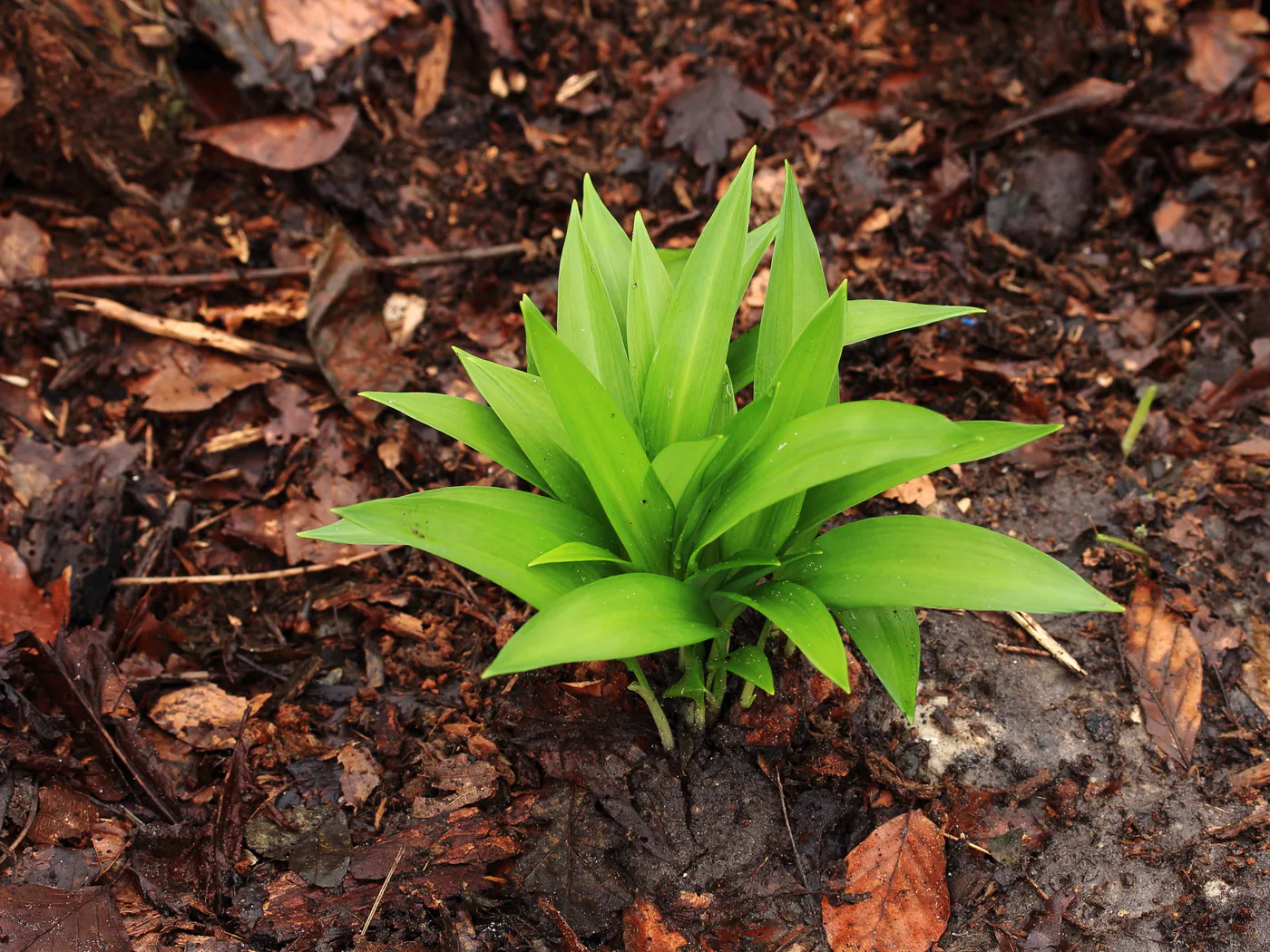
- Leaves arise from the base and are broad, soft, flat and pointed, with smooth edges.
- The leaves have conspicuous parallel veins and a strong garlic smell when bruised.
- The flowering stalk is leafless and rises above the foliage.
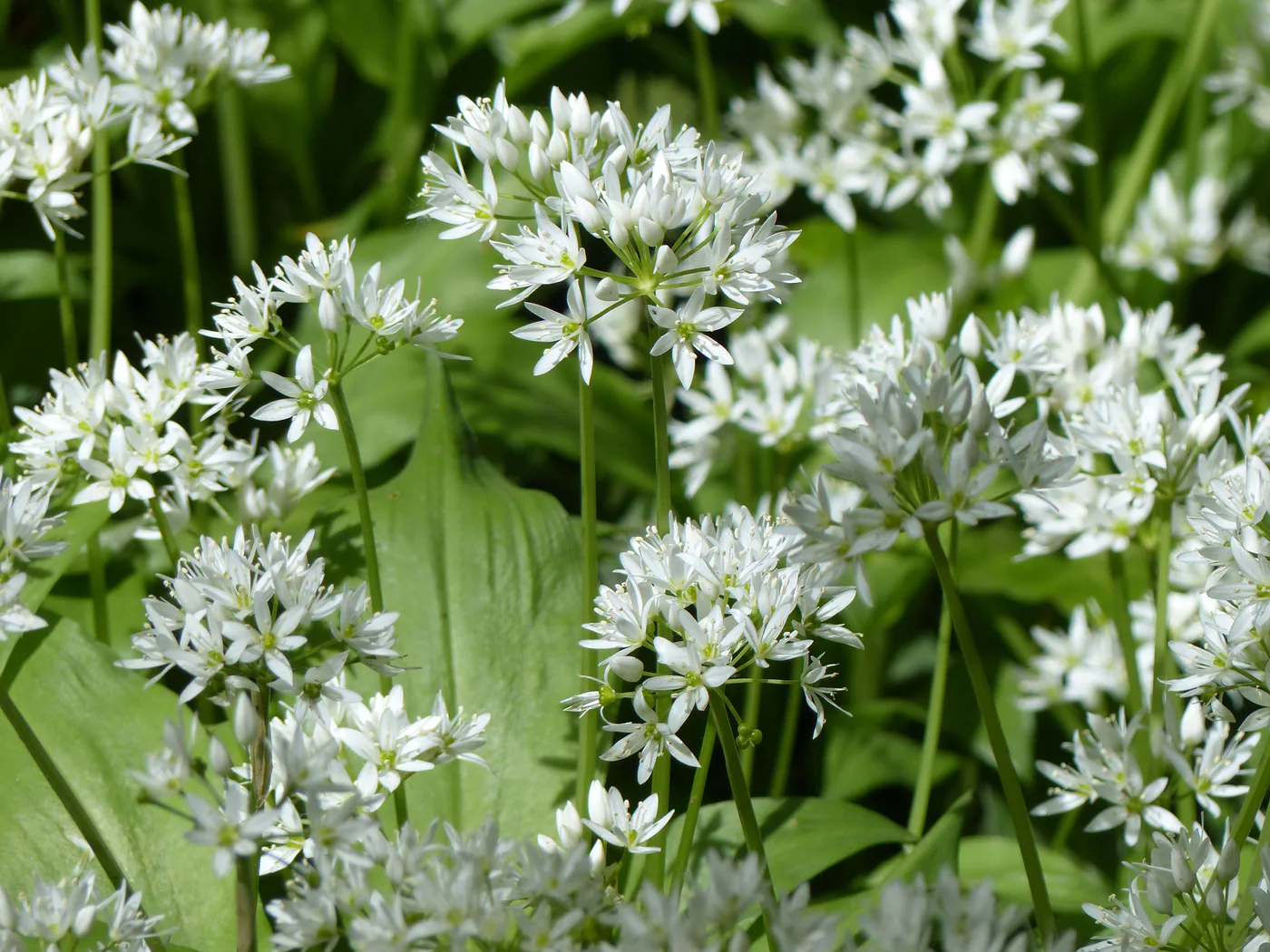
- White, star-shaped flowers are grouped into a loose rounded umbel.
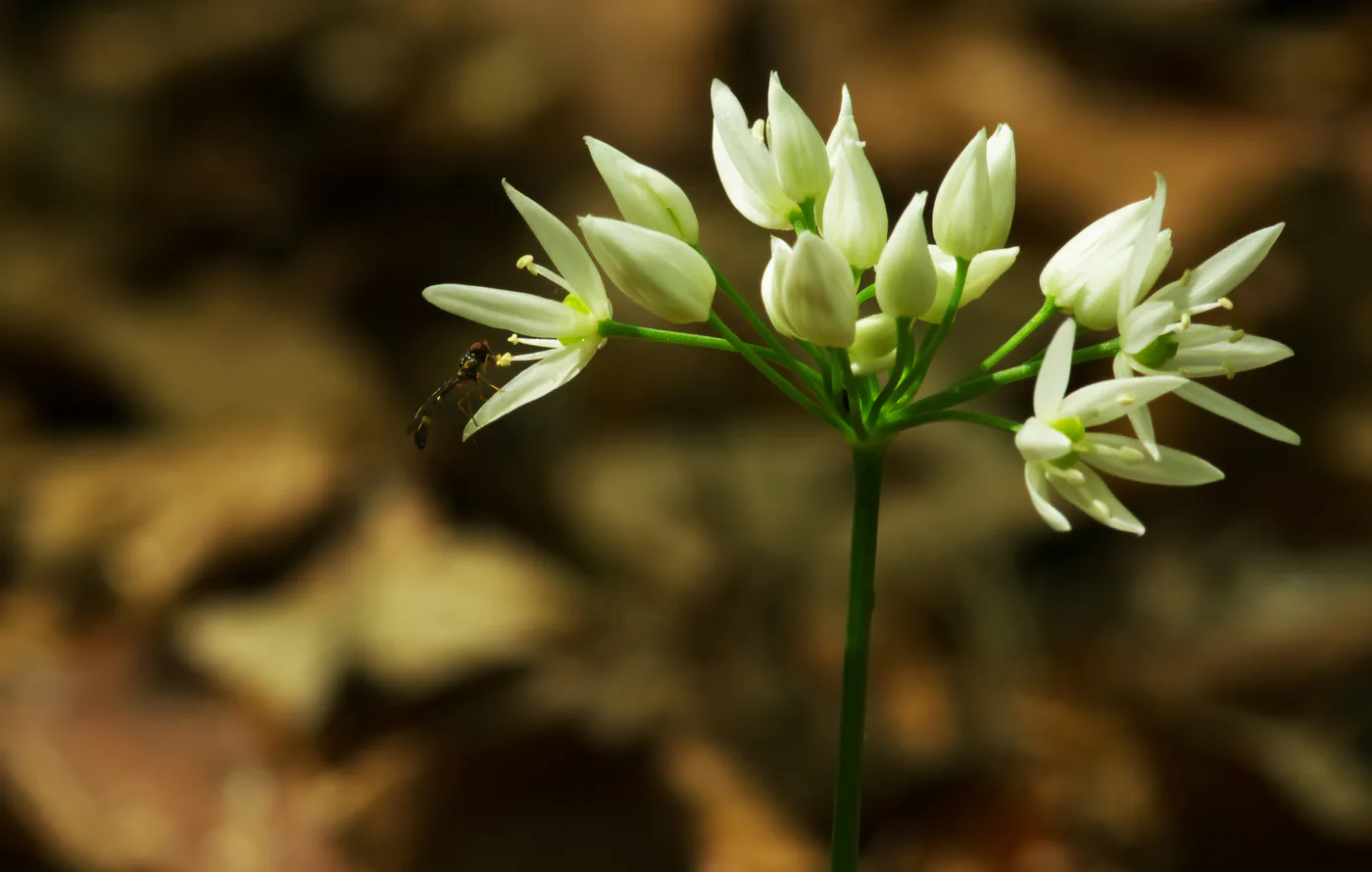
- Each flower has six narrow white tepals and six stamens.
- The flowers usually appear from April to June.
The combination of broad basal leaves, a strong garlic scent and rounded heads of six-parted white flowers is particularly characteristic.
Flower structure
A Wild Garlic flower has six white tepals. They spread outwards to give the flower its star-like appearance. Six stamens surround the central female parts.
The flowers are carried on separate slender stalks that radiate from roughly the same point, forming an umbel. Before the flowers open, the young flower head is enclosed by papery bracts which split as the inflorescence expands.
At the centre of each flower is a three-celled ovary. After flowering this develops into a small capsule containing black seeds.
Leaves and bulb
Wild Garlic leaves are one of its most useful identification features. They are:
- broad and lance-shaped to oval
- pointed at the tip
- smooth-edged rather than toothed
- soft and flexible rather than leathery
- strongly parallel-veined
- produced individually from the base of the plant
The plant survives underground as a bulb. Leaves can appear very early in spring, allowing the plant to grow before the tree canopy becomes dense.
The familiar garlic smell is produced when the leaves are crushed or bruised. Smell is a useful supporting character, but it should not be the only feature used for identification.
Habitat
Wild Garlic is strongly associated with cool, damp, shaded places. Typical habitats include:
- deciduous woodland
- old and ancient woodland
- shaded hedgebanks
- stream banks and damp valleys
- scrub and woodland edges
It can form very large colonies where conditions are suitable. Wild Garlic is also recognised as an ancient woodland indicator in Britain, although a single species should always be considered alongside other evidence when judging the history of a wood.
Flowering period
Wild Garlic usually flowers from April to June. The leaves may emerge considerably earlier, sometimes appearing while much of the woodland ground flora is still dormant.
By early summer the flowers fade and the above-ground parts eventually die back, leaving the bulb beneath the soil until the following spring.
Similar species
- Lily-of-the-valley (Convallaria majalis) can be confused with Wild Garlic before flowering. Its leaves are also broad and parallel-veined, but they are arranged differently, and its flowers are white bells hanging from one side of a stem rather than star-shaped flowers in an umbel. Lily-of-the-valley is poisonous.
- Lords-and-Ladies (Arum maculatum) often grows in the same woods and can become mixed through Wild Garlic colonies. Its leaves are usually arrow-shaped or heart-shaped, often with backward-pointing basal lobes, and lack the characteristic parallel-veined Wild Garlic shape. The plant is poisonous.
Because poisonous woodland plants can grow intermixed with Wild Garlic, anyone gathering it for food should identify each leaf individually and should not rely on scent alone.
Where the names come from
Wild Garlic is named for its unmistakable garlic smell and flavour, although it is a woodland plant rather than the cultivated garlic of kitchens. Another widespread English name is Ramsons, an old name with an uncertain history.
Allium is the Latin name for garlic and its relatives, including onions and leeks. Ursinum means ‘of bears’, recalling the traditional European association of this plant with bears emerging in spring.
Folklore & history
Older names include Buckrams, Wood Garlic, Bear’s Garlic and Bear Leek. European tradition has long connected the fresh spring leaves with bears emerging after winter.
The plant has a long history as a spring food and in traditional herbal practice. Its strong smell also helped it acquire a reputation in folklore as a protective plant, including traditions in which garlic was used to ward off harmful influences.
Dense Wild Garlic colonies have long been a familiar feature of old British woods, and their presence can form part of the botanical evidence used when recognising ancient woodland.
Wildlife
The spring flowers provide nectar and pollen for bees, hoverflies and other early-flying insects at a time when woodland food sources can still be limited.
Wild Garlic also supports specialist insects. In suitable woods, the Wild Garlic Hoverfly (Portevinia maculata) is closely associated with the plant; its larvae develop around the bulbs and stem bases.